On this page
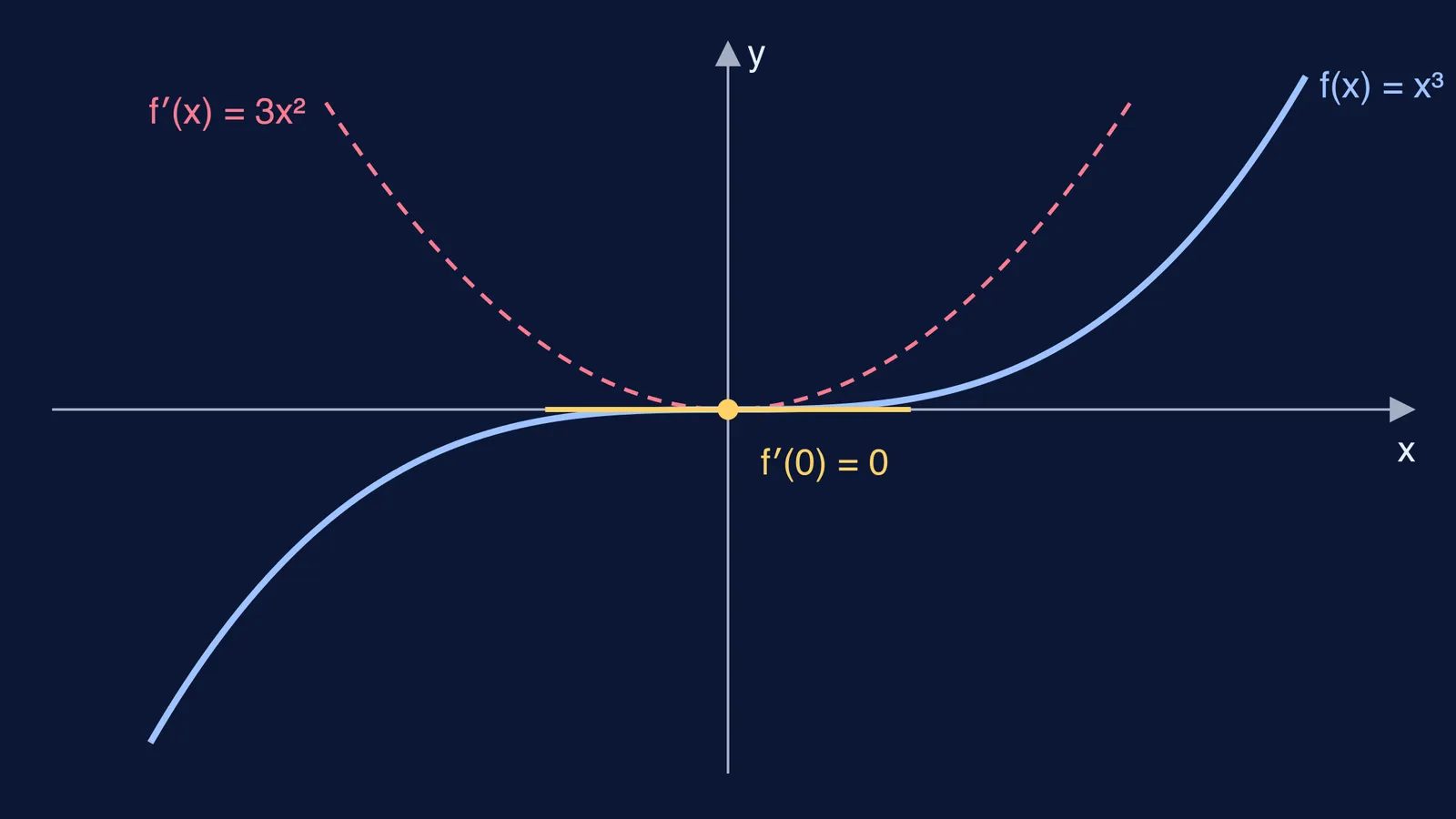
Most students learn "if f′(x) > 0, the function is strictly increasing" and then meet f(x) = x³. Its derivative, 3x², is zero at x = 0, so the rule seems to say the function stops increasing there. It doesn't. The fix is to read the definitions exactly as the textbook writes them.
What does NCERT mean by increasing and strictly increasing?
The definitions are in Section 6.3 of the NCERT Class 12 Mathematics Part I chapter Application of Derivatives (Definition 1, pages 152-153 of the 2026-27 reprint).
Increasing on I: x₁ < x₂ in I implies f(x₁) ≤ f(x₂).
Strictly increasing on I: x₁ < x₂ in I implies f(x₁) < f(x₂).
Constant on I: f(x) = c for all x in I.
In NCERT's language, "increasing" allows equal values (other books say non-decreasing). Only "strictly increasing" demands that a later point sits higher.
The same chapter's Theorem 1 says that if f is continuous on [a, b] and differentiable on (a, b), then f is increasing in [a, b] if f′(x) ≥ 0 for each x in (a, b). That is the non-strict word. To get "strictly", you need one more idea.
Is x³ strictly increasing even though f′(0) = 0?
Yes, and you can prove it straight from the definition without any calculus. Take any x₁ < x₂. Then:
x₂³ − x₁³ = (x₂ − x₁)(x₁² + x₁x₂ + x₂²)
The first bracket is positive. The second can be written as (x₁ + x₂/2)² + 3x₂²/4, a sum of squares that is zero only when x₁ = x₂ = 0, which cannot happen because x₁ < x₂. So it is positive too, and x₂³ > x₁³ every time. That is exactly NCERT's strict definition.
The calculus route works as well. On (0, ∞) the derivative 3x² is positive, and x³ is continuous at 0, so x³ is strictly increasing on [0, ∞). The same holds on (−∞, 0]. If x₁ < 0 < x₂, then f(x₁) < f(0) < f(x₂). Every case is covered.
Why does one flat point not stop a function from increasing?
Rule: if f is continuous on an interval, differentiable inside it with f′(x) ≥ 0, and f′(x) = 0 only at isolated points (never on a whole sub-interval), then f is strictly increasing on that interval.
Why: NCERT's Theorem 1 already tells you f is increasing, so f never goes down. Suppose two points x₁ < x₂ had f(x₁) = f(x₂). A function that never goes down and ends where it started must be constant on [x₁, x₂]. Then f′ = 0 on the whole interval (x₁, x₂), which contradicts "zero only at isolated points". So equal values are impossible, and f is strictly increasing.
If f′ = 0 on a whole stretch, the function is flat there: increasing, but not strictly. Isolated zeros are harmless; zero over an interval is not. Points like x = 0 for x³ are stationary points that are neither a maximum nor a minimum; our post on stationary points versus critical points sorts out that vocabulary.
How should you write this in a board or JEE answer?
Use NCERT's own Exercise 6.2, Question 18 from the same chapter: prove that f(x) = x³ − 3x² + 3x − 100 is increasing in R.
Differentiate: f′(x) = 3x² − 6x + 3.
Factor so the sign is obvious: f′(x) = 3(x − 1)² ≥ 0 for all real x.
Name the zeros: f′(x) = 0 only at x = 1, a single point.
Conclude with the word the question uses: f is increasing on R, and in fact strictly increasing, because the derivative vanishes only at an isolated point.
Notice that f(x) = (x − 1)³ − 99. It is the x³ curve shifted one unit right and 99 units down, with its flat point moved to x = 1.
A quick checklist before you write the last line:
Did you write f′(x) > 0 for all x? Check it. For x³ that is false at 0, and an examiner will notice.
Did you conclude "not strictly increasing" because f′ is zero somewhere? Ask whether the zero is a point or an interval.
Does the question say "increasing" or "strictly increasing"? Match the word, and show the extra step if strict is asked.
For more practice on finding intervals, see our guide to increasing and decreasing functions, and for questions with a parameter, finding the range of k so a function increases for all x.
If you want to test yourself on more monotonicity questions, the Fermi Problem Library has worked problems with a step-by-step solver that explains the reasoning rather than printing an answer. If the gap is the definition itself, the Fermi Concept Library gives each mathematics concept its own lesson.