

On this page
Students often freeze when a calculus problem asks them to find an unknown parameter. A common hurdle in JEE and CBSE mathematics is determining the range of a constant, k, that makes a function strictly increasing across its entire domain. Learning this by watching a teacher solve it on a board might not be enough. A landmark 2014 meta-analysis in the *Proceedings of the National Academy of Sciences* found that students in traditional lecture-based STEM classes were 55% more likely to fail than those using active learning methods (Freeman et al., 2014). You have to work through the logic yourself.
Here is the step-by-step method to handle these parameter questions, built around the core rule of derivatives.
What is the rule for an increasing function?
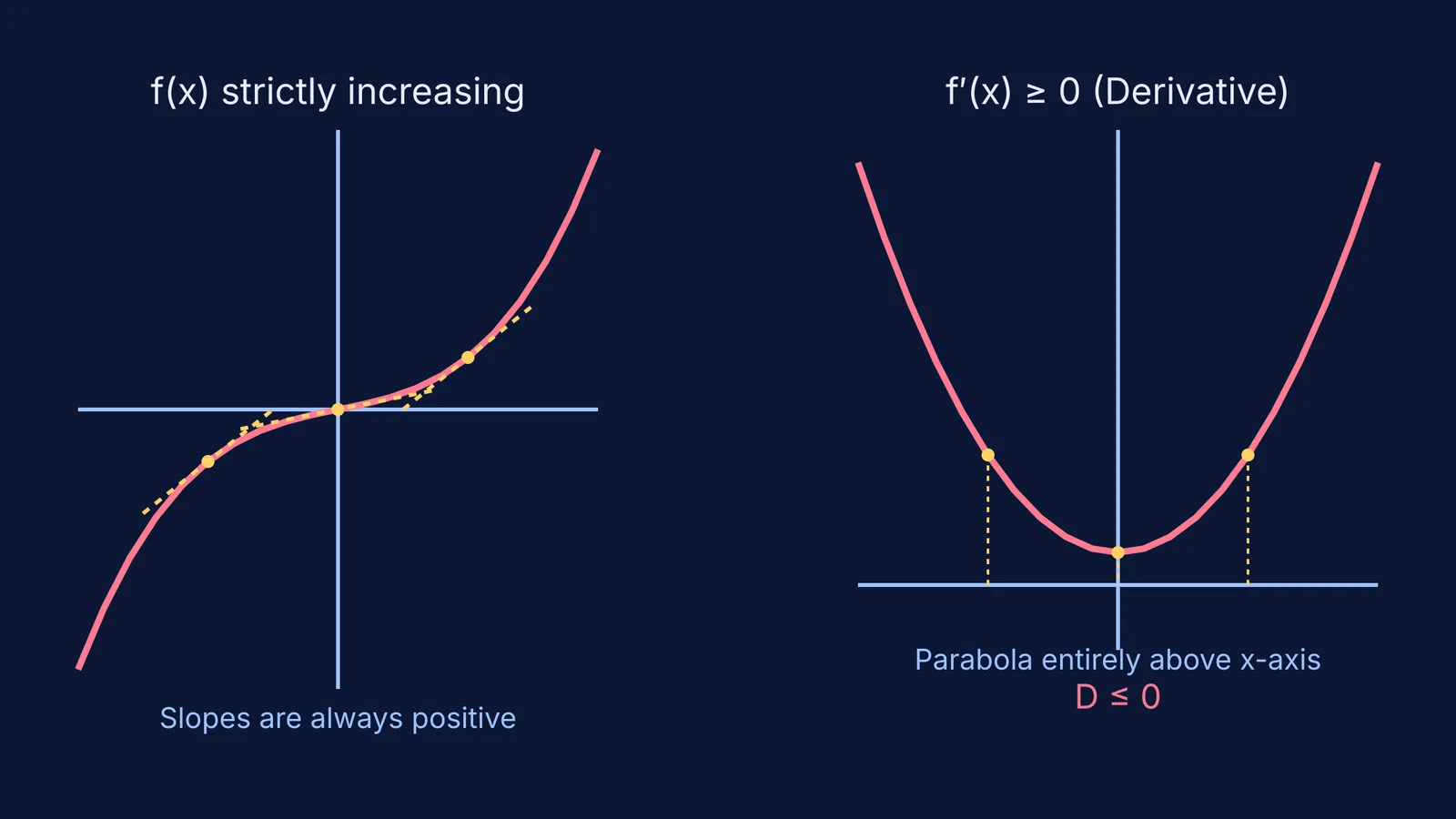
For a continuous and differentiable function f(x) to be strictly increasing for all real numbers x, its slope must never be negative.
Mathematically, this means the first derivative must be non-negative everywhere: f′(x) ≥ 0 for all x. (The derivative can equal zero at discrete points, as long as it does not stay zero over an interval).
When the original function is a cubic polynomial, its derivative is a quadratic function: f′(x) = ax² + bx + c. This transforms a calculus problem into an algebra problem.
How do you find k so that function is increasing for all x?
To ensure the quadratic derivative ax² + bx + c ≥ 0 for all x, two conditions must be met:
The parabola must open upwards, so the leading coefficient must be positive (a > 0).
The parabola must not dip below the x-axis, meaning it can have at most one real root. Therefore, the discriminant must be less than or equal to zero (D ≤ 0, where D = b² − 4ac).
Students often make a critical mistake here. Because the problem says the function is "increasing" (a positive idea), they instinctively write D > 0. But D > 0 means the derivative crosses the x-axis and becomes negative, which would mean the original function starts decreasing.
How do you solve a typical exam question?
Let's apply this to a typical exam question.
Question: Find the range of values of k for which the function f(x) = x³ − kx² + 3x + 5 is strictly increasing on the set of real numbers.
Step 1: Find the derivative. f′(x) = 3x² − 2kx + 3
Step 2: Set the condition. For f(x) to be strictly increasing, we need f′(x) ≥ 0 for all x. So, 3x² − 2kx + 3 ≥ 0.
Step 3: Check the leading coefficient. The coefficient of x² is a = 3. Since 3 > 0, the parabola opens upwards. This condition is already satisfied.
Step 4: Apply the discriminant test. We need D ≤ 0. b² − 4ac ≤ 0 (−2k)² − 4(3)(3) ≤ 0 4k² − 36 ≤ 0
Step 5: Solve the inequality. Divide by 4: k² − 9 ≤ 0 (k − 3)(k + 3) ≤ 0
The roots are −3 and 3. Testing the intervals tells us that the inequality holds when k is between these two values. Therefore, −3 ≤ k ≤ 3.
If k falls in the interval [−3, 3], the function will never decrease.
Building active study habits
Reading through that example is a start, but as the PNAS study showed, active practice is what secures the grade. If you get stuck on a homework question involving inequalities or parameters, Fermi's AI tutor can help.
Instead of just printing the final interval, the Fermi Problem Library uses a step-by-step solver that explains the reasoning. If you mistakenly set D > 0, the tutor will notice where you are stuck, draw the graph to show why a positive discriminant breaks the rule, and guide you back to the right path.
To explore more about quadratic conditions, see our guide on When is ax² + bx + c positive for all x? or review how to solve Equations and inequalities with modulus.


