On this page
Your textbook says plants lose water "mainly through stomata". True, but water vapour leaves by three routes, and their shares change when the plant runs short of water.
What are the three types of transpiration?
Transpiration is the loss of water as vapour from a plant's aerial parts. It is sorted by route:
Stomatal transpiration: vapour diffuses out through stomata, the pores between pairs of guard cells, mostly on leaves.
Cuticular transpiration: vapour seeps straight through the cuticle, the waxy film over the epidermis.
Lenticular transpiration: vapour escapes through lenticels, loose patches of cells in the bark of woody stems and on some fruits.
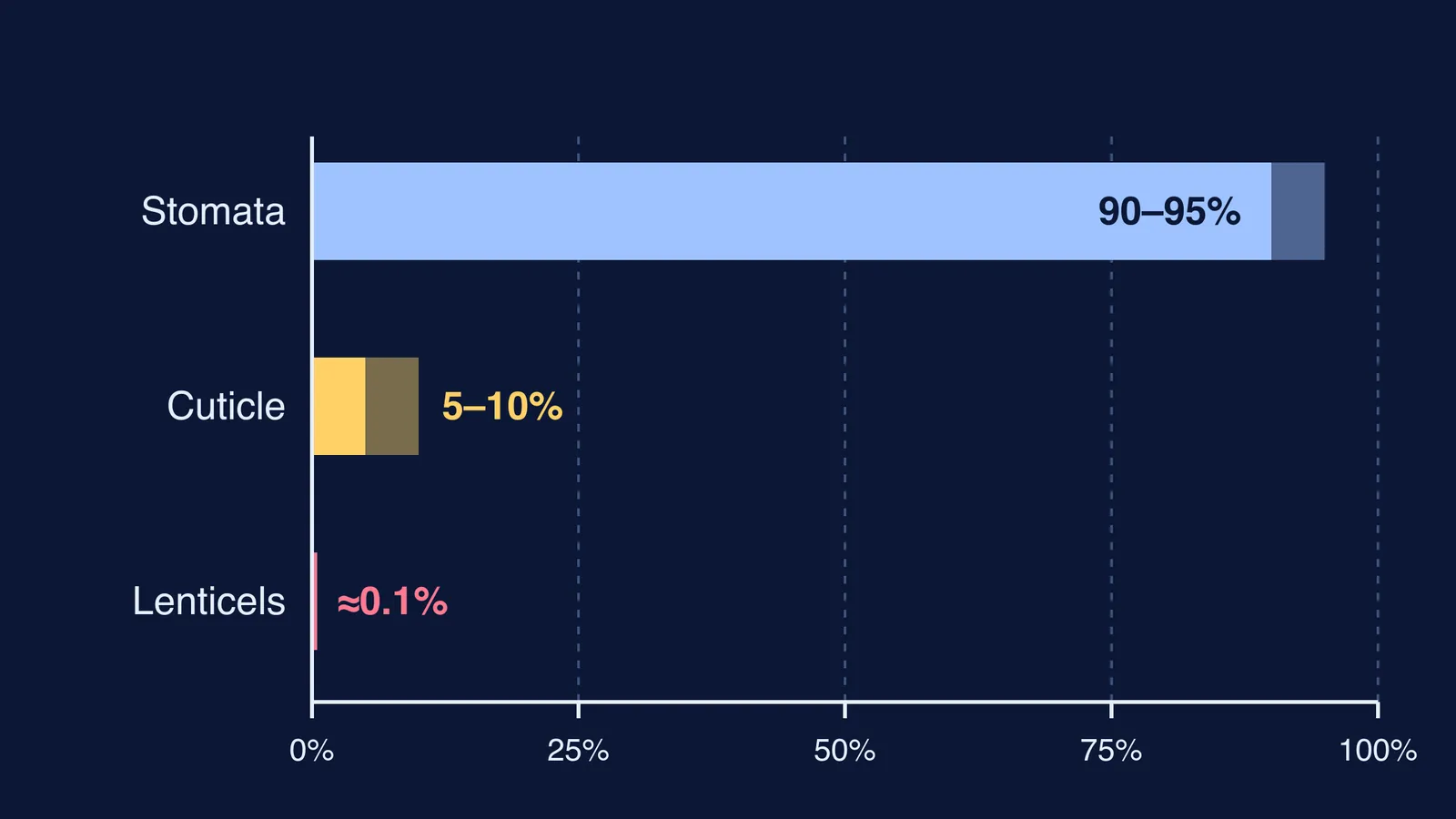
Stomatal transpiration accounts for 90–95% of a plant's water loss, according to the transpiration chapter of Plant Physiology: Theory and Applications by S. L. Kochhar and Sukhbir Kaur Gujral of the University of Delhi. The same chapter puts cuticular transpiration at 5–10% and lenticular transpiration at about 0.1%. These are typical figures for a well-watered plant, not constants.
Why do stomata account for most transpiration?
Stomatal pores cover less than 3% of the leaf surface but carry up to 95% of a plant's water loss, as a 2022 editorial in Frontiers in Plant Science notes. Two reasons explain the mismatch.
An open pore offers little resistance. The cuticle, by contrast, is "a non-cellular and hydrophobic film containing cuticular waxes", as Lintunen and colleagues describe it, and water has to work its way through that wax.
Even a nearly shut pore leaks about as much as wax. In a review in the Journal of Experimental Botany, Gerhard Kerstiens points out that residual stomatal gaps of about 0.1 µm are likely to lose water at a rate similar to typical cuticular transpiration.
Stomata dominate even at night. In a 2022 review, Jiří Šantrůček measured seven species in the dark, and stomata still supplied on average roughly 70–80% of leaf water loss (Annals of Botany, 2022).
Stomata are also the only route the plant can regulate; see how stomata open and close.
When do the cuticle and bark matter more?
Once stomata close, the small routes become the main leak. Water still escapes through the cuticle and incompletely closed stomata, together called the minimum leaf conductance (g_min), and a New Phytologist review by Remko Duursma and colleagues found it varies a lot and responds strongly to growing conditions such as soil water, temperature and humidity.
Bark can matter even more. Anna Lintunen and colleagues measured Aleppo pine (Pinus halepensis) in a semi-arid forest in Israel for six months (Frontiers in Plant Science, 2021). Bark transpiration made up 64–78% of total water loss in drought-stressed trees but only 6–11% in irrigated ones, because the stressed trees had shut their stomata. Irrigation did not change the bark rate itself: water loss through bark is passive.
How do xerophytes reduce cuticular and lenticular transpiration?
The cuticle and bark cannot be switched off, so desert plants build them to leak less.
Better wax, not just thicker wax. Kerstiens calls the idea that thicker cuticles make better barriers a common misconception; the chemistry matters. In the desert shrub Rhazya stricta, triterpenoids made up 85.2% of the cuticular wax, and the cuticle's permeability rose only 2.4-fold between 15 and 50 °C, against median rises of 12-fold and 9-fold in deciduous and evergreen non-desert plants (Schuster and colleagues, AoB Plants 2016).
Hidden stomata. Many species shield their stomata from the air in sunken crypts, antechambers or behind hairs. In Šantrůček's study, hidden stomata contributed less (about 70%) to night-time leaf water loss than surface stomata (about 80%).
Less exposed surface. Every bit of leaf and young stem is cuticle that can leak, and bark carries lenticels, so less surface means less unstoppable loss. See xerophytic adaptations in desert plants for examples and how lenticels and stomata manage gas exchange for why bark needs pores.
Worked example: splitting one day's water loss
Say a potted plant loses 400 mL in a day, stomata open. Applying the Kochhar and Gujral shares:
Stomata: 90–95% of 400 mL = 360–380 mL.
Cuticle: 5–10% of 400 mL = 20–40 mL.
Lenticels: 0.1% of 400 mL = 0.4 mL.
Now let a drought close the stomata. Total loss falls sharply, but a much larger share of what is still lost goes through cuticle and bark: the Aleppo pine result in miniature.
How to compare them in a three-mark answer
For each route, write one line on each point (shares from Plant Physiology: Theory and Applications):
Route: pore between guard cells, waxy film, or loose cells in bark.
Share: 90–95%, 5–10%, about 0.1%.
Control: only stomata can be opened and closed by the plant.
Location: mostly leaves; all young surfaces; woody stems and some fruits.
Xerophyte fix: sunken or hairy stomata; well-sealed wax; less exposed surface.
If the links still feel loose, the Fermi Concept Library gives each biology concept its own lesson and its place in the map, so you can see how transpiration connects to stomata and the ascent of sap.