

On this page
A desert plant has one problem: water leaves through its surface faster than its roots can replace it. Sort the textbook list by job and five separate facts become one idea you can explain.
What are xerophytic adaptations?
Xerophytes are plants built for dry places, and every one of their features does one of three jobs:
Cut the loss: a thick waxy cuticle, few or sunken stomata, leaves reduced to spines, and stomata that open at night (CAM).
Store water: fleshy, water-storing stems, as in cacti such as Opuntia.
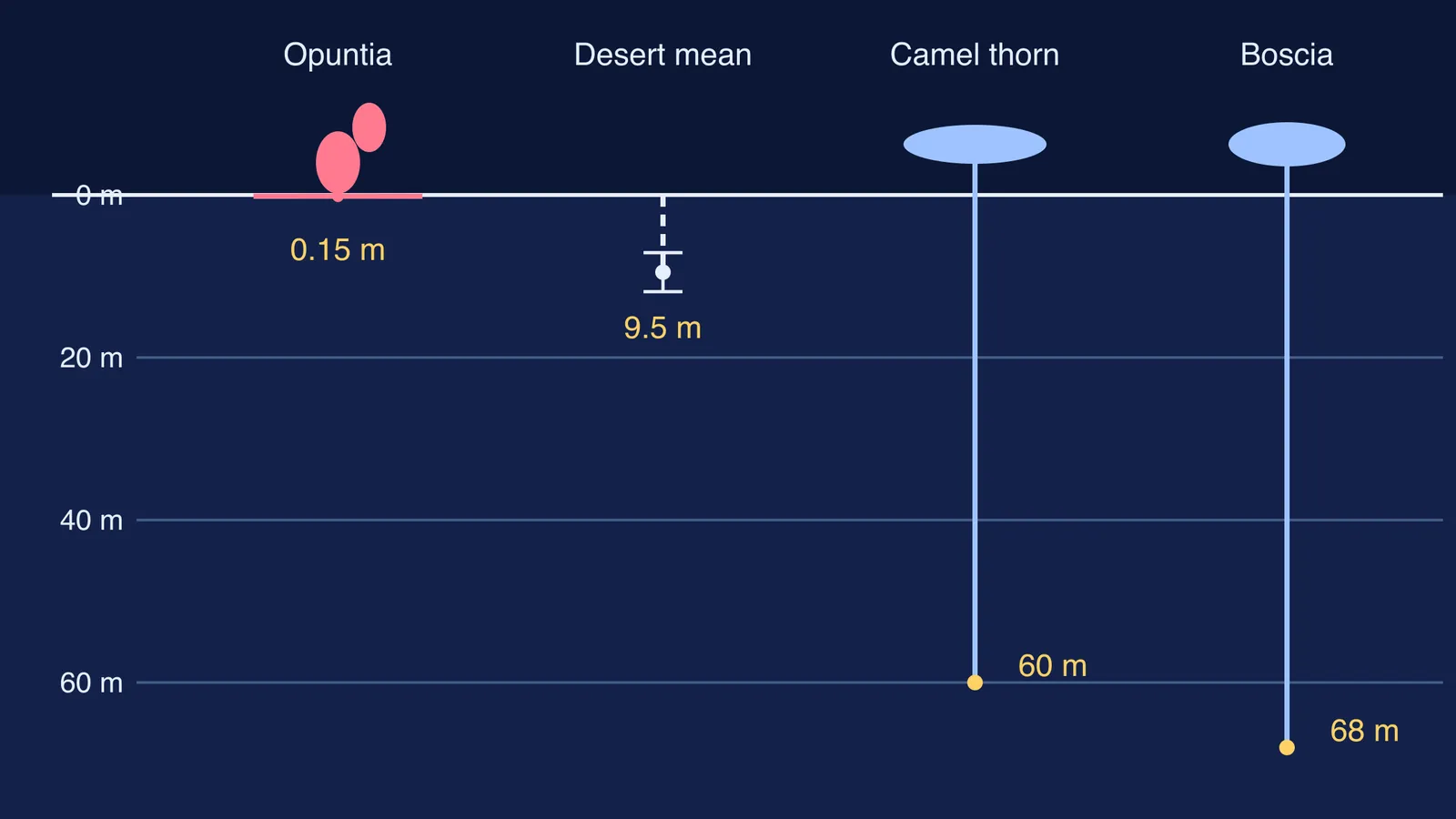
Reach water: very deep taproots, as in the camel thorn acacia, or shallow roots that grow fast after rain, as in Opuntia.
How do a thick cuticle and sunken stomata save water?
The best-studied example is the prickly pear, Opuntia ficus-indica, described in a Food and Agriculture Organization chapter by plant physiologist Park S. Nobel. Its waxy stem cuticle is generally 5 to 30 µm thick. Its stems usually carry only 20 to 30 stomata per square millimetre, so little of the surface lets water vapour out.
Timing matters as much as structure. Opuntia opens its stomata at night, the pattern called Crassulacean Acid Metabolism (CAM), and stores the CO2 it takes in as four-carbon acids such as malate until daylight. Because plant tissues are cooler at night, the chapter says CAM plants tend to lose only 20 to 35% as much water as C3 or C4 plants for the same stomatal opening. In the chapter's example, Opuntia's water-use efficiency is about triple that of C4 crops such as maize and five times that of C3 crops such as wheat under similar conditions. If the pathway names blur together, our table comparing C3 and C4 plants sets them side by side.
Sunken stomata come with a caveat. A 2008 study in the American Journal of Botany examined over 1400 species of the Proteaceae plant family. Deep encryption, meaning stomata in deep pits or grooves, evolved at least 11 times in very dry environments. Stomata that were sunken but not closely enclosed, or covered by hairs, also evolved repeatedly but had no systematic link to dry climates. So the pit has to be deep to count as a drought adaptation.
Why do cacti have spines instead of leaves?
A broad leaf is a large wet surface. In cacti the leaves are reduced, and the green stem takes over photosynthesis. In Opuntia the flat pads are stems, and the FAO chapter places both night-time CO2 fixation and daytime photosynthesis in the green chlorenchyma of those stems. Its history as an invasive plant is told in our post on the prickly pear and the cactus moth.
The standard answer is that cactus spines are modified leaves. A 2024 study of saguaro seedlings by Miravel-Gabriel and colleagues found no clear leaf structures where spines form and reopened the question.
How do fleshy stems and roots help desert plants survive?
Opuntia stems hold a large volume of water-storage tissue. During a three-month drought, the FAO chapter reports that this tissue shrank by 50% in thickness while the green tissue shrank by only 13%. Its roots are shallow, with mean depths near 15 cm, and can form new roots within 24 hours of rain wetting dry soil.
Acacias take the opposite route. The camel thorn, Acacia erioloba, often the only sizeable tree in southern Africa's deserts, has a taproot that can descend to 60 m to reach groundwater, according to South Africa's national biodiversity institute. It also carries paired spines up to 60 mm long and finely divided leaves with many small leaflets.
A global review of rooting depth by Canadell and colleagues found that desert plants had an average maximum rooting depth of 9.5 m. The deepest root in their data reached 68 m, for Boscia albitrunca in the central Kalahari. Deep roots are one route to water; Opuntia's shallow, fast roots are the other.
How do you write a xerophyte answer in an exam?
Use a three-part line for each adaptation: feature, what it reduces or provides, and a named example. Here is a worked answer to "Explain three adaptations of Opuntia to a desert habitat," using figures from the FAO chapter on Opuntia.
Its stem has a thick waxy cuticle (about 5 to 30 µm) and few stomata, which reduces water loss by transpiration.
It uses CAM: stomata open at night when it is cool and close by day, so it takes in CO2 while losing far less water.
Its leaves are reduced to spines and the flattened green stem stores water and carries out photosynthesis.
Before you submit, check for three common slips:
Writing "no stomata". Opuntia has few stomata, not none.
Saying every desert plant has deep roots. Opuntia's are shallow.
Calling CAM the same as C4. Both form four-carbon acids, but CAM separates the steps by time of day.
To see how temperature and humidity change water loss, try our post on factors affecting transpiration rate. If CAM, stomata and transpiration still feel like separate topics, the Fermi Concept Library gives each biology concept its own lesson and shows its place in the map, so you can see how they connect.


