

On this page
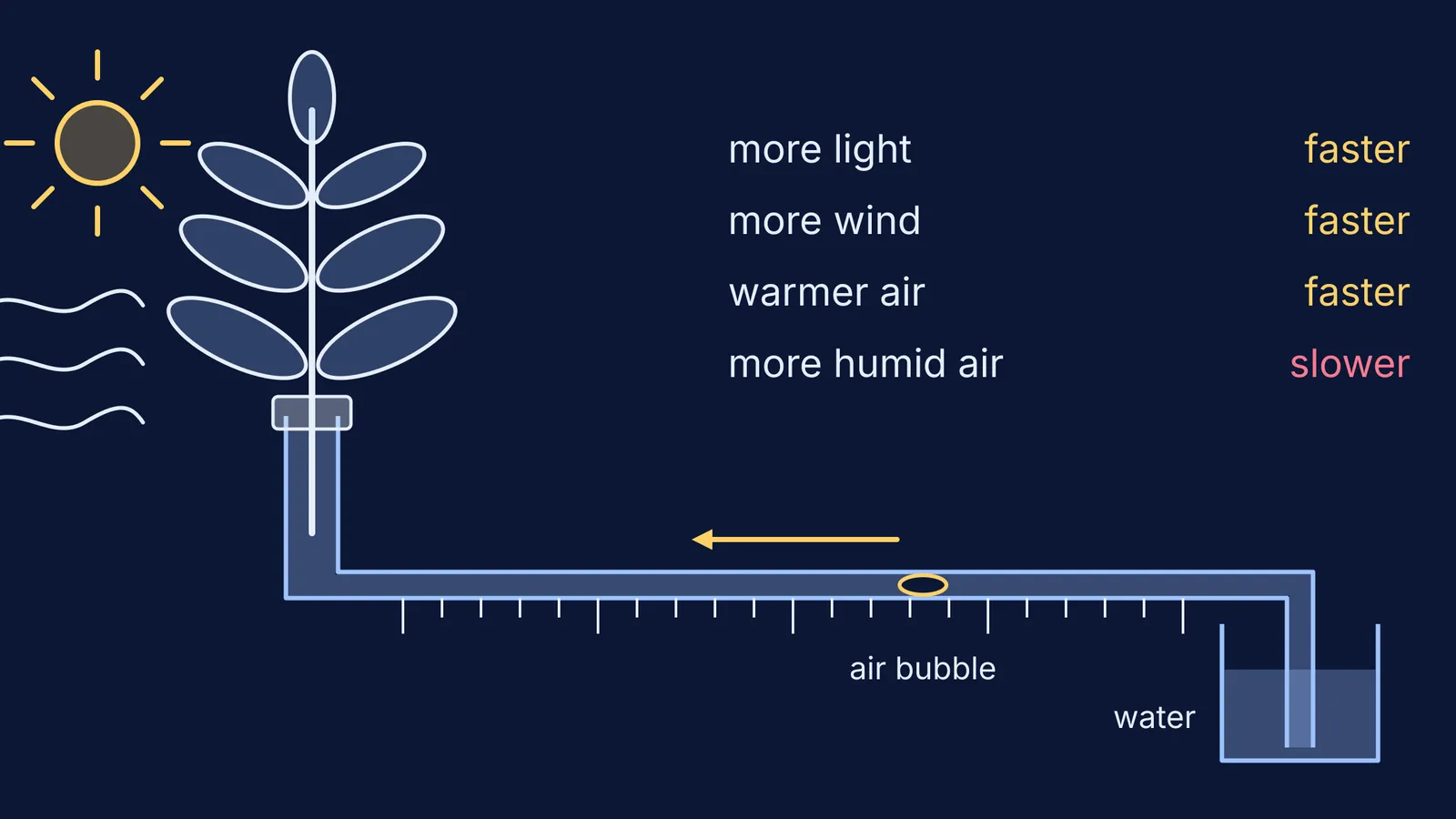
Put a leafy shoot in a potometer, watch an air bubble creep along a thin tube, then change the air around the leaves. The bubble speeds up or slows down, and every change goes back to the stomata. Here are four runs for a real or virtual potometer, with a prediction and an explanation for each.
What does a potometer actually measure?
A potometer measures how fast a leafy shoot takes up water, not how fast it loses it. In a 2021 article for Azim Premji University's i wonder magazine, retired botany professor Kishore Panwar explains that a plant absorbs nearly as much water as it loses by transpiration, so uptake is a fair estimate of the transpiration rate (Panwar, i wonder, 2021). The same article notes that only about 2-5% of the water absorbed by roots is used for life processes, and the remaining 95-98% is lost as water vapour, mainly from the leaves.
Stomata are the small pores on the surfaces of leaves and stalks that regulate the flow of gases in and out of the plant (Hetherington and Woodward, Nature, 2003). Each pore is surrounded by a pair of guard cells, and it opens when the guard cells accumulate potassium salts and sugars (Shimazaki and colleagues, Annual Review of Plant Biology, 2007). Water vapour leaving the stomata creates a pull that runs down the xylem to the cut stem and drags the bubble along; our explainer on how xylem and phloem transport water covers that pull.
What are the factors affecting the rate of transpiration?
The four you can change on a potometer are light, wind, humidity and temperature, weather factors the US Geological Survey also lists (USGS Water Science School). Prediction first, explanation second:
More light: faster bubble. Blue and red light drive stomatal opening in guard cells (Shimazaki and colleagues, above), and wider pores let more vapour out. Stomata must open to let carbon dioxide in for photosynthesis, so the plant trades water for carbon (College Board, AP Biology Investigation 11).
More wind: faster bubble. USGS says more air movement around a plant raises the transpiration rate. Moving air sweeps away the moist layer outside each stoma, so vapour keeps diffusing out.
More humid air: slower bubble. USGS states that as relative humidity around the plant rises, transpiration falls. The air inside the leaf is already moist, so moist outside air shrinks the difference that drives vapour out.
Warmer air: faster bubble. USGS notes that transpiration rises with temperature, and that warmth makes the cells controlling the stomata open while cold makes them close. Warmth also speeds evaporation inside the leaf.
A warning for run 4: stomata respond to signals from inside the plant too (Hetherington and Woodward, above), and a shoot short of water can close them even in heat, as our post on abscisic acid, the stress hormone that closes stomata explains. If the bubble slows in a hot run, check for wilting.
How do you set up a fair potometer experiment?
Change one factor per run and keep the rest fixed, the same logic as finding the limiting factor in a photosynthesis simulation.
Cut the stem under water and push it into a tube slightly narrower than the stem, so the joint is watertight, as Panwar does (above).
Time the bubble over a fixed distance in room conditions. This is your baseline.
Write your prediction and one reason before changing anything.
Change one factor, wait until the bubble moves steadily, and time the same distance three times.
Compare each run with the baseline, not with other runs.
How do you turn bubble distance into volume?
The College Board version of this lab uses a 0.1 mL or 1.0 mL pipette as the scale (College Board, AP Biology Investigation 11). Suppose, with made-up readings, the bubble moves 30 mm in 5 minutes in still air and in 2 minutes with a fan on: 6 against 15 mm per minute. For volume, multiply by the cross-section: for a capillary of radius 0.5 mm, the area is π × 0.5² ≈ 0.785 mm², so 15 mm per minute is about 11.8 mm³, or 11.8 microlitres, per minute.
How do you explain each result in an exam answer?
A full answer is a chain of cause and effect, not a keyword. If you cannot fill in the stomata link, that is your gap to fix:
Change: when light intensity increased,
Stomata: more stomata opened, or the vapour difference across them grew or shrank,
Water loss: so more (or less) vapour diffused out of the leaf,
Bubble: so the shoot took up water faster (or slower) and the bubble moved faster (or slower).
The Fermi Simulation Lab has interactive simulations for ideas easier to see than to read, and this predict, run and explain routine works on any of them. When a result does not match your prediction, Fermi's AI tutor notices where you are stuck and decides whether to explain, ask or show, so you find the link that broke.
Pick one factor tonight, write your prediction, and see if the bubble agrees.


