

On this page
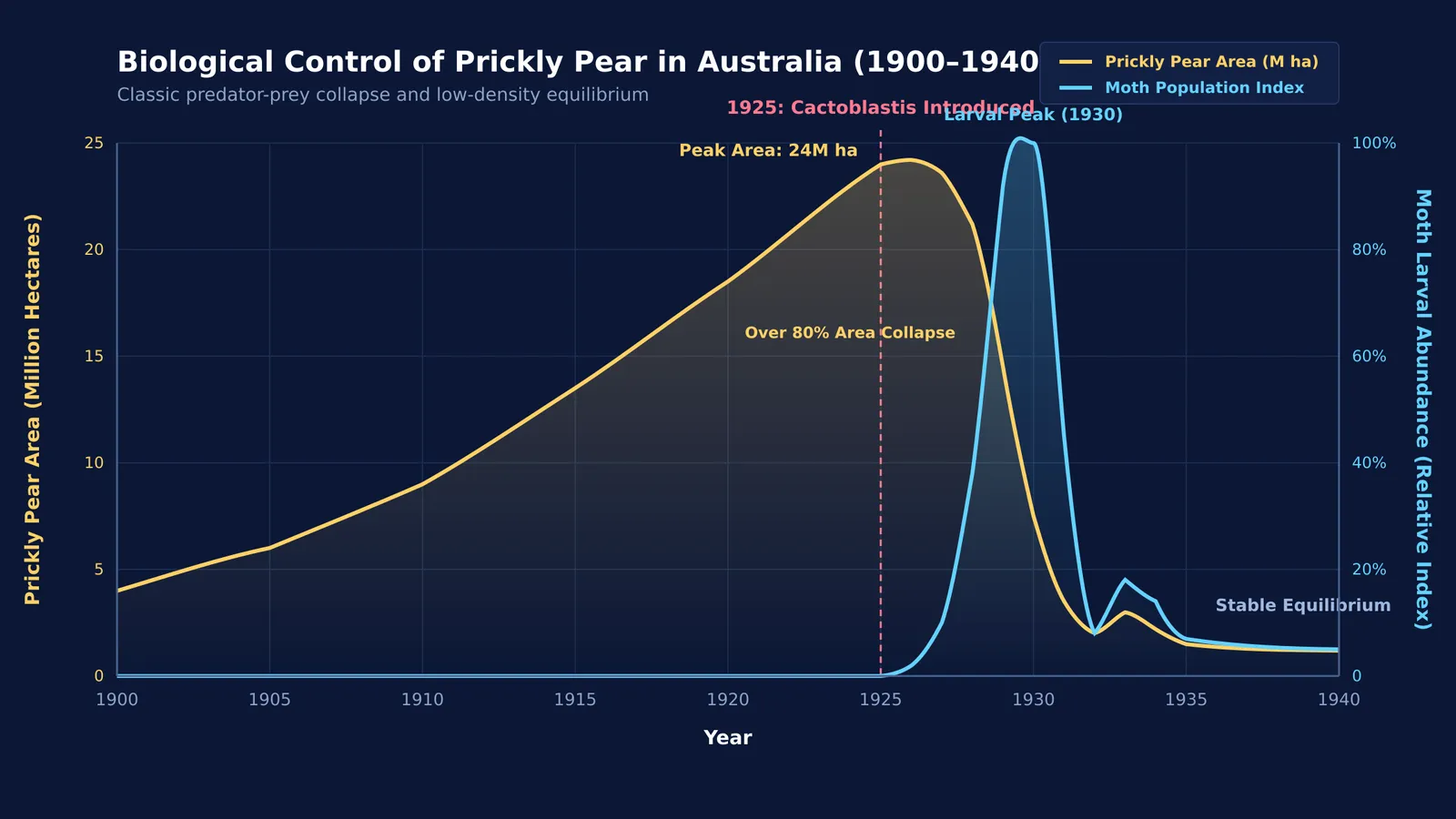
In the early twentieth century, eastern Australia faced an ecological catastrophe known locally as the "green flood." What began in 1788 as an attempt by the First Fleet to cultivate cochineal dye insects on *Opuntia* cacti grew into an uncontrollable thicket. By 1925, *Opuntia inermis* and *Opuntia stricta* had smothered roughly 24 million hectares (nearly 60 million acres) of pastoral land across Queensland and New South Wales, expanding at 400,000 hectares each year, as recorded by the National Library of Australia. Farms were abandoned, cattle were blinded by spines, and mechanical rollers proved powerless. The disaster was halted not by machines or poison, but by a small South American moth.
Why did the prickly pear cactus spread so fast across Australia?
Invasive plants explode when placed into environments free of natural checks. This principle, known in ecology as the enemy release hypothesis, explains the prickly pear crisis. In South America, specialized beetles, sap-sucking bugs, and caterpillars feed on cacti, keeping their density low. In Australia, no native herbivore possessed mouthparts or digestive enzymes adapted to penetrate the tough, mucilage-filled pads and dense spines of *Opuntia*.
Beyond missing predators, the cactus possessed superior drought adaptations. Cacti use Crassulacean Acid Metabolism (CAM) photosynthesis, opening stomata at night to capture carbon dioxide and conserve water, as detailed by Osmond and colleagues in the Journal of Experimental Botany. While native grasses withered during dry spells, *Opuntia* produced succulent cladodes and sweet fruits. Birds and cattle consumed the fruits, spreading seeds across miles in their droppings.
Early attempts to destroy the weed with mechanical crushing and chemical spraying failed. Spraying dense thickets with arsenic pentoxide cost up to £20 per acre, while the freehold market value of the land itself was only £1 to £2 per acre, as noted by Frank Wilson in the Annual Review of Entomology.
How did the Cactoblastis moth destroy dense prickly pear stands?
Recognizing that chemical clearing could not scale across 24 million hectares, the Australian government formed the Commonwealth Prickly Pear Board. In 1925, entomologist Alan P. Dodd imported a founding shipment of 2,750 *Cactoblastis cactorum* individuals from Argentina to Queensland, as recorded in Commonwealth Prickly Pear Board bulletins at the National Library of Australia. Before field release, quarantine trials confirmed that caterpillars starved to death rather than chew on commercial crops or native flora, proving their strict host specificity.
Between 1927 and 1930, field workers and settlers distributed approximately 3 billion eggs across Queensland and New South Wales, an operation documented by S. Raghu and Craig Walton in BioScience. Female moths laid chains of 50 to 100 eggs, known as "egg sticks." Field workers collected these sticks, pasted them onto paper cards, and pinned them directly to cactus cladodes at an average release density of 7,320 egg sticks per square kilometer.
The destruction was driven by two biological mechanisms:
Gregarious larval feeding: Groups of 30 to 50 caterpillars tunneled through pad interiors, hollowing out parenchymal storage tissue.
Pathogenic rot: Chewing admitted secondary bacteria and fungi that liquefied cladodes and roots into a foul slurry.
By 1932, over 80 percent of dense stands in Queensland had collapsed, as reviewed in the Journal of Applied Ecology.
What does the cactus moth campaign teach us about biological control?
The recovery of Australia's pastures is widely cited as the classic success of biological control, but its real value lies in predator-prey dynamics. When millions of hectares of cactus liquefied between 1928 and 1932, the loss of food caused billions of caterpillars to starve, cutting moth populations by over 90 percent, as documented in BioScience.
This crash allowed surviving cactus fragments to regenerate in scattered patches. As these patches expanded, surviving moths relocated them, laid new egg sticks, and suppressed them again. Over several decades, both species settled into a stable, low-density equilibrium.
For students curious about mathematical models of population cycles, our guide to differential equations for population growth and decay shows how predator-prey feedback loops prevent unchecked exponential growth.
How should NEET students solve questions on predator-prey balance?
In NCERT Class 12 Biology, this case appears under "Predation" in *Organisms and Populations*. NEET questions frequently test why predators are vital for community stability.
Use this 4-step framework to evaluate biological control questions:
Identify the regulating force: Invasive explosions occur because top-down predator control is absent, not because biotic potential has changed.
Verify host specificity: Safe biocontrol requires specialized predators that cannot switch to non-target native species.
Trace the numerical lag: Predator population peaks and crashes always follow prey density shifts after a time delay.
Distinguish control from eradication: Biocontrol maintains prey below economic damage thresholds; it never produces complete eradication.
When revising ecology, you can explore trophic cascades in the Fermi Concept Library, which covers every concept in physics, chemistry, biology, mathematics and computing. If you get stuck on population numericals, the Fermi Problem Library provides worked problems with a step-by-step solver that explains the reasoning rather than printing an answer. You can test your preparation by solving NEET ecology questions on food webs and population dynamics and review selection pressures in our guide to reading natural selection curves.


