

On this page
Animals rely on a central respiratory system—lungs, gills, and a heart—to pump oxygen to every distant cell. Plants, however, manage to grow to enormous sizes without a single breathing organ.
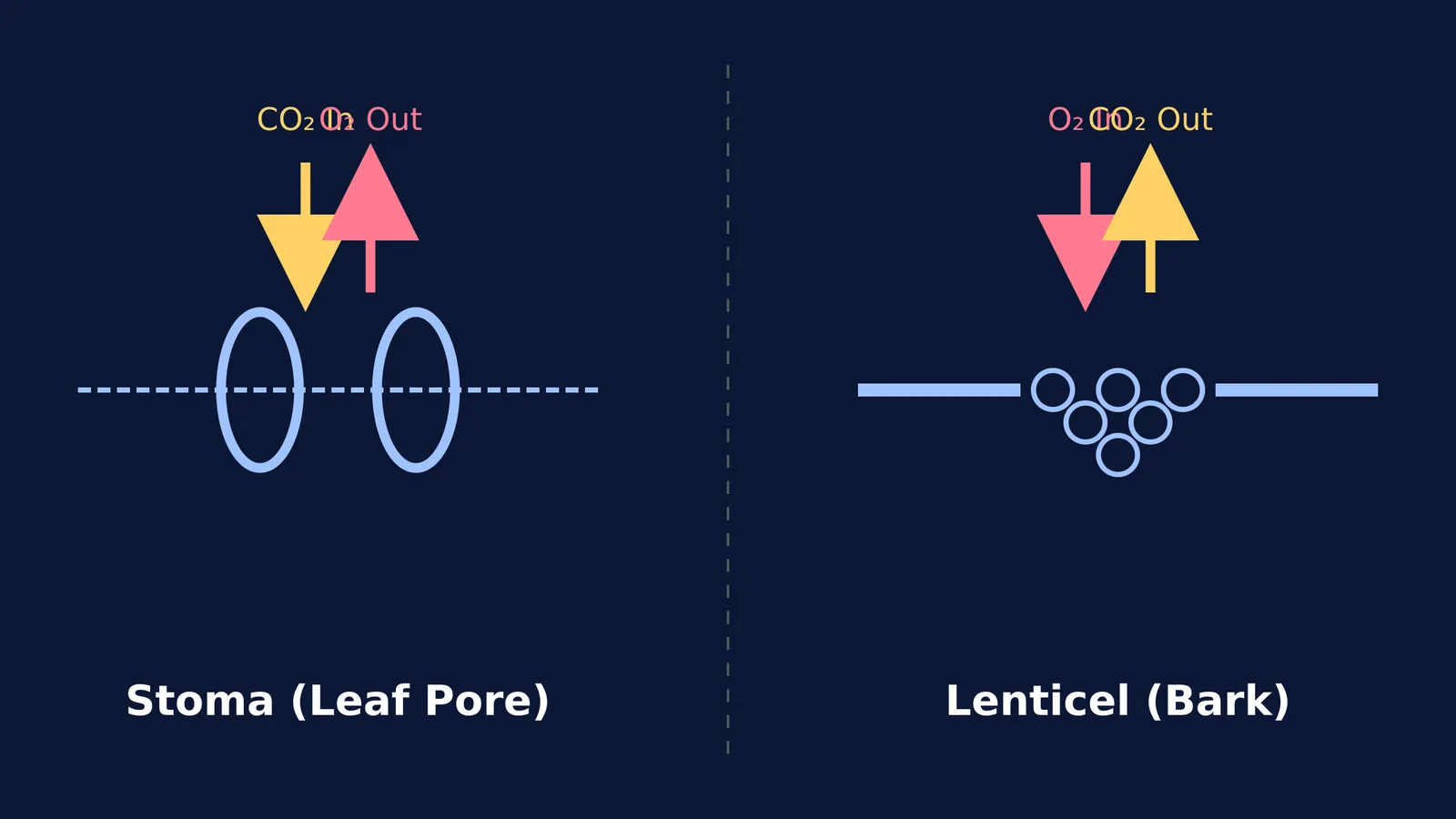
Instead of moving gases through a circulatory system, a tree handles its gas exchange locally. Every leaf, stem, and root exchanges oxygen (O₂) and carbon dioxide (CO₂) directly with its surroundings. The two main gateways for this process are stomata on the green surfaces and lenticels on the woody bark.
Why do plants not have breathing organs?
Plants can survive without lungs because their biological structure and energy needs differ fundamentally from animals. The primary reason is their low metabolic demand. Plants are sedentary; they do not need to fuel muscle movement or maintain a high body temperature, so their rate of cellular respiration is much lower. Simple diffusion is fast enough to meet their oxygen needs.
Furthermore, a plant's internal anatomy is highly optimized for airflow. Plant tissues, such as the spongy mesophyll inside leaves, are loosely packed. This creates a network of internal air spaces that allows gases to diffuse rapidly to almost every living cell.
During the day, plants also benefit from self-sufficiency. As leaves perform photosynthesis, they produce oxygen as a byproduct. Much of this oxygen is used immediately by the plant for its own respiration, reducing the need to pull large amounts of oxygen from the outside air.
Finally, in large trees, the vast majority of the trunk's interior is heartwood—dead tissue that provides structural support but requires no oxygen. The living cells are concentrated in a thin layer just beneath the bark, keeping the distance that gases must travel extremely short.
If you are struggling to connect these ideas for an exam, the Fermi Concept Library covers every concept in physics, chemistry, biology, mathematics and computing, each with its own lesson and its place in the map, helping you trace exactly how gas exchange supports respiration.
What is a stoma and how does it exchange gas?
A stoma (plural: stomata) is a microscopic pore found primarily in the epidermis of leaves and young, green stems. Stomata typically range in size from 10 to 80 μm in length.
Unlike a passive hole, each stoma is actively controlled by a pair of specialized guard cells. When the plant is well-hydrated, these guard cells swell (become turgid) and bow outward, opening the pore. This open gateway allows atmospheric carbon dioxide to diffuse directly into the leaf for photosynthesis, while the waste oxygen exits.
Because an open stoma inevitably leads to water loss through transpiration, the plant must constantly balance its need for carbon dioxide against the risk of drying out. During a drought, or at night when photosynthesis stops, the guard cells lose turgor pressure and close the pore to conserve water. (If you are studying plant metabolism, you can see how this relates to photorespiration when carbon dioxide levels drop).
How do lenticels work in woody stems?
As a plant matures and undergoes secondary growth—driven by lateral meristems—its green epidermis is replaced by a tough, impermeable layer of cork or bark. Because bark completely blocks gas diffusion, the plant develops lenticels to let the underlying living tissues "breathe."
Lenticels are porous, lens-shaped regions of loosely arranged complementary cells that erupt through the bark of woody stems and roots. They act as microscopic snorkels that bypass the impermeable cork. Unlike stomata, lenticels lack guard cells and cannot actively close; they remain permanently open to provide a continuous pathway for oxygen to enter and carbon dioxide to escape.
They are not just found on tree trunks. Lenticels are also present on the surfaces of some root crops and fruits. For example, a single apple fruit can have between 450 and 2,500 lenticels on its surface. These tiny specks ensure that the living cells inside the fruit continue cellular respiration long after they are picked.
What are the key differences between stomata and lenticels?
While both structures facilitate gas exchange, they serve different primary roles in the plant's life cycle. Stomata act as regulated valves on leaves, primarily facilitating the massive influx of carbon dioxide required for photosynthesis. They are dynamic, opening and closing in response to light, humidity, and internal chemical signals.
Lenticels, on the other hand, are the permanent, unregulated vents of the woody plant body. They primarily exist to ensure that the living cells in the stem and root systems have a constant supply of oxygen for respiration, day and night, regardless of the weather. Together, this decentralized system allows a giant oak tree to breathe just as effectively as a tiny moss, without ever needing a pair of lungs.


