On this page
Your Class 12 biotechnology chapter calls them sticky ends, and exam questions keep asking why they matter. The short version: an overhang is a few unpaired bases that can pair with a matching overhang, so the two pieces of DNA hold on to each other long enough for DNA ligase to seal them.
What is the difference between sticky ends and blunt ends?
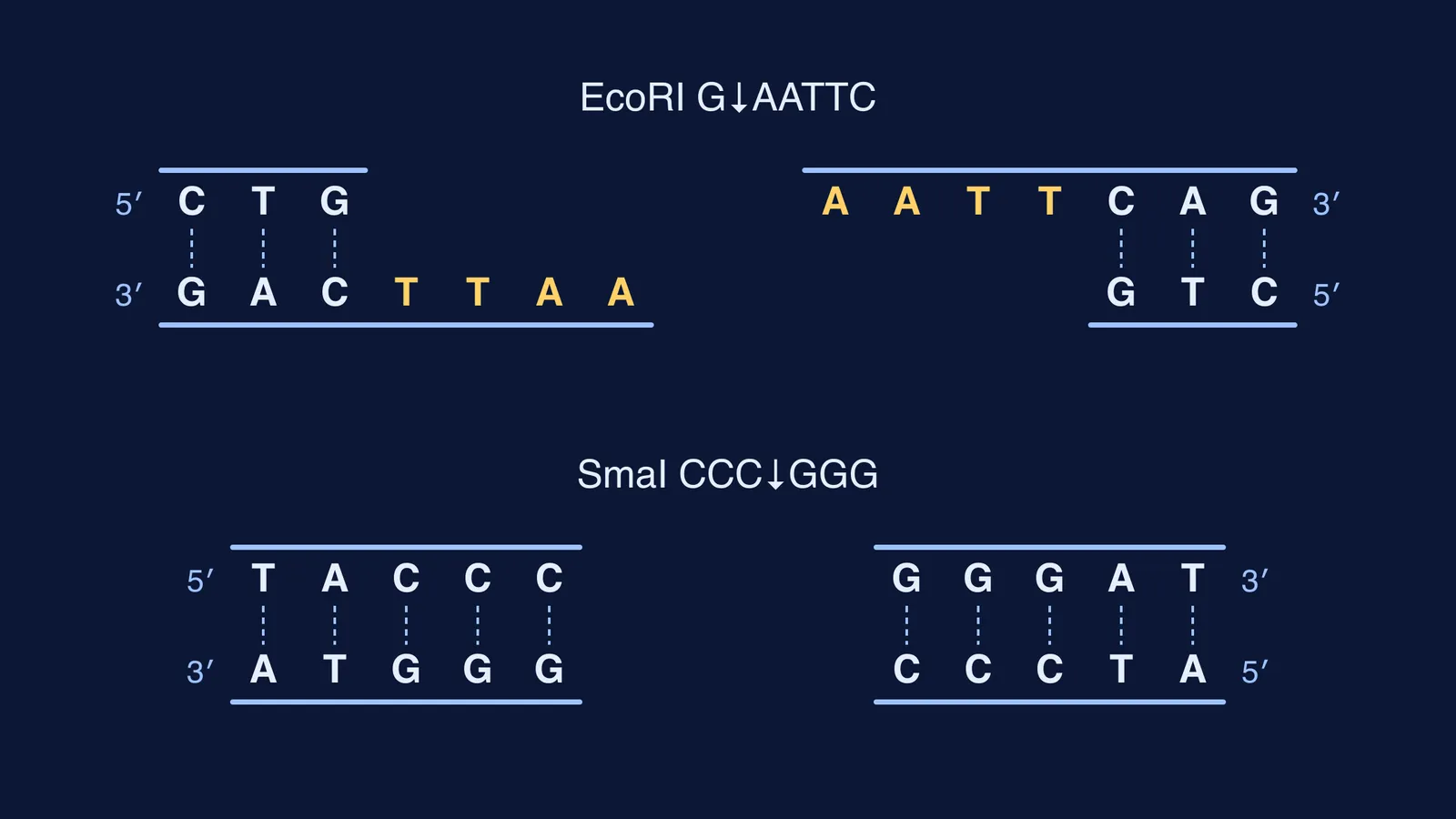
Blunt ends are ends where both strands are the same length and stop at the same base, leaving no unpaired bases (Wikipedia: sticky and blunt ends). Sticky, or cohesive, ends are ends where one strand is longer than the other, so the extra bases sit unpaired as an overhang (same source). The overhang can be on either strand, giving a 5′ overhang or a 3′ overhang.
The evidence that a restriction enzyme leaves sticky ends comes from two papers published in 1972. Janet Mertz and Ronald Davis showed that the enzyme now called EcoRI makes staggered breaks and leaves identical, complementary single-strand ends, so DNA molecules can be joined at those sites using the enzyme and ligase (Mertz and Davis, PNAS 1972). The same year and in the same journal, Hedgpeth, Goodman and Boyer reported that EcoRI leaves short cohesive ends of four nucleotides, and that its recognition site is symmetrical (Hedgpeth et al., PNAS 1972).
Which restriction enzymes make sticky ends and which make blunt ends?
The arrow shows where the enzyme cuts the top strand, read 5′ to 3′. Cut sites are from the Wikipedia tables of restriction sites (E–F, Ba–Bc, G–K, O–R, S).
EcoRI, G↓AATTC: sticky, 5′ overhang AATT
BamHI, G↓GATCC: sticky, 5′ overhang GATC
HindIII, A↓AGCTT: sticky, 5′ overhang AGCT
PstI, CTGCA↓G: sticky, 3′ overhang TGCA
SmaI, CCC↓GGG: blunt
EcoRV, GAT↓ATC: blunt
Worked method: find the end type in four steps
These sites are palindromes: the top strand read 5′ to 3′ is the same as the bottom strand read 5′ to 3′. So the enzyme cuts the bottom strand at the mirror-image position. (Our post on palindromic sequences in restriction sites explains this symmetry in more detail.)
Write the site 5′ to 3′ and mark the cut. A 6-base site has its middle after base 3.
Cut exactly in the middle: blunt ends. SmaI cuts CCC↓GGG, after base 3, so it is blunt.
Cut left of the middle: a 5′ overhang. EcoRI cuts after base 1, so the overhang is bases 2 to 5: AATT.
Cut right of the middle: a 3′ overhang. PstI cuts after base 5, so the overhang is bases 2 to 5 again: TGCA.
Why do sticky ends make ligation easier?
DNA ligase can only seal a nick where a 5′ phosphate and a 3′ hydroxyl sit side by side. With sticky ends, the four overhanging bases on one fragment form hydrogen bonds with the complementary four on the other, which holds the ends in position while ligase works. Blunt ends have nothing to pair, so the two ends meet only briefly and by chance.
Thermo Fisher's ligation guide states that blunt-end ligation is less efficient than sticky-end ligation (Thermo Fisher, DNA ligation tips). The same guide suggests 1.0 to 1.5 Weiss units of T4 DNA ligase for sticky ends but 1.5 to 5.0 units for blunt ends, plus a crowding agent, PEG, to speed up blunt ligation.
Blunt ends do have one advantage: any blunt end can join any other blunt end, whichever enzyme made it. The cost is control. A sticky end joins only an end with a matching overhang, so cutting a gene and a vector with two different sticky-end enzymes lets the insert go in only one way round. That is one reason vectors carry several unique cutting sites, covered in our guide to the features of a good cloning vector.
How should you answer sticky-vs-blunt questions?
Use this checklist before you mark an option.
Find the arrow. Middle of the site means blunt; anywhere else means sticky.
Name the overhang: left of the middle is 5′, right of the middle is 3′.
Count overhang bases: for a 6-base site, it is the distance between the cut and the middle, times two.
If two different enzymes leave the same overhang, their ends can pair. If an end is blunt, it pairs with any blunt end.
Keep roles apart: the restriction enzyme cuts, ligase joins.
The next step is working out how many fragments a cut makes, and our walk-through of counting fragments in a restriction digest picks up from there.
If palindromes or 5′ and 3′ ends still feel shaky, the Fermi Concept Library has every concept in biology with its own lesson and its place in the map. For practice, the Fermi Problem Library has worked problems with a step-by-step solver that explains the reasoning rather than printing an answer.