

On this page
A DNA palindrome is not like the English word "MADAM" or "RACECAR". If you write those words backwards on the same line, they read exactly the same. But DNA is a double helix made of two anti-parallel strands, and its palindromes work differently.
Instead of reading a single strand backwards, a DNA palindrome means that if you read the top strand in one direction (5' to 3'), and then read the bottom, complementary strand in that exact same direction (5' to 3'), you get the identical sequence.
What makes a DNA sequence a palindrome?
More than 4,000 restriction enzymes have been characterized from bacterial and archaeal species. Most of the ones used in biology labs recognise a palindromic sequence of 4 to 8 base pairs.
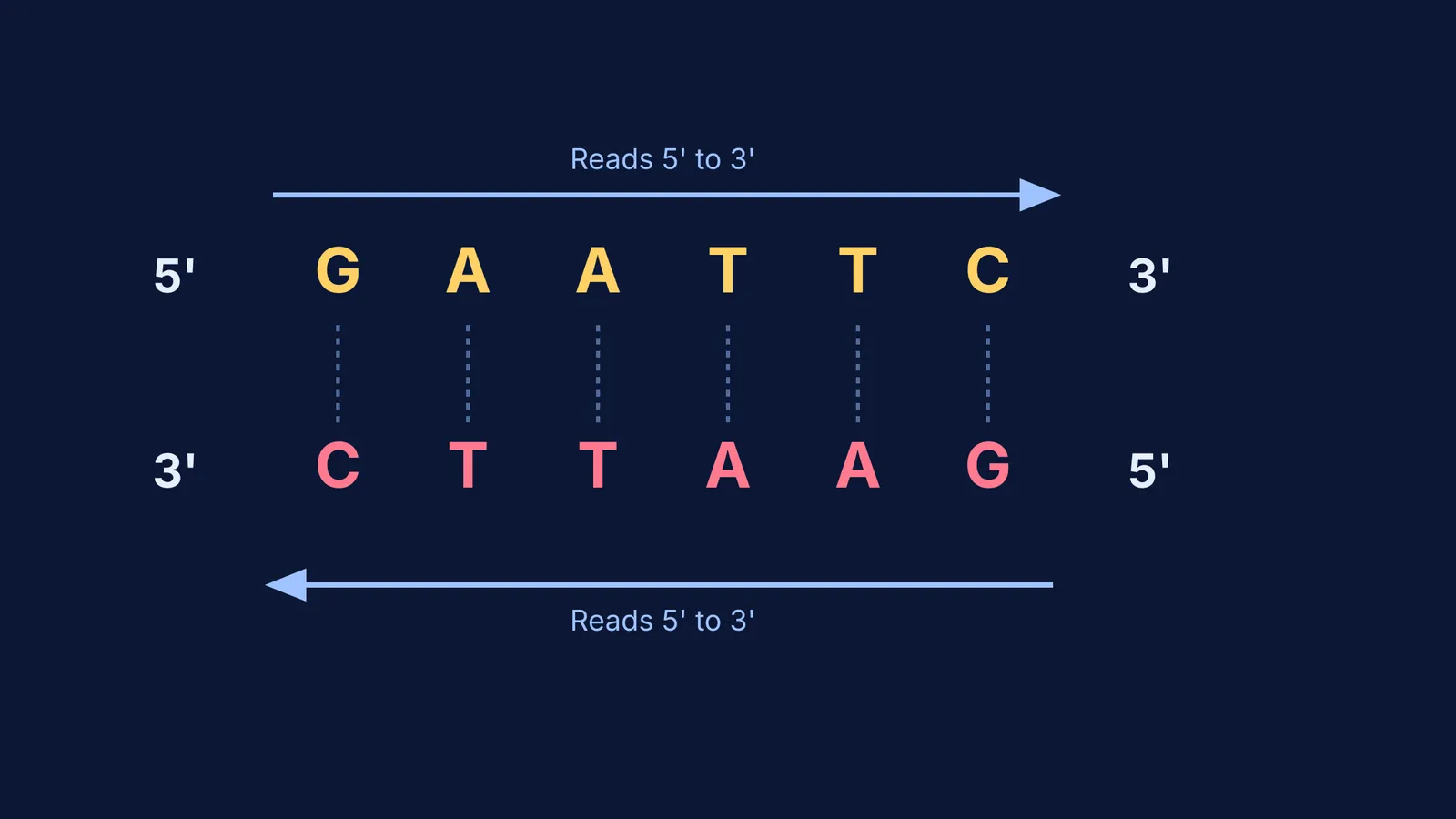
Let's look at EcoRI, one of the most famous restriction enzymes found in *Escherichia coli*. It recognises the sequence:
The top strand is 5'—GAATTC—3'.
The complementary bases on the bottom strand are 3'—CTTAAG—5'.
If you read that bottom strand in the 5' to 3' direction (from right to left in the drawing above), it is GAATTC. The sequence is perfectly symmetrical across the two strands. This symmetry is the hallmark of the recognition sites targeted by Type II restriction endonucleases.
Why do restriction enzymes look for these sequences?
In nature, bacteria use restriction enzymes as molecular scissors to chop up the DNA of invading viruses (bacteriophages). It is an ancient, microscopic immune system.
Because DNA is a double helix, a palindromic site ensures that an enzyme composed of two identical halves (a homodimer) can bind to both strands simultaneously. The two halves of the enzyme match the two halves of the DNA palindrome. When the enzyme locks on, it cuts both strands of the sugar-phosphate backbone at the exact same time.
What are sticky and blunt ends?
When a restriction enzyme cuts a palindromic sequence, it does not always cut straight down the middle.
Enzymes like EcoRI cut off-centre. On the top strand (GAATTC), it cuts between the G and the first A. On the bottom strand, it also cuts between the G and the A. Because the cuts are staggered, the DNA breaks apart leaving overhanging, single-stranded stretches of bases.
These overhangs are called "sticky ends." They are incredibly useful to genetic engineers because any two pieces of DNA cut with the same enzyme will have matching sticky ends that can readily form hydrogen bonds with each other. This is the foundation of recombinant DNA technology.
Other enzymes cut straight down the middle of the palindrome. For example, HaeIII recognises the sequence 5'—GGCC—3' and cuts straight between the G and the C on both strands. This leaves flat, "blunt ends" with no overhangs.
How to spot a palindrome in a sequence question?
Examiners for tests like NEET-UG often ask you to identify a palindromic sequence from a list of single strands. You can spot one quickly with this three-step test:
Look at the given strand, for example, 5'—GGATCC—3'.
Write down its complementary strand underneath it using the base-pairing rules (A with T, G with C): 3'—CCTAGG—5'.
Read the complementary strand backwards (so you are reading from 5' to 3'). It reads 5'—GGATCC—3'.
Does it match the first strand? If yes, it is a palindrome. This particular sequence is the recognition site for the enzyme BamHI.
Another common example is HindIII, which recognises 5'—AAGCTT—3'. If you write out its complement (3'—TTCGAA—5') and read it backwards, you get AAGCTT again.
If you are staring at a multiple-choice question and feeling unsure about which bases pair up or how to read the directionality, the Fermi Concept Library can help. You can bring any biology problem to Fermi's AI tutor, and it will walk you through writing out the complementary strand step by step until you can reliably spot the symmetry yourself.


