

On this page
To successfully transport a gene—such as when engineering a bacteria for recombinant insulin production—the vector must be able to survive, multiply, and advertise its presence inside the host cell.
According to standard molecular biology definitions, a cloning vector is a small piece of DNA that can be stably maintained in an organism (Wikipedia). But a random loop of DNA will not work; researchers use engineered plasmids that meet specific requirements.
What are the features of a good cloning vector?
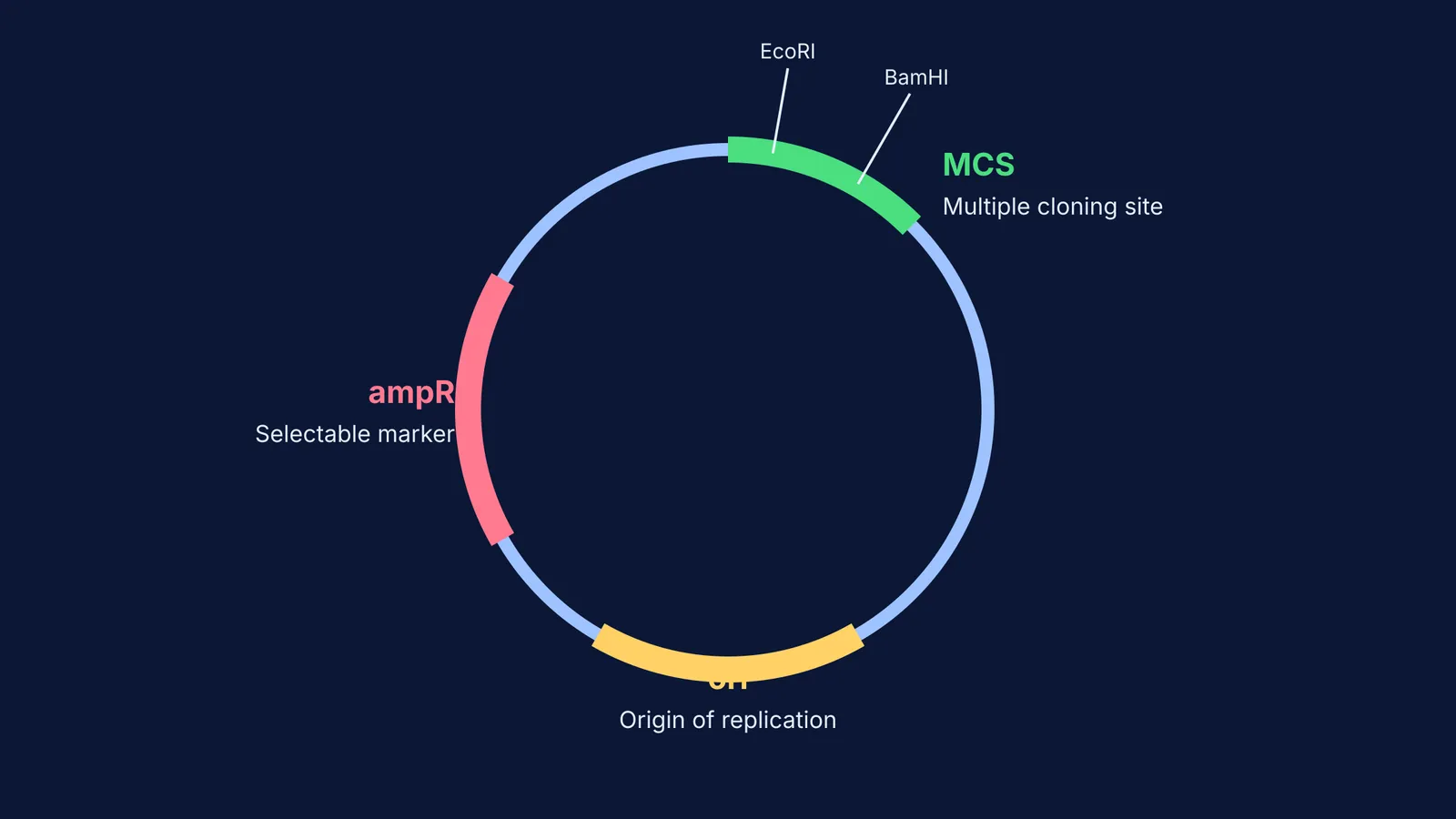
Whether it is a simple plasmid or a bacterial artificial chromosome, a good vector must possess three core features to be useful in a laboratory or exam setting:
An origin of replication (ori)
A selectable marker
Unique recognition sites (often clustered in a multiple cloning site)
To understand how these elements come together, we can look at the first multipurpose cloning vehicle. In 1977, researchers published the construction of pBR322, a plasmid with a molecular weight of 2.6 × 10⁶ daltons that carried resistance genes for two antibiotics, ampicillin and tetracycline (Bolívar et al., 197790000-2)).
When revising biotechnology for board exams, mapping out these plasmid structures can feel overwhelming. The Fermi Concept Library maps out every concept in biology, each with its own lesson, helping you visualise how these genetic tools function rather than just rote-learning their names.
Why is the origin of replication (ori) important?
The origin of replication, or *ori*, is a specific sequence of DNA where the replication machinery of the host cell binds to start copying the plasmid. Without an *ori*, the vector would not duplicate when the cell divides, and the foreign gene would quickly be lost.
The *ori* also serves a second crucial role: it controls the copy number of the linked DNA. Depending on the specific sequence of the *ori*, a host cell might maintain just a few copies of a large vector, or it might produce many copies of a smaller plasmid. If the goal is to harvest a large amount of a specific protein, researchers will choose a vector with an origin that supports a very high copy number.
How do selectable markers work?
After you introduce the DNA into host cells using techniques like heat shock or microinjection, only a small fraction of the cells will actually take up the vector. A selectable marker is a gene that allows you to distinguish these successful "transformants" from the cells that remain empty.
The most common selectable markers in bacterial cloning are genes that confer resistance to antibiotics, such as ampicillin, chloramphenicol, tetracycline, or kanamycin. Normal bacteria do not naturally carry resistance to these drugs. Therefore, if you grow the treated bacteria on an agar plate containing ampicillin, the normal cells will die. Only the cells that successfully absorbed the vector—and its ampicillin resistance gene—will survive and form visible colonies.
Why are single recognition sites needed?
To insert an alien piece of DNA into the vector, you must cut the vector open using a restriction enzyme. A good cloning vector needs very few, preferably single, recognition sites for commonly used restriction enzymes.
If a vector has multiple recognition sites for the same enzyme, treating it with that enzyme will chop the plasmid into several useless fragments, complicating the cloning process. Most modern vectors solve this by grouping single restriction sites into a short sequence called a multiple cloning site (MCS). Because each site in the MCS appears only once in the entire plasmid, the restriction enzyme will slice the circular vector open exactly once, creating a neat gap where the foreign DNA can be ligated.
A checklist for picking the right vector
If you are planning a cloning experiment, choosing a vector is a matter of matching the tool to the task. Here is a practical checklist to guide your decision:
Check the insert size: Standard plasmids can hold smaller foreign DNA fragments. If you need to insert very large sequences, you must upgrade to bacteriophages, cosmids, or artificial chromosomes.
Verify the copy number: Choose a high-copy-number *ori* if you need high yields of plasmid DNA or protein. Choose a low-copy-number *ori* if the foreign protein is toxic to the host cell and needs to be kept at manageable levels.
Confirm the marker: Ensure that your chosen host strain is naturally sensitive to the antibiotic your vector uses as a selectable marker; otherwise, the selection process will fail.
Map the restriction sites: Make sure the restriction enzyme you plan to use cuts the vector exactly once in the multiple cloning site, and does not accidentally cut your target gene into pieces.
Understanding these features explains why recombinant DNA technology is so precise. To see how these engineered vectors are put to work, read our guide on methods to introduce DNA into host cells.


