On this page
Staffing is where Business Studies turns from structures to people. Here is what the current CBSE syllabus asks for, every list in order, and a quick way to read case questions.
What does the CBSE syllabus include in Staffing?
Staffing is Unit 6 of Business Studies (code 054) in the CBSE Class XII curriculum for 2026-27. In that document, Units 6, 7 and 8 (Staffing, Directing and Controlling) together carry 20 of the 80 theory marks.
The syllabus covers the concept and importance of staffing, staffing as part of human resource management, the staffing process, recruitment and its sources (with merits and demerits), the selection process, and training and development with its methods.
The Staffing unit reads exactly as it did in the 2025-26 curriculum, so last year's notes still match. One thing to know plainly: the NCERT Staffing chapter describes ten training methods, including coaching, job rotation, films, case studies, computer modelling and programmed instruction. The syllabus names only vestibule, apprenticeship and internship training (plus induction). Learn those in depth.
What are the steps in the staffing process?
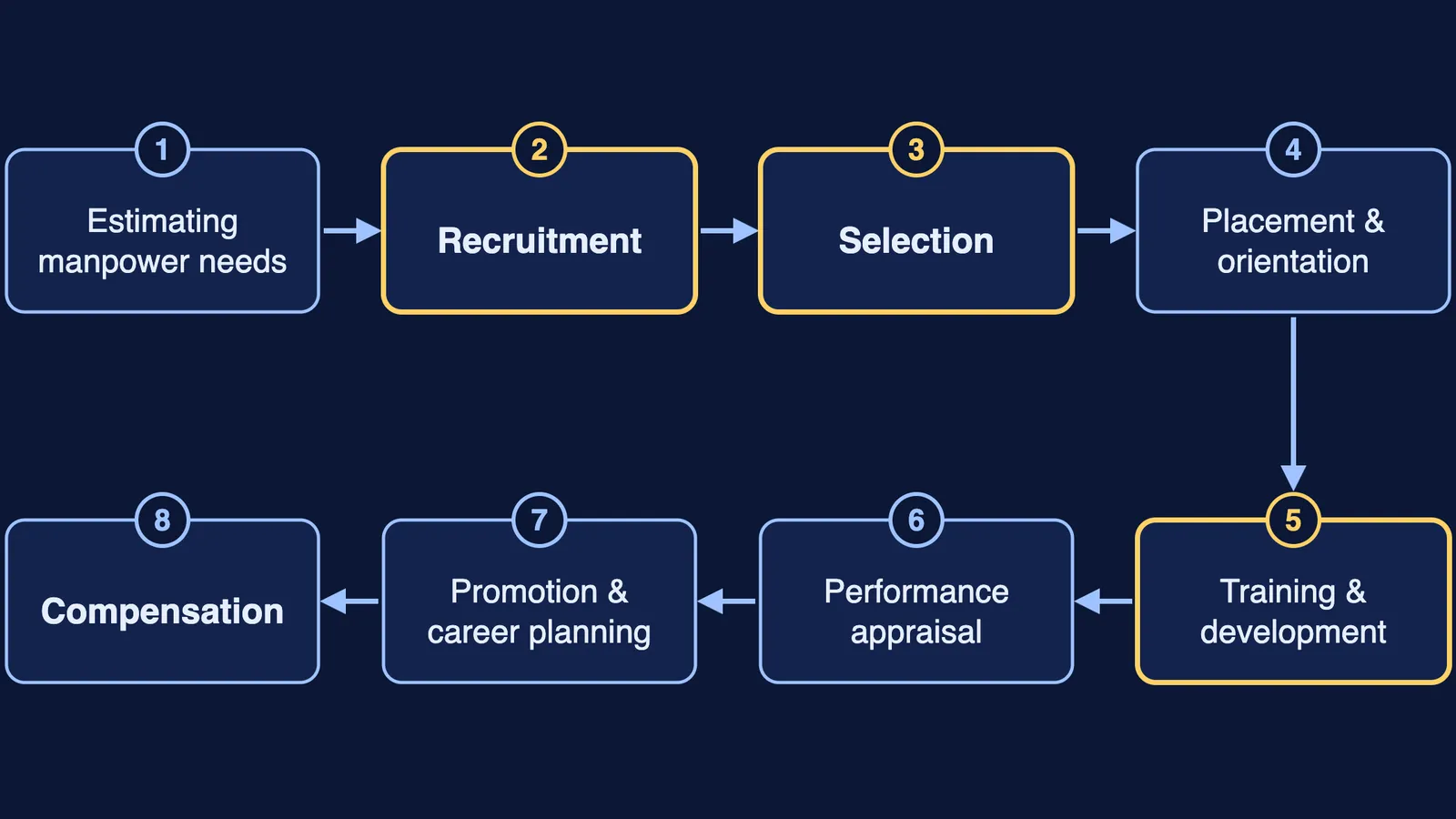
The NCERT chapter defines staffing as the management function of filling, and keeping filled, the positions in an organisation's structure. Its process has eight steps, in this order:
Estimating manpower requirements: how many people, with what skills, the structure needs.
Recruitment: searching for likely candidates and encouraging them to apply.
Selection: choosing from the pool that recruitment created.
Placement and orientation: the new employee takes up the post and is introduced to colleagues, rules and policies.
Training and development.
Performance appraisal.
Promotion and career planning.
Compensation: every form of pay or reward.
A hook: steps 1 to 4 get the right person in; steps 5 to 8 help them grow and stay.
What are the internal and external sources of recruitment?
The NCERT chapter names two internal sources. A transfer moves an employee to another job, department or shift without a real change in status or responsibility, a sideways move. A promotion moves an employee up to a post with more responsibility, status and pay.
Internal recruitment motivates staff, costs less and is more reliable, since the firm knows the candidate. But it brings in less fresh talent, and a brand-new business cannot use it.
External sources in the chapter are direct recruitment (a notice at the gate and selection on the spot, used for casual work), casual callers, advertisements, employment exchanges, placement agencies and management consultants, campus recruitment, recommendations of employees, labour contractors, television advertising and web publishing. They offer wider choice and fresh talent but cost more, take longer and can upset staff hoping for promotion.
What are the steps in the selection process?
The NCERT chapter gives eight steps:
Preliminary screening of application forms
Selection tests
Employment interview
Reference and background checks
Selection decision
Medical examination
Job offer
Contract of employment
Remember it as eight verbs: screen, test, talk, check, decide, examine, offer, sign. The medical comes after the decision, before the offer.
The chapter lists five tests: intelligence, aptitude, personality, trade and interest tests.
How do training methods differ, and how do you spot them in a case?
On-the-job methods mean learning while doing; off-the-job methods mean learning before doing, away from the workplace. Training is short-term and job-focused; development is ongoing and career-focused, and includes training.
Cues for labelling a case quickly:
Workers learn on the same equipment they will use, in a room set up away from the shop floor: vestibule training (off-the-job).
A trainee works under a master electrician for a fixed period: apprenticeship (on-the-job).
A college and a firm cooperate, and the student studies and works in an office: internship training (on-the-job).
The candidate must pass a fitness test before the offer letter: medical examination (selection step 6).
A worked case. A company is opening its first plant and needs machine operators who have never used its equipment. Which source of recruitment, and which training method?
It must use external sources, because a new enterprise has no existing staff to promote or transfer. Vestibule training fits: operators learn on the same equipment, away from the real work floor, which the chapter ties to handling sophisticated machinery. In your answer, name both, then quote one line of the case for each.
How should you revise Staffing this week?
Write the three lists from memory, then check them against the NCERT summary. For case practice, our guide on asking AI which management principle a case shows uses an approach you can apply to staffing cases too. Shaky on Unit 2? Revisit Fayol's and Taylor's principles of management. For Part B, start with financial management and capital structure.
If Mathematics is in your subject list too, the Fermi Problem Library has worked problems with a step-by-step solver that explains the reasoning rather than printing an answer.