

On this page
Chapter 9 of Class 12 Business Studies keeps asking one question: where does a company's money come from, and where should it go? Learn the three decisions and why borrowing can raise or cut a shareholder's earnings, and the rest of the chapter fits.
What does financial management mean in Class 12?
The NCERT Business Studies Part II textbook, Chapter 9 says financial management is concerned with the optimal procurement and usage of finance. Its primary aim, in NCERT's words, is to maximise shareholders' wealth, which shows up as a higher market price of the company's equity shares.
In the CBSE Business Studies curriculum for 2026-27, Unit 9 Financial Management and Unit 10 Financial Markets carry 15 marks together in an 80-mark theory paper. Unit 9 covers the three financial decisions, financial planning, capital structure, and fixed and working capital.
What are the three financial decisions?
NCERT groups a finance manager's work into three decisions. Learn each with its factors; examiners ask for factors as often as meanings.
Investment decision: where the firm's funds are invested. Long-term investment is called capital budgeting (a new machine, a new branch); short-term investment is working capital. Factors: cash flows of the project, rate of return, and the investment criteria involved.
Financing decision: how much to raise from each long-term source, mainly shareholders' funds or borrowed funds. Factors: cost, risk, floatation cost, cash flow position, fixed operating costs, control considerations, and the state of the capital market.
Dividend decision: how much of the profit after tax goes to shareholders and how much is kept as retained earnings. Factors include earnings and their stability, growth opportunities, cash flow position, shareholders' preference, taxation, and legal and contractual constraints.
What is capital structure, and when does debt raise EPS?
Capital structure is the mix of owners' funds and borrowed funds, measured as Debt/Equity or Debt/(Debt + Equity), according to NCERT Chapter 9. Debt is cheaper than equity because lenders take less risk and interest is tax-deductible. It is also riskier for the firm, because interest and repayment are compulsory.
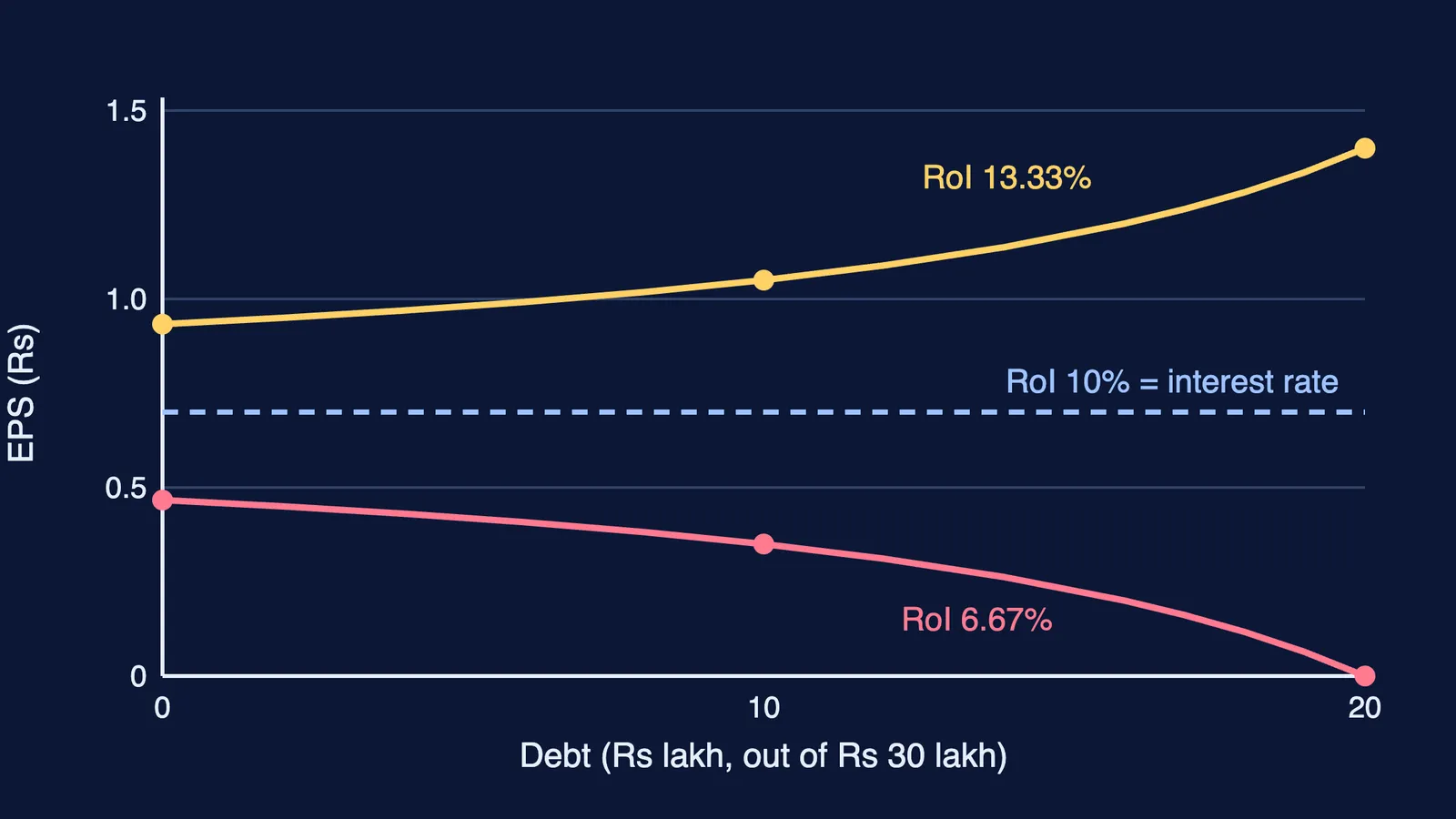
NCERT's own example shows the trade-off. Company X uses Rs 30 lakh of funds and earns Rs 4 lakh before interest and tax (EBIT). Debt costs 10% a year and the tax rate is 30%.
With no debt, EPS is Rs 0.93.
With Rs 10 lakh of debt, EPS rises to Rs 1.05.
With Rs 20 lakh of debt, EPS rises to Rs 1.40.
EPS rises because Company X's return on investment, 4 lakh divided by 30 lakh, is 13.33%, which is more than the 10% it pays on debt. NCERT calls the practice of using more of this cheaper debt to raise EPS trading on equity.
Now keep everything the same but cut EBIT to Rs 2 lakh (Company Y). Return on investment falls to 6.67%, below the cost of debt, and EPS falls from Rs 0.47 to Rs 0.35 and then to nil as debt rises. Trading on equity only pays when return on investment beats the interest rate.
Which factors affect the choice of capital structure?
NCERT lists 14 factors. They are easier to recall in four groups:
Can we pay? Cash flow position, interest coverage ratio (EBIT/Interest), debt service coverage ratio.
Is debt worth it? Return on investment, cost of debt, tax rate, cost of equity.
What does it cost or risk? Floatation costs, risk consideration (business risk plus financial risk), flexibility.
What around us matters? Control, regulatory framework, stock market conditions, capital structure of other companies.
If you want to see how a commerce case question is read for clues, our guide on asking AI which management principle a case shows uses the same habit of quoting the line that proves your answer.
How should you answer a capital structure question in the board exam?
Use this four-step checklist on any case or long-answer question:
Name the decision (investment, financing or dividend) and quote the line from the case that shows it.
If numbers are given, compare return on investment with the interest rate before saying anything about debt.
Name each factor in NCERT's words, then explain it in one sentence tied to the case.
End with the conclusion the case asks for: more debt, less debt, or a dividend change.
If you are not sure where to begin with the chapter, Fermi's AI tutor can work out what you already know and build a plan for the session.
Thinking beyond the board exam? Our explainer on careers after commerce, from CA to management helps you talk options through with your family.


