

On this page
Principles of management is Chapter 2 of the Class 12 NCERT Business Studies book (Part 1). In the CBSE Business Studies syllabus for 2026-27, Units 1 to 3 (nature and significance of management, principles of management and business environment) together carry 16 of the 80 theory marks. The syllabus asks you to discuss Fayol's principles, explain Taylor's principles and techniques, and compare the two.
What are principles of management in Class 12?
The NCERT chapter on principles of management defines them as "general guidelines, which can be used for conduct in work places under certain situations." NCERT adds that they are not as rigid as the principles of pure science, because they deal with human behaviour and must be applied creatively to each situation.
What are Fayol's 14 principles of management?
Henri Fayol (1841-1925) was a French mining engineer whose book appeared in English as General and Industrial Management in 1949, according to the NCERT textbook. The 14 principles, in NCERT's order:
Division of work
Authority and responsibility
Discipline
Unity of command
Unity of direction
Subordination of individual interest to general interest
Remuneration of employees
Centralisation and decentralisation
Scalar chain
Order
Equity
Stability of personnel
Initiative
Esprit de corps
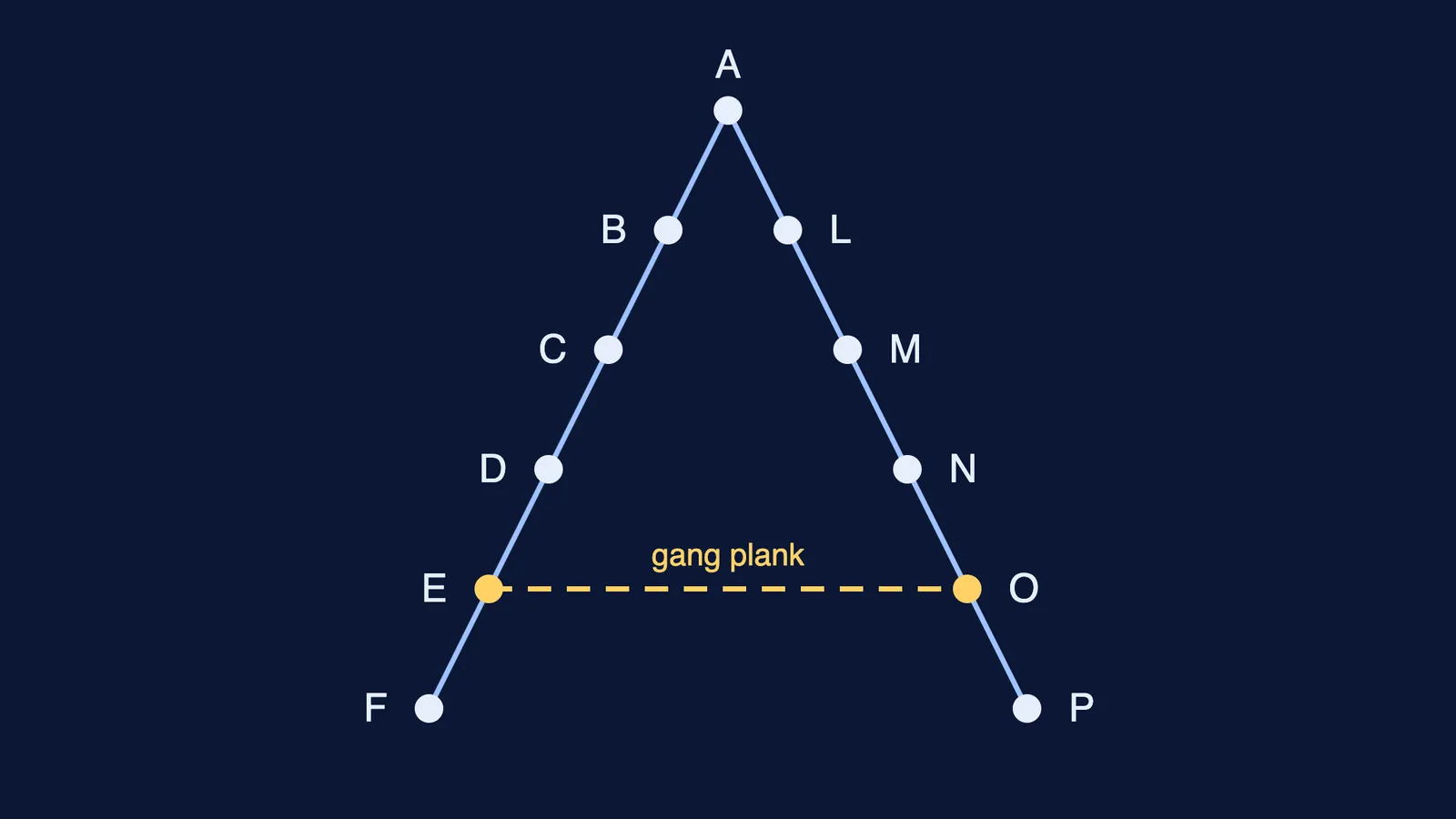
Two pairs cause most mistakes. Unity of command means one employee takes orders from only one boss; unity of direction means each group of activities with the same objective has one head and one plan. Scalar chain is the formal line of authority from top to bottom, and the gang plank (the dashed line in the diagram above) lets two people at the same level talk directly in an emergency.
What are Taylor's principles of scientific management?
F.W. Taylor (1856-1915) was an American mechanical engineer whom the NCERT chapter calls the father of scientific management. In The Principles of Scientific Management (1911), Taylor summed up his system in five lines: "Science, not rule of thumb. Harmony, not discord. Cooperation, not individualism. Maximum output, in place of restricted output. The development of each man to his greatest efficiency and prosperity."
A short memory aid is Smart Hands Can Make Difference: Science, Harmony, Cooperation, Maximum output, Development.
The NCERT chapter then lists his techniques:
Functional foremanship: eight specialists, four for planning and four for production, each instructing the worker in their area
Standardisation and simplification of work
Method study, motion study, time study and fatigue study
Differential piece wage system
How does Taylor's differential piece wage work?
This worked example comes from the NCERT chapter itself. The standard is 10 units a day. A worker who meets it is paid Rs 50 a unit; one who falls short is paid Rs 40 a unit.
Efficient worker, 11 units: 11 x 50 = Rs 550 a day.
Inefficient worker, 9 units: 9 x 40 = Rs 360 a day.
Gap: 550 - 360 = Rs 190, which Taylor saw as enough to push the slower worker to improve.
How is Fayol different from Taylor?
The comparison table in the NCERT textbook is worth learning in this compact form:
Perspective: Fayol looks from top management; Taylor from the shop floor.
Unity of command: Fayol was a firm supporter; Taylor's functional foremanship gave each worker eight bosses.
Basis: Fayol drew on personal experience; Taylor on observation and experiment.
Focus: Fayol on overall administration; Taylor on productivity.
NCERT stresses that the two are complementary, not rivals.
How do you answer a case question on principles of management?
Use the same four steps every time:
Underline the line in the case that shows the problem.
Name the principle in full.
Say whether it is followed or violated.
Quote the case words as your proof.
Example from the NCERT chapter: the marketing manager allows a salesperson a 10% discount, but the finance department says no more than 5%. Answer: unity of command is violated, because one employee receives orders from two superiors ("marketing manager" and "finance department").
For more practice, read our guide to answering case-based questions in CBSE board exams, and see how to ask AI which management principle a case shows, and check its proof. If a mnemonic will not stick, the memory palace technique works for any long list.
If you also take maths in Class 12 and do not know where to start revising it, Fermi's AI tutor can work out what you already know and build a plan for the session, so you sit down to a clear next step.
Tonight, write the Fayol sentence from memory, expand each word into its principle, and check it against the list above.


