On this page
You probably learnt (a − b)² = a² − 2ab + b² as a line to memorise. One square of paper and a pair of scissors show where every term comes from, and why the common wrong answer, a² − b², cannot be right.
Why does (a − b)² equal a² − 2ab + b²?
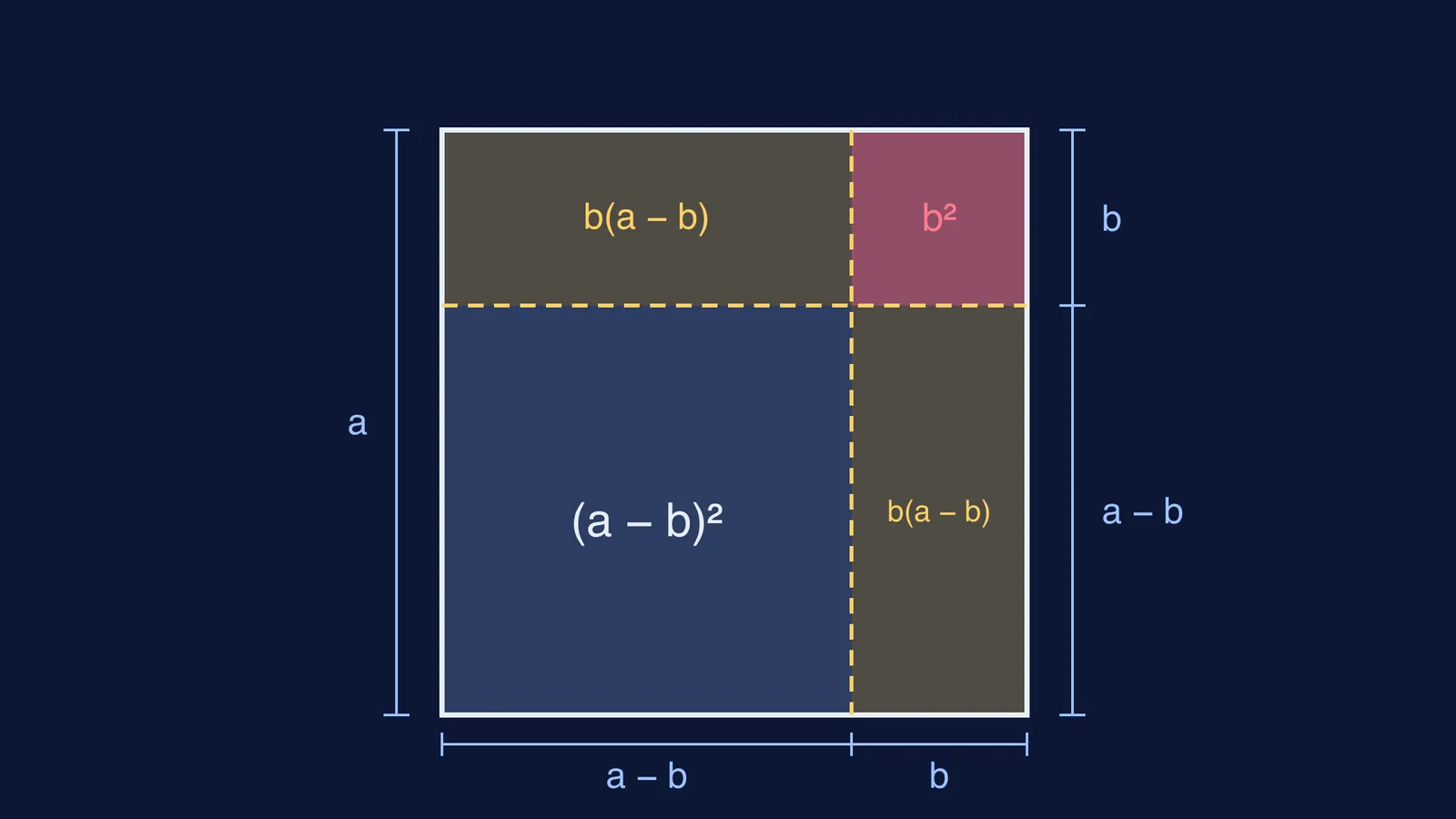
Start with a square of side a, area a². To reach the smaller square of side a − b in one corner, remove a strip of width b along the top and another down the right side.
Each strip is a long and b wide, so each has area ab. Take both away: a² − 2ab. But the small b × b square at the top-right corner was inside both strips, so you removed it twice. Add it back once: + b².
That gives (a − b)² = a² − 2ab + b². The + b² is the corner you cut away one time too many.
This is old geometry. Euclid's Elements, Book II, Proposition 7 says that the square on a whole line plus the square on one piece equals twice the rectangle of the whole and that piece plus the square on the remaining piece, which in modern symbols is x² + z² = 2xz + (x − z)² (Euclid's Elements, Book II, Proposition 7, D. E. Joyce, Clark University). Move 2xz to the other side and you have our identity. Its partner, Proposition 4, is the plus version, (y + z)² = y² + z² + 2yz (Euclid's Elements, Book II, Proposition 4).
The Fermi Concept Library gives every concept in mathematics its own lesson and its place in the map, so you can see how this identity connects to its neighbours.
How do you prove a minus b whole squared with a paper square?
You need a sheet of paper, a ruler, a pencil, scissors and two colours. Take a = 10 cm and b = 3 cm.
Cut out a square 10 cm by 10 cm. Its area is 100 cm², which is a².
Draw a line 3 cm below the top edge and another 3 cm in from the right edge.
Shade the top strip in one colour and the right strip in the other. The 3 cm by 3 cm top-right corner gets both colours.
Measure the unshaded square at the bottom left. It is 7 cm by 7 cm, so its area is 49 cm².
Now do what the identity says: 100 − 30 − 30 + 9 = 49. It matches.
Cut along both lines. You get the 7 × 7 square, two 7 × 3 pieces and the 3 × 3 corner. Check: 49 + 21 + 21 + 9 = 100.
Why do students write a² − b², and how do you catch it?
The slip a² − b² comes from treating squaring as if it spreads over subtraction. It does not: (a − b)² means (a − b) × (a − b), and that product has four pieces, not two.
Your paper square shows the damage. With a = 10 and b = 3, a² − b² gives 91 cm², but the square you measured is 49 cm². The other slip, a² − 2ab − b², gives 31 cm².
Here is a three-second check for the margin of any test. Put a = 3 and b = 1:
The real value: (3 − 1)² = 2² = 4.
The correct expansion: 9 − 6 + 1 = 4.
The wrong one: 9 − 1 = 8.
The paper needs a bigger than b, but the identity holds for all numbers: try a = 1, b = 3.
How can you use the identity in an exam?
Three places it saves time:
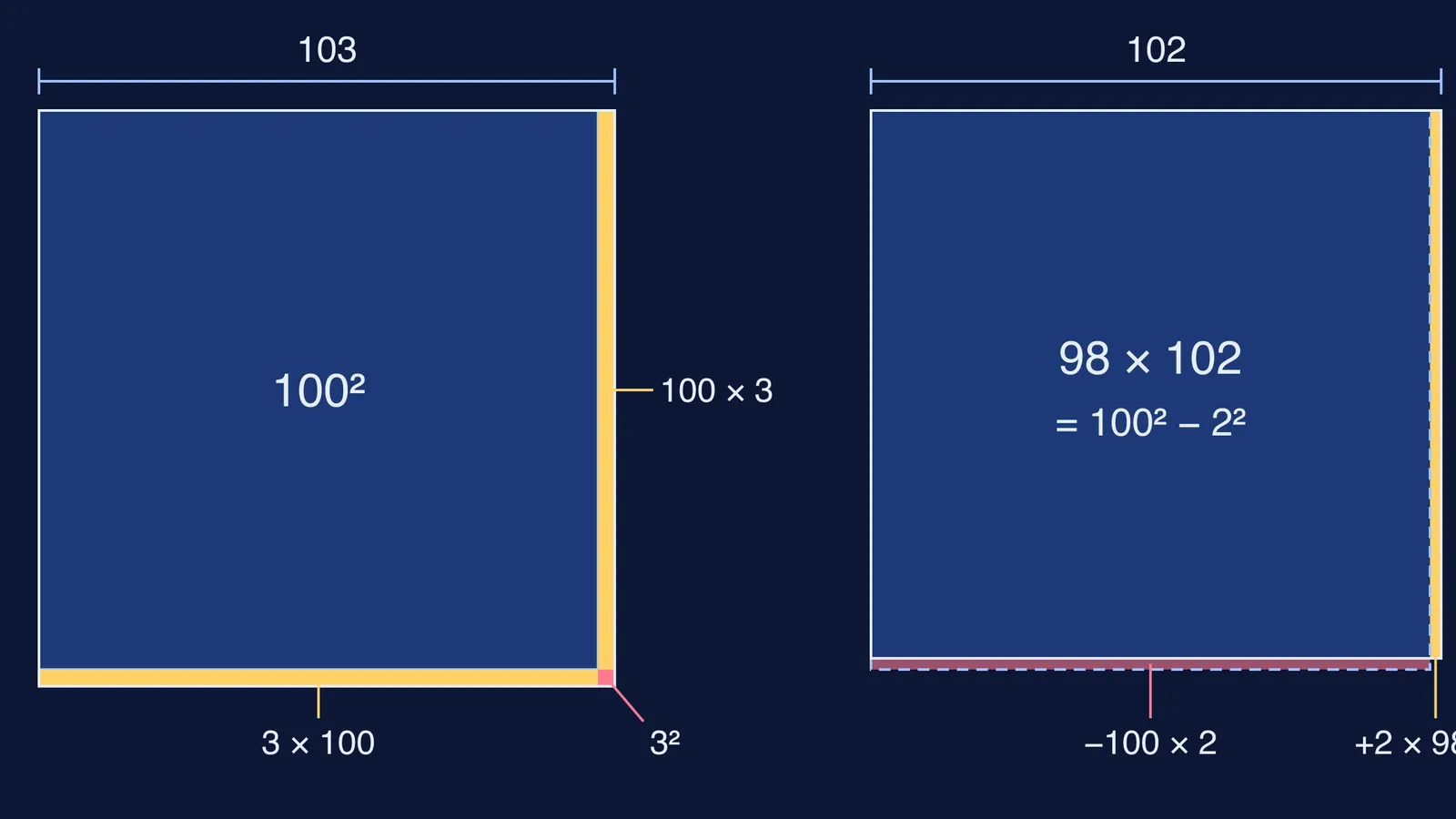
Mental squares: 98² = (100 − 2)² = 10000 − 400 + 4 = 9604.
Expanding with coefficients: (2x − 3y)² = 4x² − 12xy + 9y². Square the whole term, so 3y becomes 9y², not 3y².
Reading it backwards: x² − 10x + 25 = (x − 5)². Our guide to factorising a perfect square trinomial walks through how to spot this shape.
Before you move on from any expansion, run this checklist:
Is the middle term twice the product of the two terms, with a minus sign?
Is the last term positive?
Did you square the whole first and last terms, numbers included?
Does a = 3, b = 1 give the same number on both sides?
If your mistakes are in the method, the Fermi Problem Library has worked problems with a step-by-step solver that explains the reasoning rather than printing an answer, so you can see the exact line where a sign flipped.
For the rest of the set, see our walkthrough of Class 8 algebraic identities. Parents can try how to explain algebra identities to a teenager with pictures.
Cut one square tonight, and you will not need to memorise the sign again.