

On this page
When teenagers encounter algebraic identities in Class 8 and Class 9, many treat them as arbitrary strings of letters. The most common mistake in secondary algebra is assuming (a + b)² = a² + b². In a study of 565 Algebra I students in *The Journal of Problem Solving*, Julie L. Booth and colleagues found that algebraic misconceptions persist across the school year and predict lower standardized test scores. Memorising formulas by rote makes the middle term 2ab feel like an unnecessary hurdle.
If you are already helping with maths you have forgotten or wondering what to do when your child says they are bad at maths, paper cutouts provide a visual anchor that replaces memorisation with logic.
Why do teenagers drop the middle term in algebraic identities?
Algebraic notation is compact, but that compactness obscures geometry. Because multiplication distributes across addition—as in 2(a + b) = 2a + 2b—students intuitively assume exponents behave identically. Cognitive researchers call this universal linearisation: assuming every mathematical operation is linear. Students recall that (ab)² = a²b² and apply that pattern to sums. Anchoring algebra in geometry makes dropping 2ab as visibly absurd as building a square room and omitting two walls.
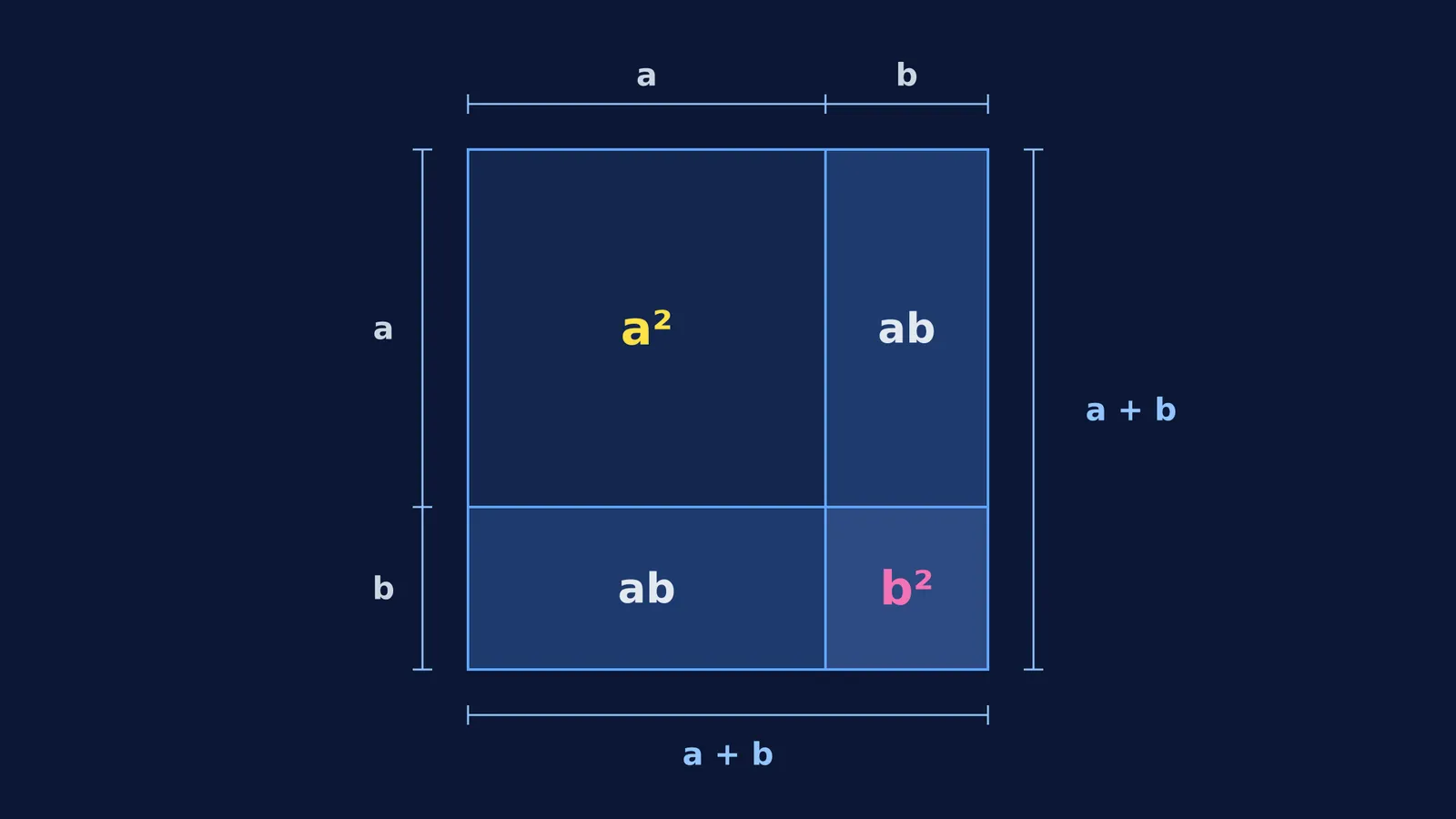
How do paper squares prove that (a + b)² = a² + 2ab + b²?
To show why (a + b)² requires 2ab, cut out four paper pieces:
One square with side a (area = a²).
One square with side b (area = b²).
Two rectangles with length a and width b (area = ab each).
Place the a × a square at top-left, the two ab rectangles along its right and bottom edges, and the b × b square at bottom-right. Together, they form a large square with side (a + b) and area (a + b)². Because the large square comprises these four regions, its area equals their sum: a² + ab + ab + b² = a² + 2ab + b².
This tactile approach follows the Concrete-Representational-Abstract (CRA) model. In a study of 34 matched student pairs in *Learning Disabilities Research & Practice*, Bradley S. Witzel, Cecil D. Mercer, and M. David Miller found that students taught through CRA made significantly fewer procedural errors in algebra than peers receiving abstract instruction alone.
Classroom trials show similar gains. In a study of 56 junior high school students in the *Journal of Education and Practice*, Ernest Larbi and Mavis Okyere reported that students using visual algebra tiles achieved a post-test mean of 32.16 compared to 20.35 for lecture-taught peers. On factorisation questions, the visual group averaged 3.96 out of 5, while the control group averaged 0.84.
How can you show (a − b)² and (a + b)(a − b) with visual models?
Geometric reasoning clarifies other identities as well:
The difference square, (a − b)² = a² − 2ab + b²: Start with an a × a square. To find the inner square of side (a − b), subtract a strip of area ab from the right and another from the bottom. Because the corner b² was removed in both strips, you must add one b² back to correct the overlap.
The difference of two squares, (a + b)(a − b) = a² − b²: Start with an a × a square and cut out a b × b corner. The remaining L-shaped region splits into two rectangles, (a − b) × a and (a − b) × b, which join end-to-end to form a single rectangle of length (a + b) and width (a − b).
To use this in exams, encourage sketching a 2×2 grid. A study of 113 pupils in the *Journal of Education and Teaching Methods* by Ambrose Kombat and colleagues demonstrated that visual multiplication frames significantly improved binomial expansion performance over traditional methods.
On the Fermi Simulation Lab, students can explore interactive simulations for ideas that are easier to see than to read, while the Fermi Concept Library provides lessons across mathematics and science with each concept in its place on the map.
How can parents guide a kitchen table algebra session?
Guiding your teenager works best when you prompt discovery rather than lecturing, similar to helping your child with maths word problems:
Test numbers first: Ask whether (5 + 3)² equals 5² + 3² for a = 5 and b = 3. Calculating 8² = 64 versus 25 + 9 = 34 reveals the missing 30 immediately.
Assemble the pieces: Have them draw four sections with sides 5 and 3. The areas (25, 9, and two rectangles of 15) add to 64, proving the missing 30 comes from the two 5 × 3 rectangles.
Apply mental maths: Show how identities speed up arithmetic: 103² = (100 + 3)² = 10,000 + 600 + 9 = 10,609.
For students seeking step-by-step guidance on complex exercises, the Fermi Problem Library offers worked problems with a step-by-step solver that explains the reasoning rather than printing an answer.


