

On this page
The CBSE Physical Education curriculum for 2026-27 lists Sports and Nutrition as Class 12 Unit 5, worth 7 of the 70 theory marks.
What does Sports and Nutrition cover in Class 12?
The CBSE curriculum lists five topics:
Concept of balanced diet and nutrition
Macro and micro nutrients: food sources and functions
Nutritive and non-nutritive components of diet
Eating for weight control: a healthy weight, the pitfalls of dieting, food intolerance and food myths
Importance of diet in sports: pre, during and post competition requirements
What are macro and micro nutrients?
Macronutrients are carbohydrates, proteins and fats, eaten in grams. In ICMR-NIN's My Plate for the Day, protein supplies 15% and fat 30% of the day's energy.
Micronutrients are vitamins and minerals, needed in much smaller amounts. The ICMR-NIN Dietary Guidelines for Indians booklet names green leafy vegetables for vitamins and minerals, and legumes for protein, fibre and folic acid.
Non-nutritive components, such as fibre (roughage) and water, give little or no energy but still matter. The WHO healthy diet fact sheet says everyone older than 10 should aim for at least 25 g of dietary fibre a day; here is what roughage does in your body.
What does a balanced diet look like on an Indian plate?
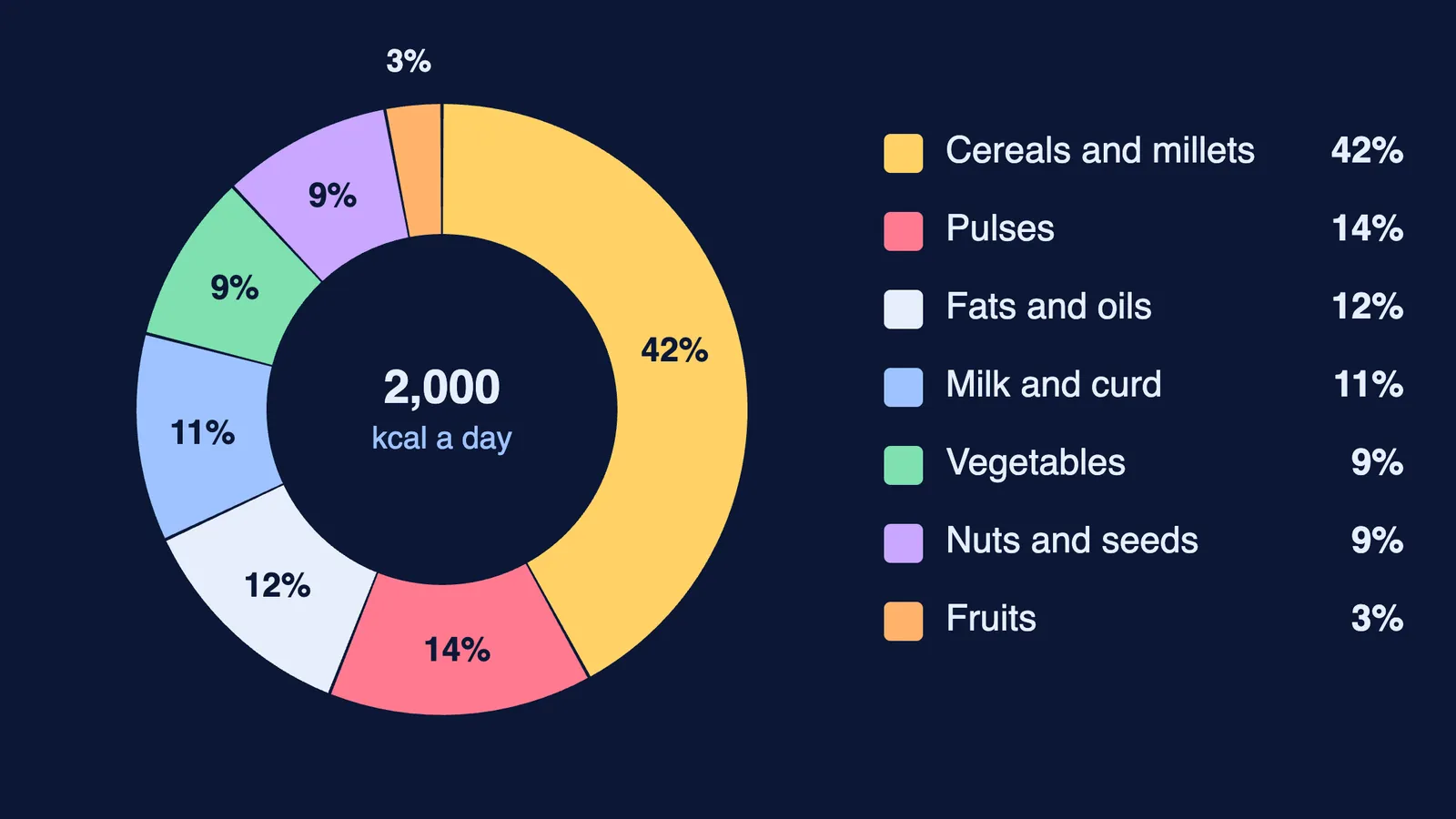
The ICMR-NIN plate sets out a reference day of about 2,000 kcal in raw weights:
Cereals and millets: 250 g, 42% of energy
Pulses (eggs, fish or meat can replace part): 85 g, 14% of energy
Milk or curd: 300 ml, 11% of energy
Vegetables and green leafy vegetables: 400 g, 9% of energy
Fruits: 100 g, 3% of energy
Nuts and seeds: 35 g, 9% of energy
Fats and oils: 27 g, 12% of energy
The sheet limits sugar to 25 to 30 g a day and says the plan is not for any specific medical condition; the Dietary Guidelines booklet adds that amounts depend on age, sex and activity. The WHO fact sheet adds at least 400 g of fruit and vegetables a day for everyone over 10, and under 5 g of salt for adults.
How do you answer weight-control and food-myth questions?
The Dietary Guidelines booklet discourages indiscriminate dieting in children and adolescents and warns that extreme approaches to weight loss may lead to health hazards. Four myths it and the ICMR-NIN plate answer:
"Athletes need protein powder." Most athletes can get enough protein by choosing foods well; the booklet calls powders unnecessary for normal healthy life.
"Tablets can replace meals." The plate says no vitamin or mineral supplement matches its nutrient adequacy.
"Health drinks are healthy." The booklet lists them among high fat, sugar or salt foods to restrict.
"Soft drinks replace water." They are not substitutes, and the booklet suggests buttermilk, coconut water or lemon water in hot weather.
A suspected food intolerance is for a doctor to confirm. For packaged snacks, see reading a nutrition label in India, line by line.
What is the role of diet before, during and after competition?
These ISSN figures describe healthy exercising adults and trained athletes, so they are reference values, not personal targets.
Before: a familiar cereal-and-pulse meal, eaten well ahead. The Dietary Guidelines booklet says a 3:1 cereal-to-pulse mix improves protein quality.
During: the International Society of Sports Nutrition (ISSN) position stand on nutrient timing advises about 30-60 g of carbohydrate per hour, as a 6-8% carbohydrate-electrolyte drink sipped every 10-15 minutes, for high-intensity exercise lasting over 60 minutes. Here is why sports drinks contain salt and sugar.
After: for fast glycogen restoration with under 4 hours to recover, the same paper lists 1.2 g of carbohydrate per kg per hour. The ISSN protein position stand gives 0.25 g of high-quality protein per kg per serving, every 3-4 hours, and suggests focusing on whole foods.
Worked example: scaling per-kg figures. Take a hypothetical 55 kg adult athlete playing two 90-minute matches in a day. Using the ISSN figures:
During each match: 30-60 g of carbohydrate per hour works out to about 45-90 g across 90 minutes.
Between matches: 1.2 x 55 = 66 g of carbohydrate per hour of recovery. The ICMR-NIN table gives about 172 g of carbohydrate in 250 g of raw cereal, so 66 g matches roughly 96 g of raw cereal.
Protein: 0.25 x 55 = about 14 g per serving.
This shows the arithmetic, not a plan. For a personal plan, the joint position of the Academy of Nutrition and Dietetics, Dietitians of Canada and the American College of Sports Medicine says athletes should be referred to a registered dietitian nutritionist. With a health condition, ask your doctor first.
How do you revise this unit quickly?
Define macro and micro nutrients, with food sources.
Sketch the My Plate split from memory.
Rebut two food myths.
Write the three-window competition plan with one number per window.
If the biology underneath is shaky, the Fermi Concept Library has every concept in biology and chemistry, each with its own lesson and its place in the map.
Start with the plate: if you can draw it, most of Unit 5 follows.


