

On this page
Picture a Saturday football match in April in Nagpur. Ninety minutes in, your shirt is soaked and you reach for a bottle. If it is a sports drink, the label lists two odd ingredients for a thirst-quencher: sodium and sugar. Both trace straight back to your biology chapters on osmosis and respiration.
What does sweat take out of your body?
Sweat is not just water. A 2017 review of sweat testing in athletes by Lindsay Baker reports that whole-body sweating rates typically run from about 0.5 to 2.0 litres per hour.
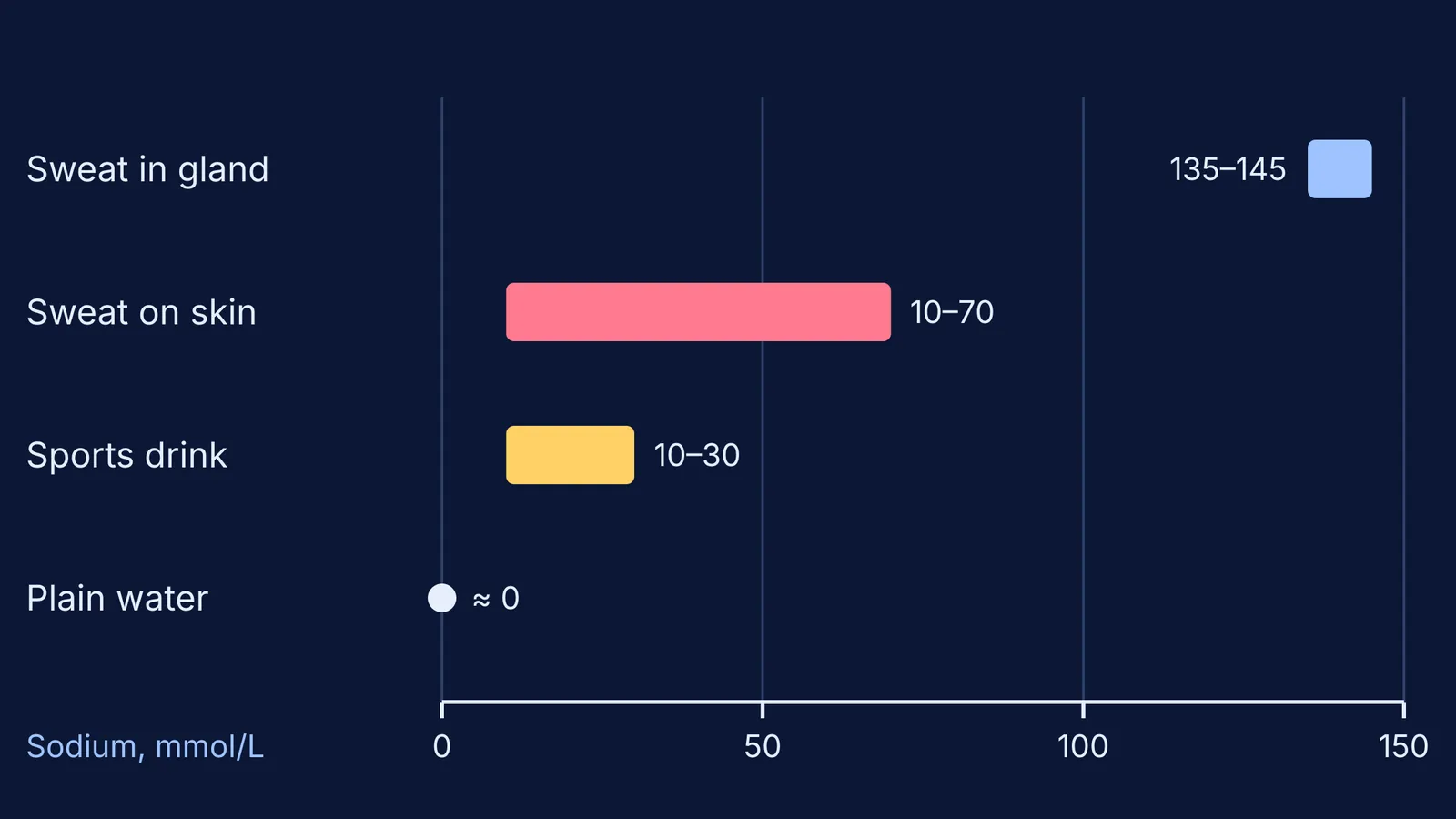
The same review explains that the fluid first made in a sweat gland is close to blood plasma, with about 135–145 mmol/L of sodium. As it travels up the duct, the duct cells pull much of that sodium back, so the sweat that reaches your skin is diluted: whole-body sweat carries roughly 10–70 mmol/L of sodium.
The range is wide because people differ in heat acclimation, training, diet and exercise intensity. Our explainer on why we sweat when we exercise covers the cooling side.
Why do sports drinks contain salt?
If you lose both water and sodium but replace only water, you put back the solvent without the solute. Sodium is the main solute in the fluid outside your cells, so it strongly affects which way water moves by osmosis. Put back some sodium, and the water you drink is more likely to stay in your body fluids.
The Australian Institute of Sport's sports drink guide gives the target composition as 4–8% carbohydrate and 10–30 mmol/L sodium. It also notes that the sodium helps keep up your thirst drive, so you keep drinking.
Notice that 10–30 mmol/L sits at the low end of what sweat contains. Sports drinks top you up; they do not replace everything. The AIS guide notes that lower sodium makes a drink taste better. A drink saltier than your body fluids would pull water the wrong way, the same osmosis problem behind why we cannot drink sea water.
How does sugar help your gut absorb salt and water?
Cells lining your small intestine carry a transport protein called SGLT1. A 2020 study in Scientific Reports by Vittoria Buccigrossi and colleagues describes SGLT1 as a pump that carries two sodium ions and one glucose molecule across the cell membrane together.
So glucose brings sodium into the gut cells with it, and as these solutes move, water follows by osmosis. The idea that sodium and glucose cross together was first proposed by Crane in 1960, as a review in Physiological Reviews by Ernest Wright and colleagues recounts. It is the same principle behind oral rehydration solution; our worked example on the molarity of glucose and salt in WHO ORS runs the numbers.
If osmosis still feels abstract, the Fermi Simulation Lab has interactive simulations for ideas that are easier to see than to read.
Where does the sugar go after that?
Once absorbed, glucose travels in the blood to your muscles, where cellular respiration breaks it down to make ATP, the molecule that powers contraction. Muscles also keep a store of glucose as glycogen. A 2019 review in Nutrients by Fernando Mata and colleagues notes that glycogen depletion is considered an important limiting factor of performance.
For exercise lasting 1–2.5 hours, the Australian Institute of Sport suggests 30–60 g of carbohydrate per hour. For hard sessions of 45–75 minutes, it suggests only small amounts, even just rinsing the drink around your mouth.
Worked example: how much salt does a match cost you?
Use the figures above to estimate one 90-minute match. Assume a sweat rate of 1.0 L per hour and sweat sodium of 40 mmol/L, both inside the ranges in the Baker review.
Sweat lost: 1.0 L/h × 1.5 h = 1.5 L.
Sodium lost: 1.5 L × 40 mmol/L = 60 mmol.
In grams: 60 mmol × 23 mg/mmol = about 1.4 g of sodium, the sodium in about 3.5 g of table salt (60 mmol × 58.5 mg/mmol).
One litre of a drink with 20 mmol/L sodium puts back 20 mmol, about a third.
Sugar: 750 mL of a 6% drink holds 45 g of carbohydrate, or 30 g per hour across the match, the low end of the AIS range.
So when is water enough?
The AIS guide says sports drinks are not needed at every training session, and warns about extra energy intake and dental erosion. A quick checklist:
Short or easy sessions, such as a PE period or a walk: water.
Over an hour of hard, sweaty exercise, especially in heat: a sports drink can help with both fluid and fuel.
Protect your teeth: use a straw or squeezy bottle, rinse with water afterwards, and wait at least 30 minutes before brushing.
Diarrhoea, vomiting, dizziness or confusion in the heat: this is not a sports-drink problem. Tell an adult and get medical help.
To revise osmosis and respiration together, the Fermi Concept Library has a lesson for every concept in biology and chemistry.


