On this page
Ask why a motor has a split ring and many students say "to reverse the current". True, but that is half an answer. A full answer also says what goes wrong without it and when the reversal happens. Here is one coil through a full turn, then the exam answer.
What does a split ring commutator do in an electric motor?
A split ring commutator is a rotary switch in a DC motor that reverses the current through the coil every half turn to keep it rotating (Physics Teacher blog). It is a ring cut into two halves, each joined to one end of the coil, with two fixed carbon brushes pressing on it to connect it to the DC supply (Mini Physics).
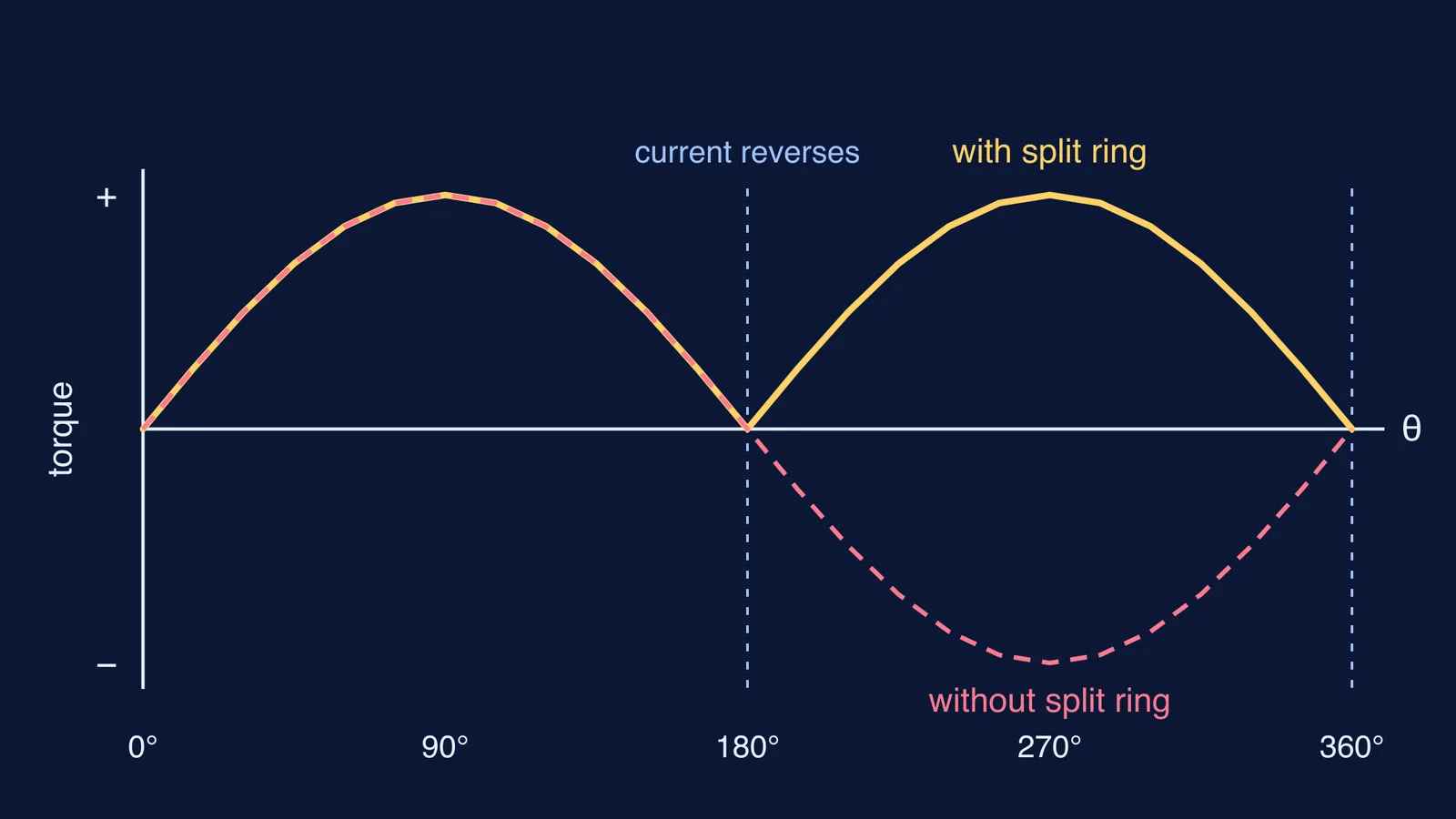
Why flip the current? The turning effect on a coil in a magnetic field is τ = NIAB sin θ, where θ is the angle between the field and the line perpendicular to the coil (OpenStax College Physics 2e). The torque is largest when θ is 90° and zero when θ is 0°, which is when the coil stands upright, facing the magnet's poles.
What would happen to the coil without the split ring?
Join the coil straight to a battery and the force on each side always points the same way. Once the coil swings past upright, sin θ turns negative and those same forces turn it back. OpenStax puts it plainly: "unless we do something, the coil will oscillate back and forth about equilibrium at θ=0" (OpenStax College Physics 2e). Friction does the rest: the coil makes a partial turn, rocks, and stops upright (Mini Physics).
How does one full rotation work, step by step?
Picture a coil ABCD with a north pole on the left and a south pole on the right. Apply Fleming's left-hand rule at each step.
Start, coil flat (θ = 90°). Side AB is on the left with current coming towards you; side CD is on the right with current going away. AB is pushed up and CD is pushed down. The coil turns clockwise with the largest torque.
Quarter turn, coil upright (θ = 0°). Both forces still act, but their lines pass through the axle, so the turning effect is zero (Mini Physics). The gaps in the ring sit under the brushes, so the current is briefly cut and the coil's momentum carries it through (Physics Teacher blog).
Just past upright. The two halves of the ring have swapped brushes, which reverses the current in the coil as it passes the upright position (Mini Physics). AB is now on the right with current going away, so it is pushed down. CD is now on the left with current coming towards you, so it is pushed up. Still clockwise.
Three-quarter turn, coil flat (θ = 90°). Maximum torque again, still clockwise.
Full turn, coil upright. The halves swap back, the current returns to its first direction, and the cycle repeats.
If the directions tangle, our guide to Fleming's left-hand and right-hand rules sorts out which hand goes with which device. Step 3 is easier to believe once you watch it: the Fermi Simulation Lab has interactive simulations for ideas that are easier to see than to read, and our DC motor simulation post follows a coil and its torque.
How do you write the three-mark answer?
Check your syllabus first. The Cambridge IGCSE Physics (0625) syllabus for 2026 to 2028 asks students, in its Supplement content, to "describe the operation of an electric motor, including the action of a split-ring commutator and brushes" (Cambridge International). The current NCERT Class 10 chapter, Magnetic Effects of Electric Current (2026-27 reprint), names the electric motor only as a device and does not explain how it works (NCERT), so CBSE students should ask their teacher whether it is examined.
Question: Why is a split ring commutator used in an electric motor? (3 marks)
Model answer:
The split ring commutator reverses the direction of current in the coil after every half rotation, as the coil passes the position perpendicular to the magnetic field.
Without it, the forces on the coil's sides would keep their direction, so after half a turn they would turn the coil back; it would rock and stop.
Because the current is reversed, the forces given by Fleming's left-hand rule keep turning the coil in the same direction, so the motor rotates continuously.
Check your own answer:
Did you say when the current reverses (every half turn, at the upright position)?
Did you say what would happen without it?
Did you name the result: continuous rotation in one direction?
Did you say the current reverses in the coil, not in the battery or the circuit?
Next, see how slip rings turn the same coil into a generator in AC generator vs DC motor.