

On this page
A good way to understand a DC motor is to stop its coil at different angles in a simulation and predict the torque before you look. Here is the formula, worked predictions and a self-test plan, split-ring commutator included.
How does a DC motor work?
A rectangular coil sits between a north and a south pole. The field pushes its two long sides in opposite directions. These forces do not act along the same line, so there is no net force, only a torque that turns the coil.
The NCERT Class 12 Physics chapter Moving Charges and Magnetism works this out in section 4.9. The torque on a single loop is τ = IAB sin θ (Eq. 4.21), where A is the loop's area and θ is the angle between the field and the normal to the loop. For N closely wound turns, the magnetic moment is m = NIA (Eq. 4.24), so the torque becomes τ = NIAB sin θ.
θ is measured from the normal, not the coil's plane. So torque is largest when the coil's plane lies along the field (θ = 90°) and zero when the coil faces the field square on (θ = 0° or 180°).
What torque should you predict at each angle?
Use the NCERT formula τ = NIAB sin θ. Say the coil has 100 turns, carries 2 A, measures 5 cm by 4 cm (so A = 2.0 × 10⁻³ m²) and sits in a 0.5 T field. Then NIAB = 100 × 2 × 0.002 × 0.5 = 0.2 N m, the largest torque this coil can feel.
Your predictions:
θ = 0°, coil facing the field: τ = 0
θ = 30°: 0.2 × 0.5 = 0.10 N m
θ = 60°: 0.2 × 0.866 ≈ 0.17 N m
θ = 90°, plane along the field: 0.20 N m, the maximum
θ = 120°: 0.17 N m, same direction
θ = 150°: 0.10 N m
θ = 180°: zero again
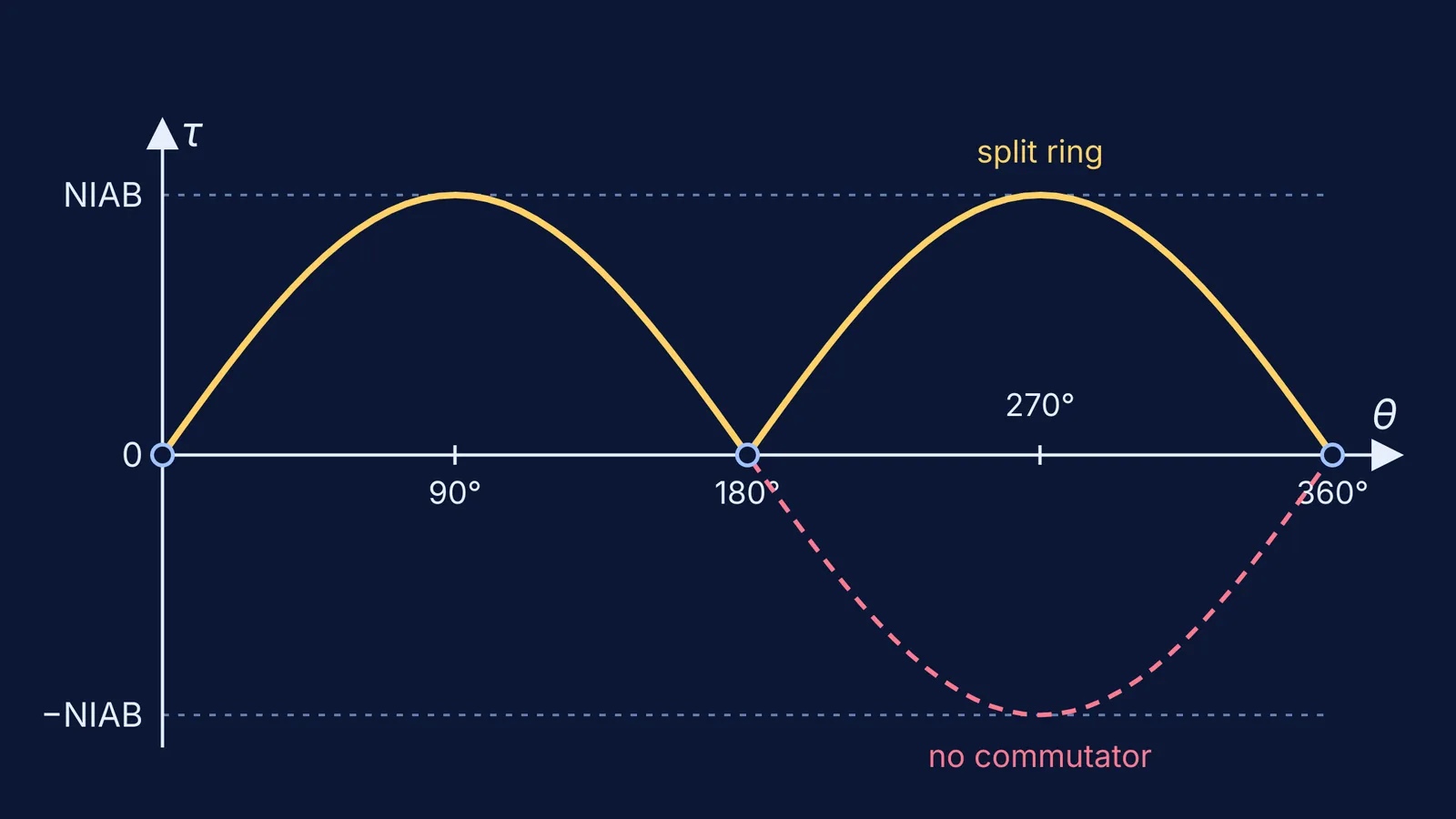
Past 180°, sin θ turns negative. At θ = 210°, with no commutator, the torque is −0.10 N m: the same size as at 30°, but turning the coil the opposite way.
Why does a DC motor need a split-ring commutator?
Without a commutator, the torque changes direction every half turn, so the coil rocks and settles where its magnetic moment lines up with the field. NCERT calls this a stable equilibrium: any small rotation produces a torque that brings the coil back (NCERT Class 12, section 4.9).
The split ring is a ring cut into two halves, one joined to each end of the coil, with brushes pressing on it. Every half turn the brushes swap halves, so the current in the coil reverses. The DC motor 3D virtual lab from Open Source Physics @ Singapore puts it this way: the commutator "reverses the coil current every half turn so that the torque continues in the same rotational sense."
The swap happens at 0° and 180°, where the torque is zero anyway. The coil coasts through that dead spot, and the reversed current pushes it onward. The torque still rises and falls, but never changes direction.
What do more turns or more current do?
In the NCERT formula, torque is proportional to N and to I. Doubling the turns doubles the torque, and so does doubling the current: 200 turns or 4 A would raise the example's peak from 0.2 to 0.4 N m.
Torque is still zero at 0° and 180° and largest at 90°, because those angles come from sin θ alone. More turns make the curve taller, not wider.
As the coil speeds up it also acts as a generator, producing a back emf that opposes the supply, so the current falls. The Singapore virtual lab models this with I = (V − back emf)/R. A spinning motor carries less current, and so less torque, than one just starting.
How do you test yourself with a motor simulation?
Commit to a prediction before every run, using the NCERT torque formula:
Stop the coil at 0°, 30°, 60° and 90°. Write the expected torque, then check.
Widen the commutator gap in the Singapore virtual lab. Predict a longer stretch with no current, where the coil only coasts.
Double the turns, then the current. Check that the peak doubles and the zeros stay put.
Reverse the battery and predict the new direction before you watch.
Our Fermi Simulation Lab has interactive simulations for ideas that are easier to see than to read. Fermi's AI tutor can run the simulation with you and check your understanding as it goes.
The same torque equation drives the moving coil galvanometer. If force directions feel shaky, see right-hand-rule mistakes in magnetic force or magnetic effects of current in Class 10.


