On this page
Spinner questions look simple, but they hide a trap: the sectors are not always the same size. Once they are not, counting sectors gives the wrong answer. Here is the rule, the reason behind it, and a full worked example with two spins.
How do you find probability on a spinner with unequal sectors?
Divide the sector's angle by 360°. A sector of 72° gives 72/360 = 1/5, and the angle ratio and the sector-area ratio give the same answer because a sector's area is proportional to its central angle, as this geometric probability review from Albert shows.
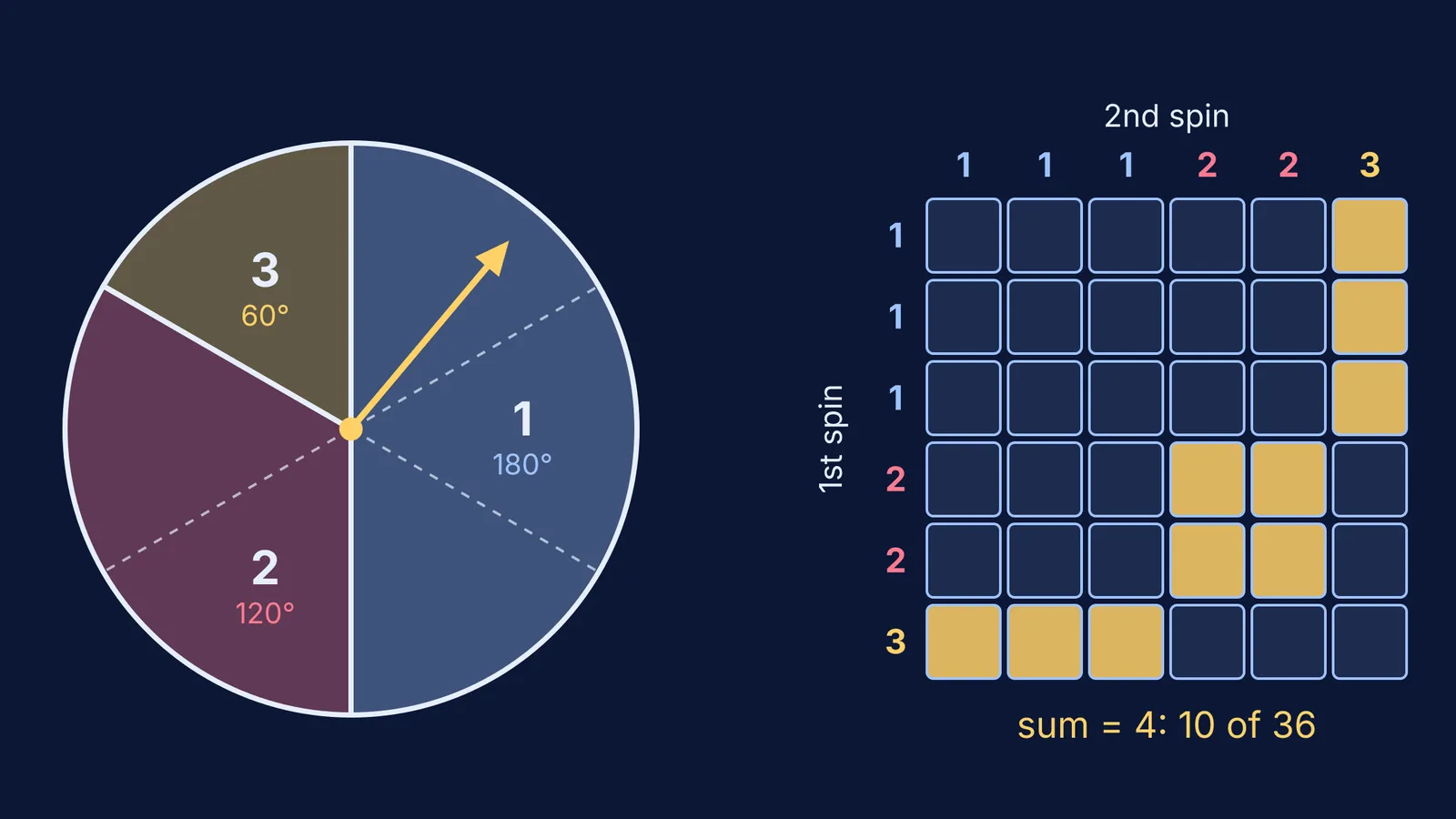
Take the spinner in the diagram above. It has three sectors:
Sector 1: 180°, so P(1) = 180/360 = 1/2
Sector 2: 120°, so P(2) = 120/360 = 1/3
Sector 3: 60°, so P(3) = 60/360 = 1/6
Check your work: 1/2 + 1/3 + 1/6 = 1. The NCERT Class 10 probability chapter states that the sum of the probabilities of all the elementary events of an experiment is 1. If your sector probabilities do not add to 1, an angle has been misread.
The angle rule works because, on a fair spinner, the pointer is equally likely to stop at any direction, so each outcome's chance is its share of the full turn. This is the same idea as length and area problems in geometric probability, and the sector itself is the one you met in area of sector and arc length formulas.
Why can't you just count the sectors?
The NCERT formula, favourable outcomes divided by all possible outcomes, assumes the outcomes are equally likely. The Class 10 chapter states this assumption with the definition and shows why it matters using a bag of 4 red balls and 1 blue ball as an example where red and blue are not equally likely.
Our spinner has three sectors, but P(1) is not 1/3. Sector 1 covers half the wheel. Writing "3 outcomes, so 1/3 each" is a common mistake on these questions.
How do you find the probability of two spins?
Two spins do not affect each other, so they are independent. The NCERT Class 12 probability chapter defines two events E and F as independent if P(E ∩ F) = P(E) · P(F), and says two experiments are independent if, for every pair of events E (from the first) and F (from the second), the probability of both happening is the product of their separate probabilities. For a refresher on how this differs from mutually exclusive events, see independent vs mutually exclusive events.
So the probability of a 1 then a 3 is 1/2 × 1/6 = 1/12.
What is the probability that two spins add up to 4?
List every ordered pair that gives 4, multiply along each, then add:
(1, 3): 1/2 × 1/6 = 1/12
(3, 1): 1/6 × 1/2 = 1/12
(2, 2): 1/3 × 1/3 = 1/9
Total: 1/12 + 1/12 + 1/9 = 3/36 + 3/36 + 4/36 = 10/36 = 5/18.
Now check it with the grid on the right of the diagram. With 6 equal slices on each spin, there are 6 × 6 = 36 equally likely pairs. Count the cells where the sum is 4: three for (1, 3), three for (3, 1) and four for (2, 2). That is 10 of 36, the same 5/18. Two methods that agree are a strong sign you are right.
Two more questions on the same spinner
Same number on both spins: 1/4 + 1/9 + 1/36 = 9/36 + 4/36 + 1/36 = 14/36 = 7/18.
At least one 3: use the complement. The NCERT Class 10 chapter gives P(not E) = 1 − P(E). The chance of no 3 on one spin is 5/6, so no 3 in two spins is 25/36, and at least one 3 is 1 − 25/36 = 11/36.
A five-step routine for any spinner question
Write each sector's angle and divide by 360°.
Check that the probabilities add to 1.
For two spins, list ordered pairs, or split the wheel into equal slices and draw the grid.
Multiply along each pair, then add the pairs you want.
For "at least one", work out the complement first.
If you keep landing on the wrong method, the Fermi Problem Library has worked problems with a step-by-step solver that explains the reasoning rather than printing an answer. If the gap is the idea of independence itself, the Fermi Concept Library gives each concept its own lesson and its place in the map.
Try this one yourself: on the same spinner, what is the probability that the two spins differ? (Hint: use your answer for "same number".)