

On this page
Most school probability is counting. Geometric probability is what you use when outcomes fill a continuum, such as a break point anywhere along a stick. MathWorld defines geometric probability as "the study of the probabilities involved in geometric problems, e.g., the distributions of length, area, volume, etc. for geometric objects under stated conditions" (MathWorld).
How do you find probability using length or area?
If a point is chosen uniformly at random from a region, the probability that it lands in a part is the size of that part divided by the size of the whole. One random number lives on a line, so you measure length; two live in a square, so you measure area.
The method, every time:
Name the random quantities and their ranges, for example x from 0 to 60 minutes.
Draw the sample space: a segment for one variable, a square for two.
Translate the event into inequalities.
Shade the region where they all hold. Lines have zero area, so < and ≤ give the same answer.
Divide the shaded size by the total. If the shaded part is awkward, find the unshaded corners and subtract from 1.
A warm-up with length: a 10 cm stick is broken at a random point x. What is the chance the longer piece is at least twice the shorter? That happens when the shorter piece is at most 10/3 cm, so x ≤ 10/3 or x ≥ 20/3. The favourable length is 20/3 cm out of 10 cm, giving a probability of 2/3.
How do you solve the meeting friends problem?
Riya and Arjun agree to meet at a metro station between 5 pm and 6 pm. Each arrives at a uniformly random time and waits 15 minutes for the other. What is the chance they meet?
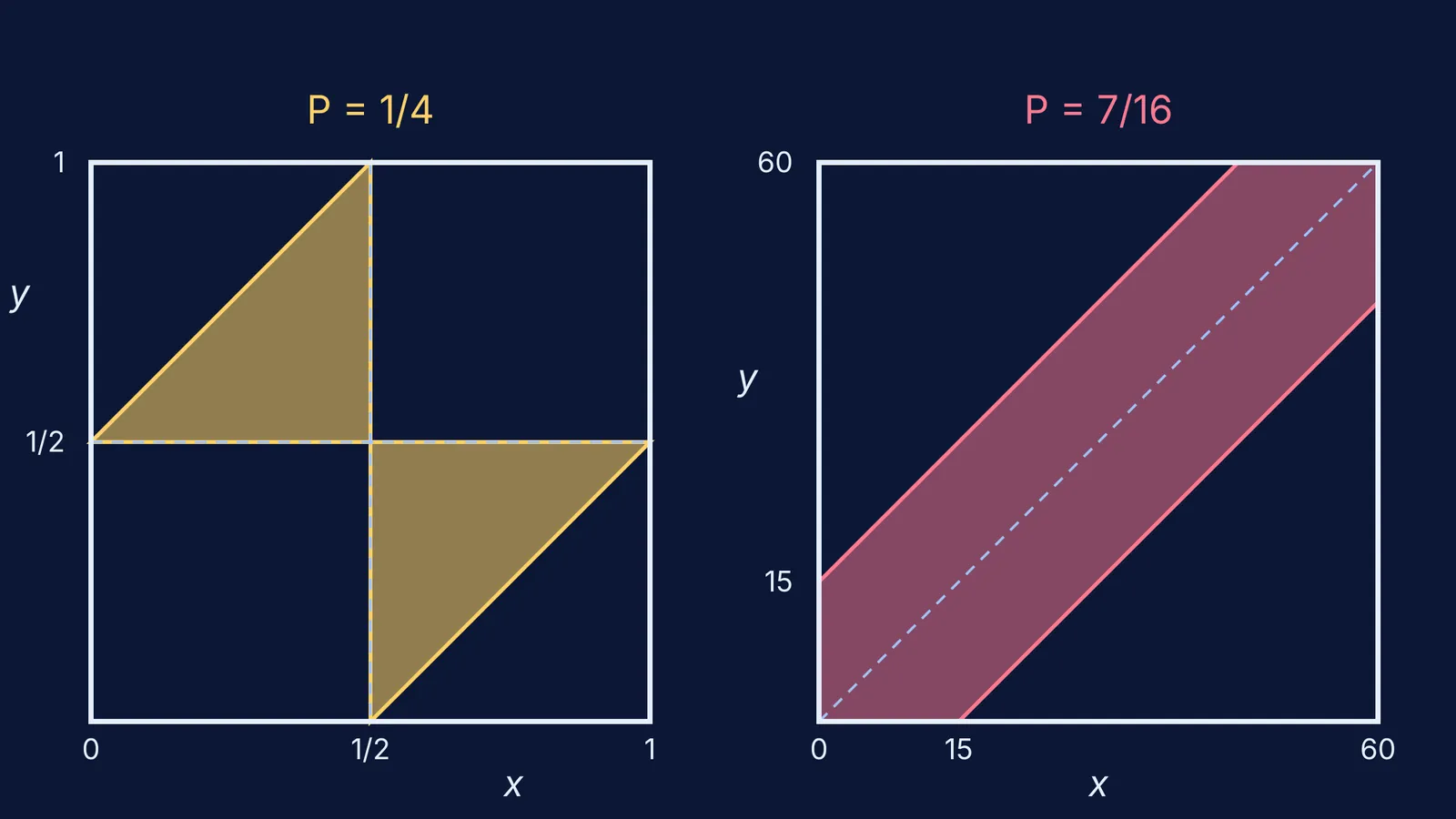
Let x and y be their arrival times in minutes after 5 pm. The sample space is a 60 by 60 square of area 3600. They meet inside the band |x − y| ≤ 15 along the diagonal. The region where they miss is two corner triangles, each with legs of 45, so together they cover 45 × 45 = 2025. The band has area 3600 − 2025 = 1575, and the probability is 1575/3600 = 7/16. A standard solution that splits the problem by who arrives first reaches the same 7/16 (GeeksforGeeks).
The square also gives you a general formula. For a window of length T and a waiting time w, the probability of meeting is 1 − (1 − w/T)². With a 10-minute wait, that is 1 − (5/6)² = 11/36.
Why is the broken stick answer 1/4?
Break a stick at two points chosen independently and uniformly along its length. The probability that the three pieces form a triangle is 1/4, the result stated in the Broken Stick Project organised by MIT PRIMES with Art of Problem Solving (arXiv).
The key step is the triangle inequality. When the three lengths add up to 1, they form a triangle exactly when every piece is shorter than 1/2 (The Math Doctors).
Take a stick of length 1 with break points x and y, so the sample space is the unit square. In the half where y > x, the pieces are x, y − x and 1 − y. You need x < 1/2, y > 1/2 and y − x < 1/2. Those three lines cut out a triangle with corners (0, 1/2), (1/2, 1/2) and (1/2, 1), of area 1/8. The half where x > y is its mirror image, another 1/8, so the total is 1/4.
Why does the phrase at random matter so much?
In his Scientific American column of October 1959, Martin Gardner wrote that the broken-stick question "cannot be answered without additional information about the exact method of breaking to be used" (Scientific American). Breaking the stick once, picking one of the two pieces and breaking that again is a different experiment, with a different answer.
The idea is old. Buffon first posed his needle problem in 1733 and published it with a solution in 1777; for a needle of length l shorter than the gap d between parallel lines, the chance it crosses a line is 2l/(πd) (MathWorld).
So before you draw anything, write down which quantity is uniform.
What mistakes cost marks in geometric probability?
Forgetting the mirror half of the square when you assumed y > x.
Dividing lengths when there are two random variables, which needs areas.
Treating arrival times as whole minutes, which turns it into a counting problem.
If you keep drawing the wrong region, the Fermi Problem Library has worked problems with a step-by-step solver that explains the reasoning rather than printing an answer. If the shaky part is uniform distributions themselves, the Fermi Concept Library gives each mathematics concept its own lesson.
Next, compare counting methods in probability with and without replacement, then try conditional probability and Bayes' theorem and probability distributions with mean and variance.
Tonight, redraw the meeting square with a 20-minute wait and check that your shaded area gives 5/9.


