On this page
You have probably learnt this as a one-line answer: small animals have a large surface area relative to their volume, so they lose heat fast. Below we work out the numbers for a small and a large animal, link them to Newton's law of cooling, and check them against real measurements.
Why are small animals rarely found in polar regions?
A warm-blooded animal makes heat throughout its body, so the heat it can produce scales roughly with its volume. It loses heat through its skin, so the heat it loses depends on its surface area. OpenStax Biology 2e explains that smaller endothermic animals have a greater surface area for their mass than larger ones, so they lose heat faster and need more energy to keep a constant internal temperature.
In a polar winter the gap between body and air temperature is huge. A very small body leaks heat so quickly that it would have to find and burn food almost without stopping. That is the reasoning behind the textbook answer, and a cousin of Carl Bergmann's body-size rule.
How do you work out surface area to volume for a small and a large animal?
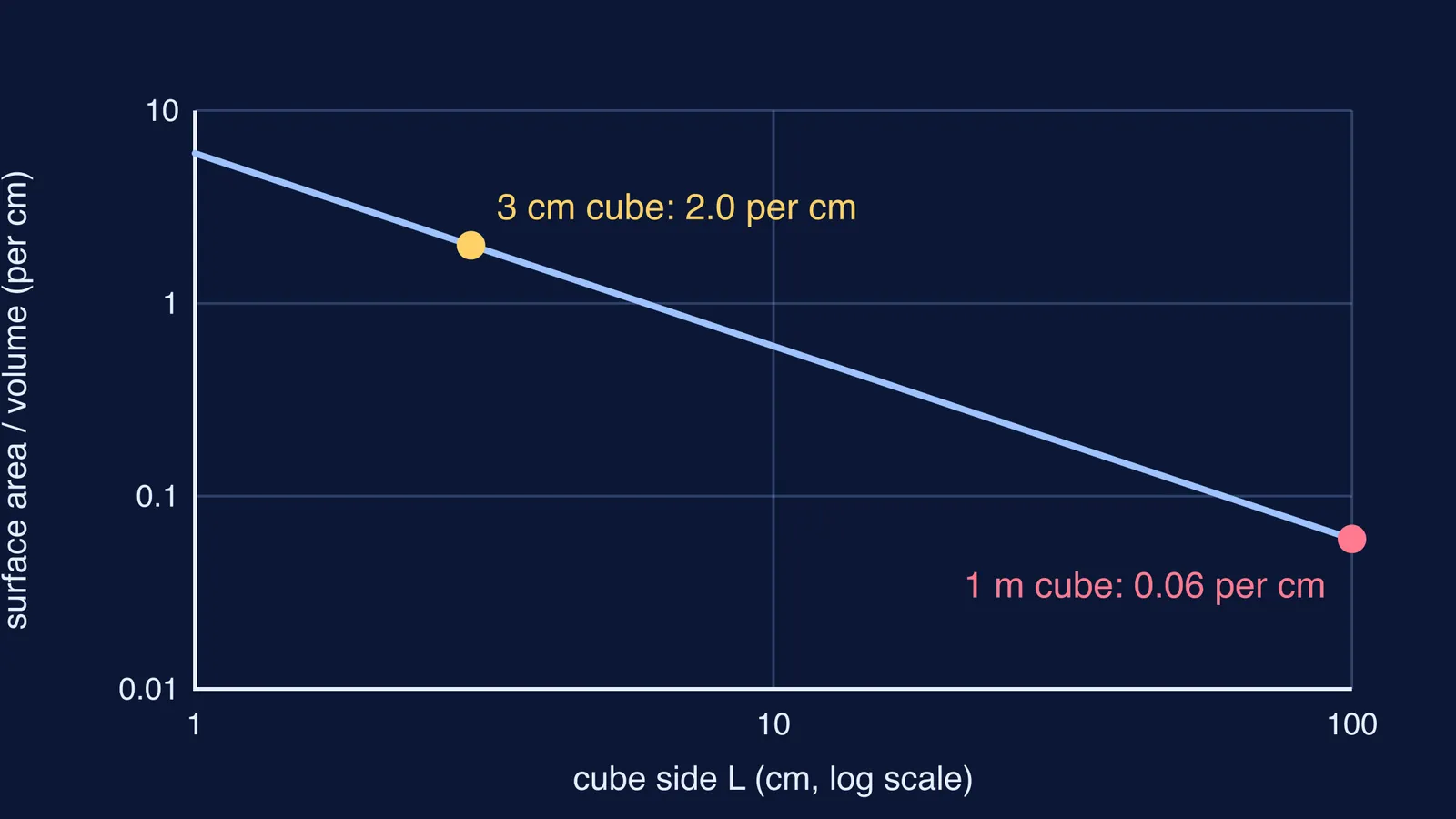
Model each animal as a cube. It is crude, but it isolates size. For a cube of side L, surface area is 6L² and volume is L³, so surface area ÷ volume = 6/L.
Small animal, a 3 cm cube: surface area = 6 × 3² = 54 cm². Volume = 3³ = 27 cm³. Ratio = 54 ÷ 27 = 2.0 per cm.
Large animal, a 1 m (100 cm) cube: surface area = 6 × 100² = 60,000 cm². Volume = 100³ = 1,000,000 cm³. Ratio = 60,000 ÷ 1,000,000 = 0.06 per cm.
Compare: 2.0 ÷ 0.06 ≈ 33. Each cubic centimetre of the small animal has about 33 times as much skin facing the cold.
Make the side 33 times longer and the ratio falls 33 times: surface grows as the square of size, volume as the cube. The diagram at the top plots that 6/L line.
If you want more scaling questions like this one, the Fermi Problem Library has worked problems with a step-by-step solver that explains the reasoning rather than printing an answer.
How much faster does a small body lose heat?
Class 11 Physics gives you the tool. NCERT's chapter on Thermal Properties of Matter writes Newton's law of cooling as −ms dT₂/dt = k(T₂ − T₁), where k depends on the area and nature of the exposed surface. Rearranged, the rate at which temperature falls is k ÷ ms times the temperature difference.
Apply that to the two cubes. k grows with surface area; m grows with volume. So with the same fur, tissue and temperature difference, the rate of cooling is proportional to surface area ÷ volume. If both stopped making heat at once, the 3 cm cube would start cooling about 33 times faster than the 1 m cube, so it must make heat about 33 times faster per gram just to hold steady.
The same chapter says the law holds well only for small temperature differences, so treat 33 as a rough guide.
If Newton's law of cooling is still hazy, the Fermi Concept Library covers every concept in physics, chemistry, biology, mathematics and computing, each with its own lesson and its place in the map.
Do real animals pay that energy price?
They do, though not in exact cube proportions. A figure in OpenStax Biology 2e compares a mouse, with an average mass of 35 grams and a metabolic rate of 890 mm³ of oxygen per gram of body mass per hour, with an elephant of 4,500 kg using 75 mm³ per gram per hour. So each gram of mouse uses about 12 times the oxygen of a gram of elephant.
The direction matches the geometry; the exact gap does not, because real animals are not cubes of identical tissue. That fast metabolism also links to why small animals have faster heart rates, and the same geometry explains how penguin huddles save heat: a huddle exposes less surface per bird.
Is this still in the NCERT Organisms and Populations chapter?
Not in the current book. NCERT's May 2022 List of Rationalised Content in Textbooks for Class XII dropped section 13.1, Organism and Its Environment, including 13.1.3 Adaptations, from the Organisms and Populations chapter, and says dropped content is not to be assessed. The current chapter, now Chapter 11 in the 2026-27 reprint, has 11.1 Populations as its first section.
So check your current syllabus before learning this as a biology answer; the physics is still in your Class 11 book. Try one more yourself: a 10 cm cube should give 0.6 per cm, on the line between the two animals.