On this page
A classic exam comparison, built on a line in NCERT's chapter on food production, makes a striking claim: a few hundred grams of bacteria can, in theory, make more protein in a day than a large herd of cattle. That is the idea behind single cell protein. Here is why microbes win, a worked check and the limits.
What is single cell protein?
Single cell protein (SCP) is protein-rich biomass from microbes such as algae, bacteria, yeast and fungi. The 2022-23 printing of the NCERT Class 12 chapter Strategies for Enhancement in Food Production (section 9.3) calls SCP one of the alternate sources of proteins for animal and human nutrition.
The chapter's case: it takes 3-10 kg of grain to produce 1 kg of meat by animal farming, and more than 25 per cent of the human population suffers from hunger and malnutrition.
It names two microbes:
Spirulina, a blue-green alga, can be grown on waste water from potato processing plants, straw, molasses, animal manure and even sewage, which also reduces environmental pollution.
Methylophilus methylotrophus, a bacterium, can be expected to produce 25 tonnes of protein because of its high rate of biomass production and growth.
Why can microbes make protein faster than cattle?
The short answer is doubling time. Bacterial cell mass can double in 20 minutes to 2 hours, according to a 2024 review of single-cell protein in Advanced Biotechnology by Zhuang and colleagues. The same review puts protein at 50-80% of dry cell weight for bacteria and about 60-70% for microalgae. A 2024 review of Spirulina in the journal Molecules gives Spirulina's protein content as 55-70%, containing all essential amino acids.
A cow grows slowly. In a microbe culture, every new cell soon starts making cells of its own: exponential growth against a steady trickle.
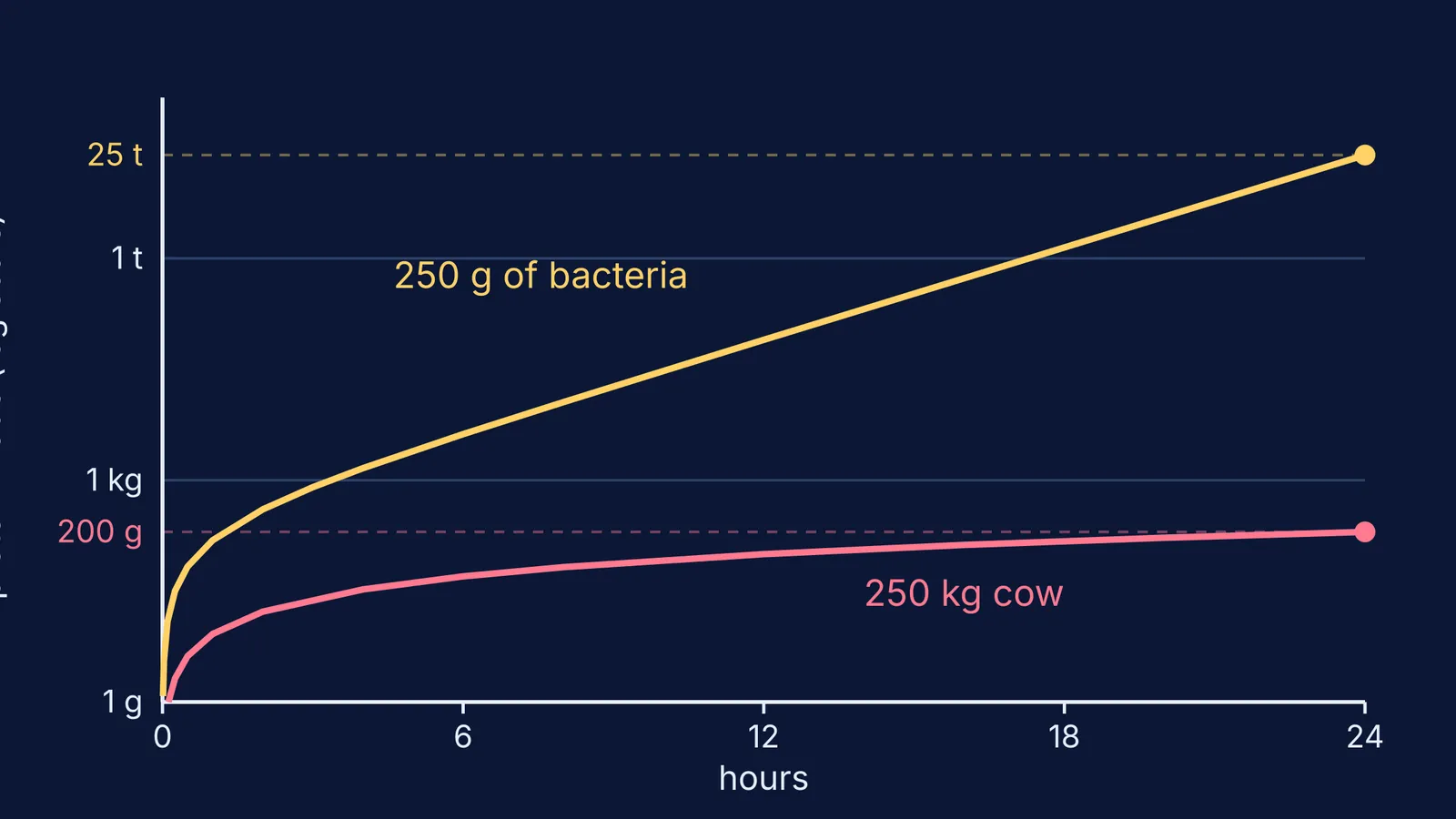
The full comparison many students learn, quoted in this Vedantu explanation, reads: a 250 kg cow produces 200 g of protein per day, while in the same period 250 g of Methylophilus methylotrophus can be expected to produce 25 tonnes of protein. The 2022-23 NCERT printing keeps only the 25-tonne claim, without the cow or the 250 g.
Does 250 g of bacteria really make 25 tonnes in a day?
Treat the cow-versus-bacteria figures as a numerical.
Cow: 200 g of protein from 250 kg of animal is 0.8 g per kg of body mass per day.
Bacteria: 25 tonnes is 25,000,000 g. Divided by the starting 250 g, that is a growth factor of 100,000.
Doublings needed: 2^n = 100,000, so n = log base 2 of 100,000, about 16.6 doublings.
Time per doubling: 24 hours divided by 16.6 is about 1.45 hours.
Sense check: 1.45 hours sits inside the 20-minute-to-2-hour range from the Zhuang review. Plausible.
One refinement: 25 tonnes is protein, not total cell mass. Pruteen, an animal feed ICI made from Methylophilus methylotrophus and methanol, was 72% protein, according to the Science Museum Group record of a Pruteen sample. So the culture needs about 35 tonnes of cells: 17.1 doublings, one every 1.4 hours. Still in range.
This is a best case: it assumes the cells never run short of food, oxygen or space for a whole day.
What are the advantages and limits of single cell protein?
Advantages, from the Zhuang review and the NCERT chapter:
Shorter production cycles than traditional animal and plant proteins.
Diverse raw materials, including wastes such as molasses, straw and sewage for Spirulina.
Food rich in protein, plus high energy efficiency and minimal environmental impact.
Limits worth one line in a long answer:
Bacterial SCP usually contains 8-12% nucleic acids, which can cause uric acid to build up in humans; microalgae carry less, typically 3-8%, per the Zhuang review.
Spirulina has a distinctive marine flavour, low consumer awareness and a relatively high price, notes the Spirulina review.
Cost matters. Pruteen was made between 1979 and 1985 and discontinued in the late 1980s, unable to match competitors' prices, says the Science Museum Group.
How do you write a strong SCP answer?
A four-point structure for a short answer:
Definition: protein-rich microbial biomass used as food or feed.
Two examples: Spirulina (blue-green alga) and Methylophilus methylotrophus (bacterium).
The reason: fast growth and high biomass production, often illustrated by the 250 kg cow versus 250 g of bacteria comparison.
A bonus point: Spirulina grows on wastes, which also cuts pollution.
SCP sits beside two other answers to food shortage in the same chapter: the steps of plant breeding for disease resistance and biofortification examples such as Atlas 66 and golden rice.
Check your current syllabus before revising SCP. In the current NCERT Class 12 Biology book (reprint 2026-27), chapter 9 is Biotechnology: Principles and Processes, so the food-production chapter quoted here comes from an earlier printing.
If logarithms are the shaky step, the Fermi Concept Library has every concept in biology and mathematics, each with its own lesson. For numericals like the one above, the Fermi Problem Library has a step-by-step solver that explains the reasoning rather than printing an answer.
Next time you see the 25-tonne figure, redo the five steps yourself.