On this page
This integral turns up in the NCERT Class 12 textbook with a different power each time: sin⁴x in a solved example, √sin x and cos⁵x in the exercises. The answer never changes. Here is the four-line method, why the power drops out, and how to spot the trick elsewhere.
What is the integral of sinⁿx/(sinⁿx + cosⁿx) from 0 to π/2?
It is π/4 for every positive n. In the NCERT Class 12 Mathematics Part II textbook, Chapter 7 (Integrals), Example 32 evaluates the n = 4 case and gets π/4. Exercise 7.10 in the same chapter asks for √sin x/(√sin x + √cos x), sin^(3/2)x/(sin^(3/2)x + cos^(3/2)x) and cos⁵x/(sin⁵x + cos⁵x), all from 0 to π/2. Each one comes out to π/4 by the same method, with no antiderivative needed.
What is the a − x property of definite integrals?
For a function f on [0, a], ∫₀ᵃ f(x) dx = ∫₀ᵃ f(a − x) dx; NCERT lists this as property P₄ and proves it with the substitution t = a − x (NCERT Class 12 Mathematics, Chapter 7).
Replacing x by a − x reads the graph from right to left, so the area under it is unchanged.
How do you solve it for any n in four lines?
Let I = ∫₀^(π/2) sinⁿx/(sinⁿx + cosⁿx) dx.
Apply the property with a = π/2. Since sin(π/2 − x) = cos x and cos(π/2 − x) = sin x, I = ∫₀^(π/2) cosⁿx/(cosⁿx + sinⁿx) dx.
Add the two forms. The denominators match, so 2I = ∫₀^(π/2) (sinⁿx + cosⁿx)/(sinⁿx + cosⁿx) dx = ∫₀^(π/2) 1 dx = π/2.
Halve: I = π/4.
In step 3, n cancels before you integrate anything; that is why the answer does not depend on the power. The same steps show that the cos version, cosⁿx/(sinⁿx + cosⁿx), is also π/4.
Why is the answer π/4 for every n?
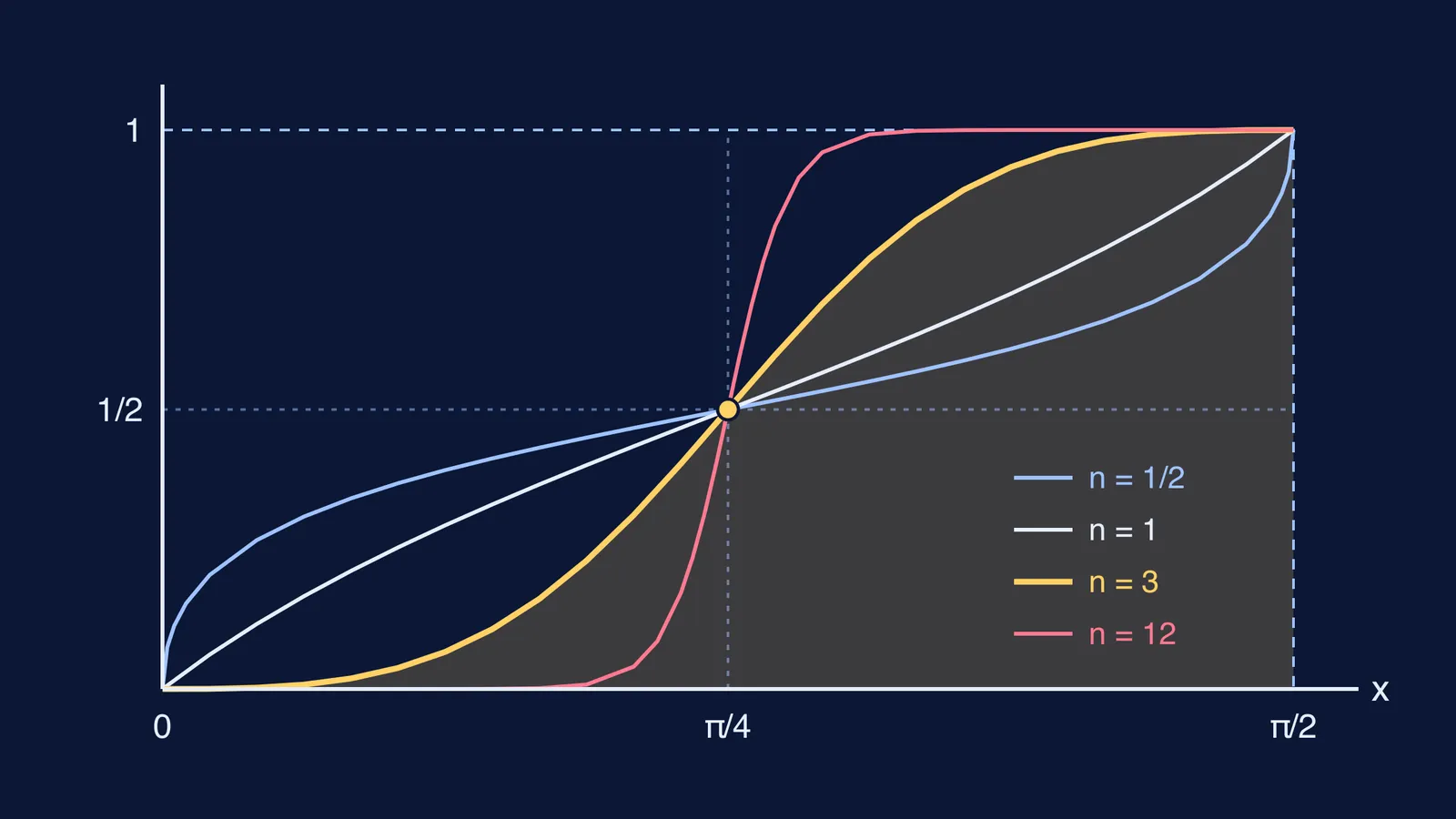
Call the integrand g(x). Step 2 hides something stronger: g(x) + g(π/2 − x) = 1 at every point. So the graph of g is symmetric about the point (π/4, 1/2). Wherever the curve rises above 1/2 on the right, it dips below 1/2 by the same amount on the left.
That means the area under g is exactly half of the rectangle of width π/2 and height 1, which is π/4. Changing n changes the shape, not the area. For n = 1/2 the curve is flat in the middle and steep at both ends; for n = 12 it is almost a step that jumps from 0 to 1 near x = π/4. The diagram at the top shows four values of n through the same centre point.
Two sanity checks: for n = 0 the integrand is the constant 1/2, and for very large n it approaches a step from 0 to 1 at π/4. Both enclose π/4.
How do you know when to use the a − x trick?
Check these first:
The limits are 0 and a, or a and b. For a and b, use the version with a + b − x, which NCERT lists as property P₃.
Replacing x by a − x (or a + b − x) swaps two pieces of the integrand: sin x with cos x on [0, π/2], tan x with cot x, or x with a − x.
After the swap the denominator is unchanged, so adding the two forms leaves something easy, often just 1.
If the swap does not happen, stop. On [0, π], sin(π − x) = sin x and cos(π − x) = −cos x, so the sin-cos ratio is not swapped and you need a different route.
The limits do not have to start at 0. NCERT Example 33 integrates 1/(1 + √tan x) from π/6 to π/3, uses a + b − x with a + b = π/2, and gets π/12: half the length of the interval, exactly as the general rule predicts.
The same move solves other standard integrals too: see the swap that turns x(1 − x)ⁿ into a one-line integral, the add-and-halve trick for f(x)/(1 + eˣ) on symmetric limits and the ln(1 + tan x) integral that comes out to (π/8) ln 2.
Which NCERT questions use the same trick?
These are all from NCERT Exercise 7.10 (chapter PDF). Try them before reading the answers.
Q2: √sin x/(√sin x + √cos x) from 0 to π/2. Answer: π/4.
Q3: sin^(3/2)x/(sin^(3/2)x + cos^(3/2)x) from 0 to π/2. Answer: π/4.
Q4: cos⁵x/(sin⁵x + cos⁵x) from 0 to π/2. Answer: π/4.
Q17: √x/(√x + √(a − x)) from 0 to a. Answer: a/2, because the integrand and its swapped form add to 1.
If you keep reaching for the wrong property, the Fermi Problem Library has worked problems with a step-by-step solver that explains the reasoning rather than printing an answer. To revise the properties of definite integrals before trying more, the Fermi Concept Library gives every concept in mathematics its own lesson.