

On this page
You will meet ∫₀¹ x(1 − x)ⁿ dx as Question 7 of Exercise 7.10 in the NCERT Class 12 maths textbook (NCERT, Chapter 7: Integrals). Expanding (1 − x)ⁿ with the binomial theorem works but is slow. One swap of x for 1 − x makes it a short problem.
What does the a − x property say?
NCERT lists it as property P₄ in Section 7.10: ∫₀ᵃ f(x) dx = ∫₀ᵃ f(a − x) dx (NCERT, Chapter 7). The proof in the same chapter is one substitution, t = a − x. It sends x = 0 to t = a and x = a to t = 0, and the minus sign from dt = −dx flips the limits back.
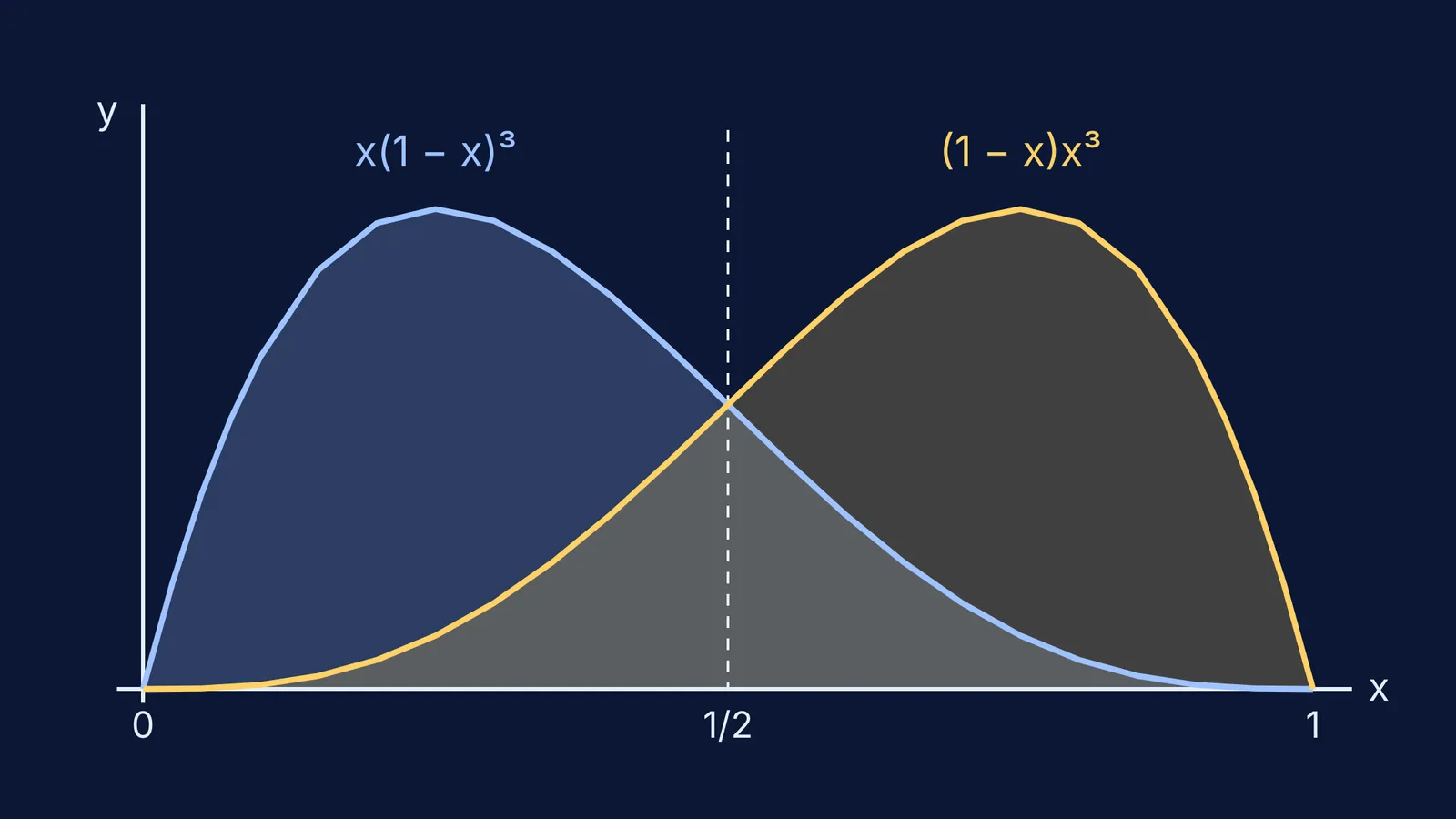
In plain words: reading the graph from right to left gives the same area as reading it from left to right.
How do you integrate x(1 − x)ⁿ from 0 to 1?
Here a = 1, so every x becomes 1 − x, and every 1 − x becomes x.
Write I = ∫₀¹ x(1 − x)ⁿ dx.
Apply P₄ with a = 1: I = ∫₀¹ (1 − x)(1 − (1 − x))ⁿ dx = ∫₀¹ (1 − x)xⁿ dx.
Multiply out the short bracket: I = ∫₀¹ (xⁿ − xⁿ⁺¹) dx.
Use the power rule on each term: I = [xⁿ⁺¹/(n + 1) − xⁿ⁺²/(n + 2)] from 0 to 1.
Put in the limits. At x = 1 both powers equal 1; at x = 0 both equal 0. So I = 1/(n + 1) − 1/(n + 2).
Combine over a common denominator: I = ((n + 2) − (n + 1))/((n + 1)(n + 2)) = 1/((n + 1)(n + 2)).
The swap moved the power n off the awkward bracket and onto plain x, where the power rule handles it in one step.
How can you check the answer is right?
Test the formula on small values of n that you can do by hand.
n = 0: ∫₀¹ x dx = 1/2, and the formula gives 1/(1 × 2) = 1/2.
n = 1: ∫₀¹ (x − x²) dx = 1/2 − 1/3 = 1/6, and the formula gives 1/(2 × 3) = 1/6.
n = 3: the formula gives 1/20. The picture at the top shows x(1 − x)³ and its mirror (1 − x)x³, two reflected regions with equal area.
A second check uses the Beta function, B(a, b) = ∫₀¹ tᵃ⁻¹(1 − t)ᵇ⁻¹ dt = Γ(a)Γ(b)/Γ(a + b) for positive a and b, as given in equation 5.12.1 of the NIST Digital Library of Mathematical Functions. Our integral is B(2, n + 1). DLMF equation 5.4.1 states that n! = Γ(n + 1) (DLMF, section 5.4), so for a whole number n the answer is 1! × n!/(n + 2)! = 1/((n + 1)(n + 2)).
The Beta condition also tells you how far the formula stretches: it needs n + 1 > 0, so the result holds for any n > −1, not only whole numbers.
Where else does the a − x swap help?
By the same property, ∫₀¹ xᵐ(1 − x)ⁿ dx = ∫₀¹ xⁿ(1 − x)ᵐ dx, so you can always put the larger power on plain x and keep the smaller one in the bracket. For whole numbers m and n, the Beta formula above gives m! n!/(m + n + 1)!; put m = 1 and you get back 1/((n + 1)(n + 2)).
Run through this checklist before you swap:
Are the limits 0 to a? If they run from a to b, use the related property P₃ and replace x with a + b − x, as NCERT shows in the same section.
Is it a definite integral? The property holds only for definite integrals, so never write a "+ C" version.
Did you swap every x, including the lone x outside the bracket? Leaving it as x gives ∫₀¹ xⁿ⁺¹ dx = 1/(n + 2), a common wrong answer.
The same property drives the "write I twice and add" trick. You can see it in how to evaluate the integral of ln(1 + tan x) and in why the integral of sin 2x log tan x is zero. If you would rather grind xᵐ(1 − x)ⁿ by parts, how to derive a reduction formula for integrals shows that longer route.
If your answer came out different and you cannot find the faulty step, the Fermi Problem Library has worked problems with a step-by-step solver that explains the reasoning rather than printing an answer. If the property itself still feels shaky, the Fermi Concept Library gives every concept in mathematics its own lesson, so you can go back to definite integrals before your next problem set.


