

On this page
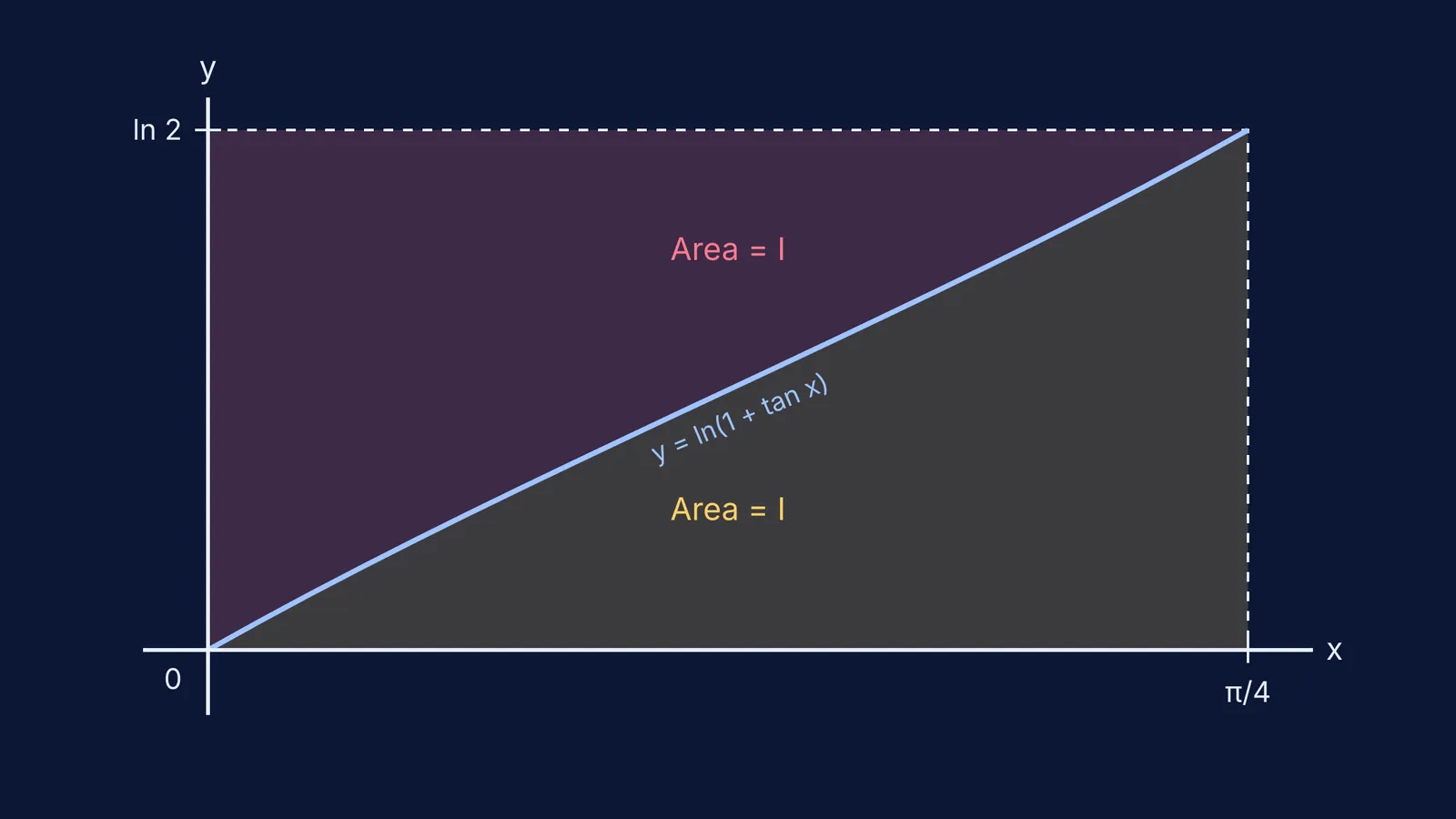
Evaluating the definite integral of ln(1 + tan x) from 0 to π/4 is a classic calculus problem. Because the indefinite integral has no simple solution in terms of elementary functions, you must use a specific property of definite integrals to solve it.
When you first look at this problem, your instinct might be to use integration by parts or to rewrite the tangent function as sine over cosine. However, these standard algebraic methods quickly lead to overly complex expressions that do not simplify easily. Integration by parts creates a tangled mix of logarithms and secant squared terms, while substitution offers no clear path forward. This is why recognising the specific bounds of the definite integral is the only practical way forward.
How do you evaluate the integral of ln(1 + tan x)?
To find the area under the curve between 0 and π/4, we rely on the reflection property of definite integrals. This property states that the integral of a function from 0 to a is equal to the integral of the function evaluated at (a - x).
In mathematical terms, the rule is: ∫₀^(π/4) f(x) dx = ∫₀^(π/4) f(π/4 - x) dx
If we let our original integral be I, we can write: I = ∫₀^(π/4) ln(1 + tan x) dx
Applying the reflection property, we replace every x with (π/4 - x): I = ∫₀^(π/4) ln[ 1 + tan(π/4 - x) ] dx
Why does tan(π/4 - x) help solve the integral?
The substitution sets up a neat trigonometric cancellation. To simplify the expression inside the logarithm, we use the tangent subtraction formula: tan(A - B) = (tan A - tan B) / (1 + tan A × tan B)
We know that the tangent of π/4 is exactly 1. Substituting this exact value into the trigonometric formula gives: tan(π/4 - x) = (1 - tan x) / (1 + tan x)
Now, we substitute this new fraction back into the logarithmic function in our integral: 1 + tan(π/4 - x) = 1 + [ (1 - tan x) / (1 + tan x) ]
To add these together and simplify the term, find a common denominator: = (1 + tan x + 1 - tan x) / (1 + tan x) = 2 / (1 + tan x)
Our integral I now looks like this: I = ∫₀^(π/4) ln[ 2 / (1 + tan x) ] dx
How do you find the final answer?
The final step uses the division property of logarithms, which states that ln(a/b) = ln a - ln b.
Applying this fundamental rule to our integral, we can split it into two separate terms: I = ∫₀^(π/4) [ ln 2 - ln(1 + tan x) ] dx I = ∫₀^(π/4) ln 2 dx - ∫₀^(π/4) ln(1 + tan x) dx
Notice that the second term is exactly our original integral, I. We can replace that entire term with I: I = ∫₀^(π/4) ln 2 dx - I
Add I to both sides of the equation to combine the unknown integrals: 2I = ∫₀^(π/4) ln 2 dx
Since ln 2 is a constant numerical value, we can bring it outside the integral and integrate directly: 2I = ln 2 × ∫₀^(π/4) 1 dx 2I = ln 2 × [x]₀^(π/4) 2I = (π/4) × ln 2
Divide by 2 to isolate I on the left side of the equation.
The definite integral of ln(1 + tan x) from 0 to π/4 is exactly (π/8) ln 2.
How can you practise calculus methods like this?
Knowing which property to apply is often the hardest part of integration in exams like the JEE Main, JEE Advanced or Class 12 boards. If you understand the theory but get stuck applying it to new calculus problems, the Fermi Problem Library has worked problems with a step-by-step solver that explains the reasoning rather than printing an answer.
For a broader review of calculus rules and their underlying proofs, you can explore the Concept Library. It covers every concept in physics, chemistry, biology, mathematics and computing, each with its own lesson and its place in the map. Taking the time to understand why a property works, rather than just memorising the procedural steps, makes it much easier to spot the right approach during a high-pressure exam.
For more advanced integration techniques, see How to Solve Integrals Using Substitution and Partial Fractions or learn how to apply definite integrals practically with the Area of an Ellipse by Integration Explained.


