On this page
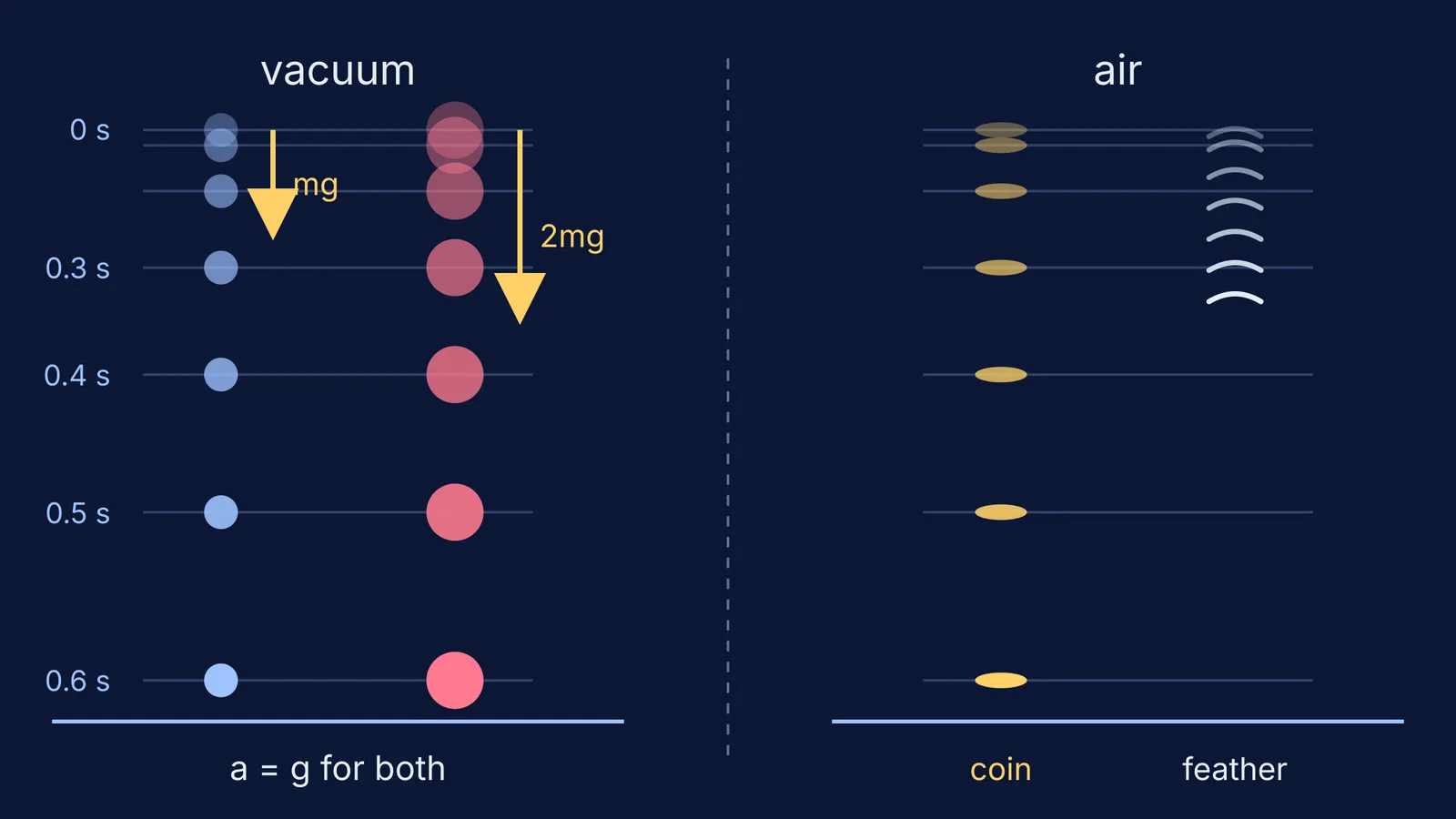
Drop a cricket ball and a sheet of paper together and the ball wins. It is tempting to decide from this that heavy things fall faster. Without air in the way, both speed up at the same rate. The difference you see comes from the air, not from gravity.
Why doesn't a heavier object fall faster?
A heavier object does feel a bigger pull. Its weight is W = mg, so a 2 kg ball is pulled down twice as hard as a 1 kg ball.
But Newton's second law says acceleration is force divided by mass: a = F/m. The 2 kg ball needs twice as much force to speed up by the same amount. Twice the pull, twice the reluctance to move, and the ratio doesn't change.
Here is the arithmetic, using the standard value of gravitational acceleration, 9.806 65 m/s², from NIST's CODATA reference (rounded to 9.8 here):
1 kg ball: F = 1 × 9.8 = 9.8 N, so a = 9.8 ÷ 1 = 9.8 m/s².
2 kg ball: F = 2 × 9.8 = 19.6 N, so a = 19.6 ÷ 2 = 9.8 m/s².
Mass appears on both sides of mg = ma and cancels, leaving a = g.
That cancellation only works if the mass that gravity pulls on (gravitational mass) is the same as the mass that resists acceleration (inertial mass). Physicists call this the weak equivalence principle, and they have tested it carefully. The MICROSCOPE satellite compared test masses made of titanium and platinum alloys in orbit and found no violation of the principle at a precision of about one part in 10^15 (Touboul et al., Physical Review Letters, 2022).
Why does a feather fall slower than a coin in real life?
In air, a falling object has a second force on it: drag, pushing up. NASA's Glenn Research Center gives the drag equation as D = Cd × ρ × V² × A ÷ 2, where ρ is air density, V is speed, A is a reference area and Cd is a drag coefficient set by shape and flow (NASA Glenn, The Drag Equation).
Notice what is missing from that equation: mass. Drag depends on size, shape and speed. So the net acceleration becomes a = g − D/m, and here mass no longer cancels.
A worked example. Take two balls of the same size moving at the same speed, so drag is the same on both, say 0.5 N:
0.5 kg ball: a = 9.8 − 0.5 ÷ 0.5 = 8.8 m/s².
5 kg ball: a = 9.8 − 0.5 ÷ 5 = 9.7 m/s².
The heavy ball pulls ahead, not because gravity accelerates it more but because the same drag matters less to it. A feather is the extreme case: so much area and so little mass that drag soon balances its weight. Our explainer on why air drag makes a fall take longer works through this, and terminal velocity with linear and quadratic drag shows how that limiting speed is reached.
What happened when astronauts dropped a hammer and a feather on the Moon?
The Moon has almost no atmosphere. During the final minutes of the third moonwalk on Apollo 15, Commander David Scott released a 1.32 kg aluminium geological hammer and a falcon feather together from about 1.6 m (NASA Space Science Data Coordinated Archive).
Mission controller Joe Allen described the result in NASA's Apollo 15 Preliminary Science Report: "Within the accuracy of the simultaneous release, the objects were observed to undergo the same acceleration and strike the lunar surface simultaneously, which was a result predicted by well-established theory".
You can see the same thing on Earth if you remove the air. Physicist Brian Cox dropped a bowling ball and a bunch of feathers at NASA's Space Power Facility in Ohio, in what Physics World calls the world's biggest vacuum chamber; in slow motion they land at the same time (Physics World).
How can you test this at home?
Make three drops from the same height, predicting each result first:
A coin and a flat sheet of paper. The coin wins.
The same sheet crumpled into a tight ball, beside the coin. They land almost together.
The flat sheet laid on top of a book. The book shields it from the air and they fall as one.
Drop 2 is the key one: the paper's mass didn't change, only its shape. Air, not mass, was slowing it down.
If you find ideas like this easier to see than to read, the Fermi Simulation Lab has interactive simulations to explore. For practice, the Fermi Problem Library has worked problems with a step-by-step solver that explains the reasoning, so you can check where your method went wrong rather than only checking the answer.