On this page
Sambhar is a salt factory run by the sun. Shallow pans, dry desert air and one rule of solubility do the work, and that rule also explains why different salts leave a solution at different times.
Where is Sambhar Lake, and why is it salty?
Sambhar Salt Lake, west of Jaipur in Rajasthan, is India's largest inland saline wetland, and it has been a Ramsar site since 23 March 1990 (Naik and Sharma, PLOS ONE, 2021). The same study puts its area at about 230 km². The lake is almost 3 m deep in the monsoon and shrinks to about 0.6 m in the dry months.
Seasonal streams such as the Mendha drain a catchment of about 5,520 km² into the lake. The PLOS ONE paper describes the basin as rich in salts of sodium, potassium, calcium and magnesium, with carbonate, bicarbonate, chloride and sulphate. When the desert sun evaporates the water, those dissolved salts stay behind.
How is salt made from Sambhar Lake?
A 5 km stone dam crosses the eastern end of the lake. East of it are evaporation ponds where salt has been farmed for a thousand years, according to NASA Earth Observatory. Salt workers interviewed by India Water Portal describe the process in four steps:
Get the brine: once the lake water reaches a certain concentration, it is let through the dam gates from the western side, or salty groundwater is pumped up from wells.
Hold it: reservoirs and canals on the eastern side store the brine.
Crystallise it: the brine goes into shallow salt pans called kyaris, separated by narrow ridges, where evaporation leaves white salt crystals.
Collect the salt and start again.
Dhanraj Sharma, secretary of the NGO Prayatna Sansthan, told India Water Portal that seasonal river water used to take over 50 days to become brine as it evaporated from the pans, while water from deep borewells now gives crystallised salt in about 15 days. He said more than 10 borewells run in every acre and that groundwater tables have dropped quickly as a result.
Deborah Sutton, a historian of modern South Asia at Lancaster University, writes that a 1964 award gave the rights to the lake's salt to Sambhar Salts Ltd, which was 60% held by Hindustan Salts Ltd, a central government company, and 40% by the Government of Rajasthan (Arcadia, 2026). She also notes that groundwater at the lake has been at critical levels since the 1990s.
In what order do salts crystallise as brine evaporates?
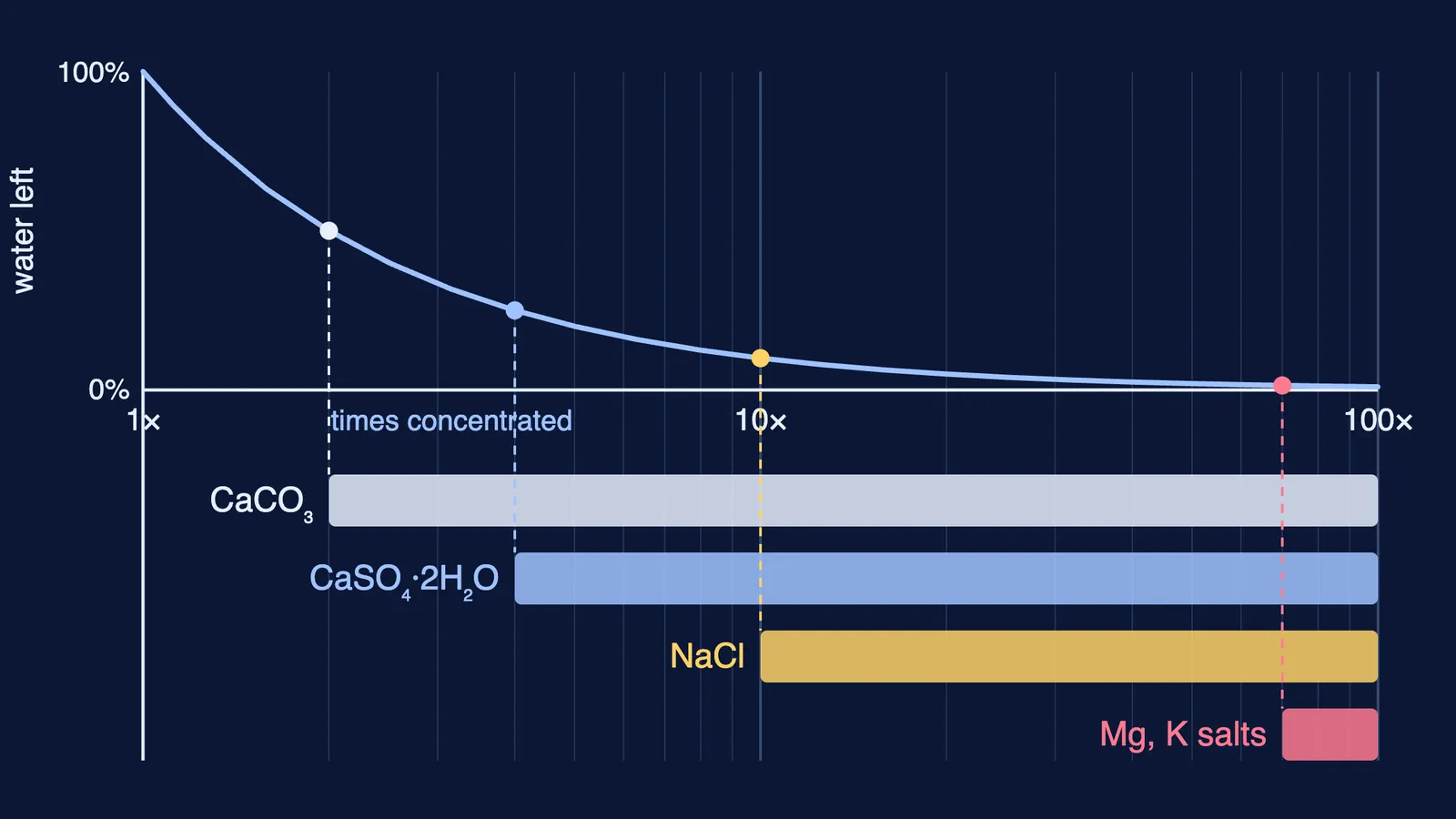
The least soluble salt comes out first: each salt crystallises once too little water is left to keep it dissolved.
For seawater, the University of Hawaii gives this order: calcium carbonate at about 50% evaporation, gypsum (calcium sulphate) at about 80%, sodium chloride at about 90%, and potassium and magnesium salts only beyond 95%. Saltwork Consultants puts it in concentration terms: gypsum at four to five times seawater strength, halite (sodium chloride) at 10 to 12 times, and the bittern salts at more than 70 to 90 times.
Sambhar's brine has a different mix of ions, so the exact points shift, but the logic explains why salt is made in stages. If gypsum settles out early, the sodium chloride that crystallises later is cleaner. If the bittern is drained off before it dries, the bitter magnesium salts stay out of the table salt. The same idea sits behind why crystallisation beats evaporation for purifying a salt.
Worked example: how much water has to go?
The dissolved salt stays in the pan while the water leaves, so the concentration factor is starting volume divided by volume left. Start with 1,000 L of seawater-strength brine (Saltwork Consultants thresholds):
At 4 times strength (gypsum starts), 250 L is left, so 75% of the water has evaporated.
At 10 times strength (sodium chloride starts), 100 L is left: 90% gone, which matches the Hawaii figure.
At 70 times strength (bittern salts), only about 14 L is left.
The lesson for exams: nine-tenths of the water has to go before any table salt appears. See also how much salt dissolves in 100 mL of water.
If solubility still feels like a rule to memorise, the Fermi Concept Library covers every concept in physics, chemistry, biology, mathematics and computing, so you can go back to how saturation works.
What gives Sambhar Lake its colours?
NASA notes that specialised algae and bacteria growing in the lake give its water striking colours. Among them is the green alga Dunaliella: researchers have isolated a strain from Sambhar itself (Phadwal and Singh, 2003). Under salt stress and strong light, its beta-carotene, an orange-red pigment, rose from a maximum of 1.15 pg per cell without stress to about 4.21 pg per cell. Worldwide, Dunaliella is responsible for most of the primary production in very salty water, according to a review by Aharon Oren in Saline Systems.
In pink lakes around the world, the colour usually comes from Dunaliella's carotenoids together with salt-loving bacteria and archaea such as Halobacterium salinarum (overview of pink lakes). We found no study that settles which organism dominates Sambhar's colours. For a contrast, read why Chilika Lake is brackish.