On this page
Fire alpha particles at a thin gold foil and count the flashes on a screen at different angles. How does that count change with angle? The answer is a very steep law, and once you see where it comes from, a ratio question takes seconds.
What does Rutherford's formula say about the number scattered at an angle?
In his 1911 paper in the Philosophical Magazine (Rutherford, 1911), Ernest Rutherford asked what would happen if an atom's positive charge sat in a tiny centre. He found that the number of alpha particles landing on unit area of a zinc sulphide screen, at a fixed distance from the foil, is proportional to cosec⁴(φ/2), where φ is the scattering angle (text of the 1911 paper). The count also rises with foil thickness and central charge, and falls as 1/(mu²)², where mu² is twice the kinetic energy.
The modern textbook form, as written by Belloni, Christian and Cox on ComPADRE, is:
N(θ) = (nt/4r²) × (zZ/2K)² × (e²/4πε₀)² × 1/sin⁴(θ/2)
Here n is nuclei per unit volume, t the foil thickness, r the detector distance, z and Z the charge numbers, and K the alpha particle's kinetic energy. The same page notes that laboratory counts followed the 1/sin⁴(θ/2) dependence.
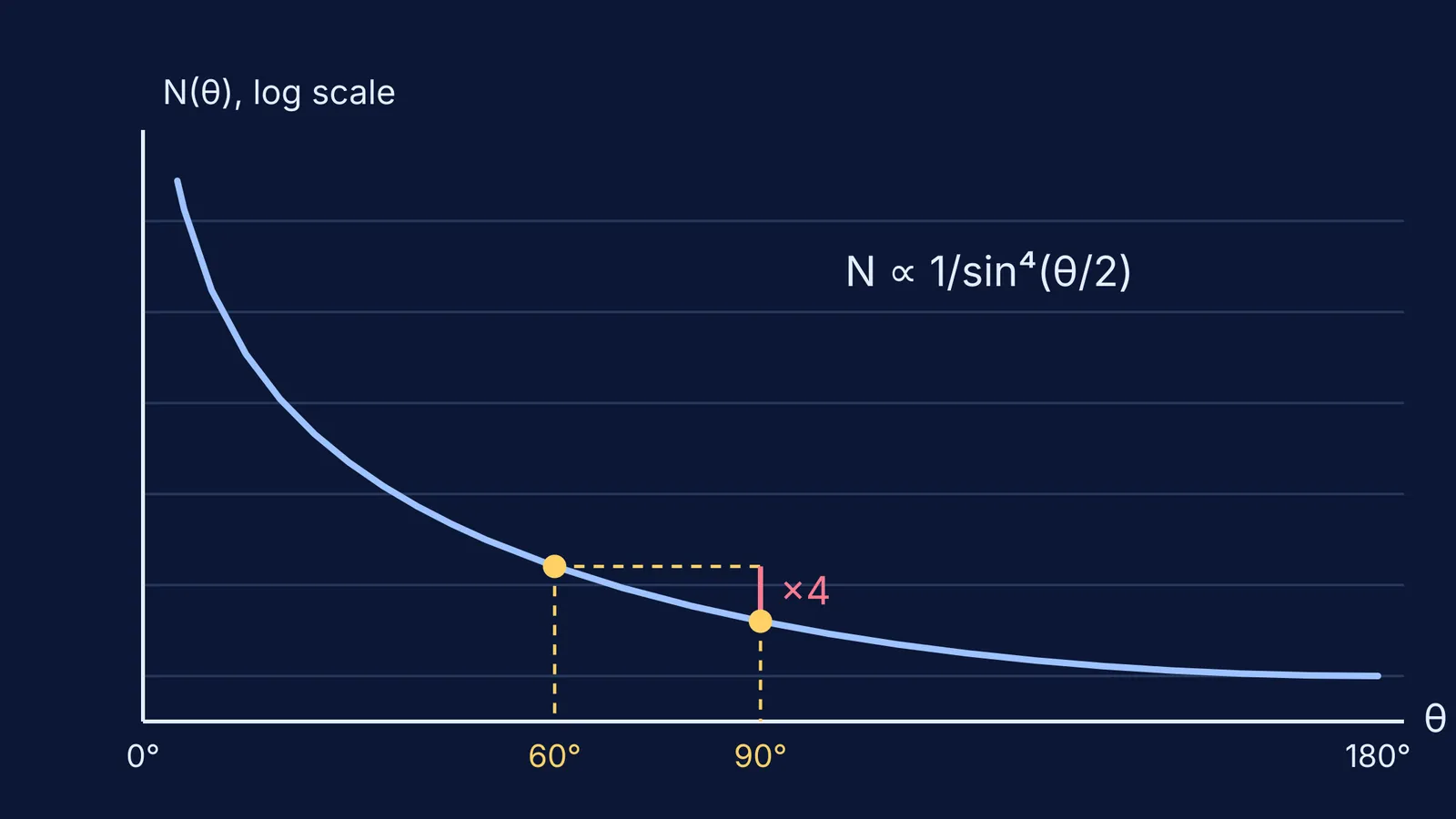
For a ratio question almost everything cancels. Same foil, same beam, same detector: N ∝ 1/sin⁴(θ/2).
Why do most alpha particles pass undeviated?
NCERT's Class 12 chapter on Atoms describes the Geiger–Marsden setup: 5.5 MeV alpha particles from a bismuth-214 source aimed at a gold foil 2.1 × 10⁻⁷ m thick (NCERT Physics Part II, Chapter 12). The same chapter states that only about 0.14% of the incident alpha particles scatter by more than 1°, and about 1 in 8000 deflect by more than 90°.
The reason is size. NCERT puts the nucleus at about 10⁻¹⁵ to 10⁻¹⁴ m and the atom at about 10⁻¹⁰ m, so most alpha particles never pass close to a nucleus.
How close is close? Rutherford's paper links the deflection to the impact parameter p, how far off-centre the particle is aimed, through cot(φ/2) = 2p/b, where b is the head-on distance of closest approach (Rutherford, 1911). His own table shows that aiming at p = 10b gives only 5.7°, while p = 0.5b gives 90°. For a 7.7 MeV alpha particle and gold, NCERT's Example 12.2 works out b as about 3.0 × 10⁻¹⁴ m. So to be turned past 90°, a particle has to be aimed within about 1.5 × 10⁻¹⁴ m of a nucleus, in an atom about 10⁻¹⁰ m across: a target several thousand times narrower than the atom.
Because the area you must hit grows as p², Rutherford also showed that the fraction deflected by more than φ is proportional to cot²(φ/2). For the energy argument behind b, see our explainer on closest approach and impact parameter in Rutherford scattering.
How do you work out the ratio for 60° and 90°?
Suppose a detector at 90° counts 56 alpha particles a minute. How many would it count at 60°, with nothing else changed?
Write the law from Rutherford's formula: N ∝ 1/sin⁴(θ/2).
Halve the angles: 60° becomes 30°, 90° becomes 45°.
Find the sines: sin 30° = 1/2 and sin 45° = 1/√2.
Raise them to the fourth power: (1/2)⁴ = 1/16 and (1/√2)⁴ = 1/4.
Take the ratio: N(60°)/N(90°) = sin⁴45° ÷ sin⁴30° = (1/4) ÷ (1/16) = 4.
Answer: 4 × 56 = 224 a minute.
How steep is the fall? From the formula, relative to the count at 90°:
10°: about 4,300 times as many
30°: about 56 times as many
60°: 4 times as many
90°: 1
180°: one quarter
What mistakes cost marks on this question?
Using sin⁴θ instead of sin⁴(θ/2). With full angles the 60° to 90° ratio comes out as 16/9 instead of 4.
Flipping the ratio. A smaller angle always gets more particles; if your answer gives 90° the bigger count, start again.
Counting a whole ring. For every particle between θ and θ + dθ all round the beam, the ring's area adds a factor of sin θ; Rutherford divided by it to get his count per unit area.
Missing a changed setup. If the foil, element or energy also changes, bring back t, Z² and 1/K².
To see aim and deflection together, try our Rutherford gold foil simulation, which asks you to predict each deflection. For what the tiny nucleus meant next, read why Rutherford's model failed to explain stability.
When a ratio question still goes wrong, the Fermi Problem Library has worked problems with a step-by-step solver that explains the reasoning rather than printing an answer, so you can see which step slipped. If impact parameter itself feels shaky, the Fermi Concept Library gives each concept its own lesson and its place in the map.
Halve the angle, take the fourth power of the sine, and check which way the ratio goes before you write the answer.