

On this page
Fire alpha particles at gold foil in a simulation and most fly straight through. A few swing wide; now and then one comes almost straight back. You can predict each outcome before you press play, and use that reasoning to rule out the plum pudding atom.
What did Rutherford's gold foil experiment actually find?
In 1909 Hans Geiger and Ernest Marsden reported that alpha particles striking a metal plate sometimes came back out on the side they entered (Proceedings of the Royal Society A, 1909). In their words, "of the incident α-particles about 1 in 8000 was reflected" from a platinum plate (full text on ChemTeam).
In 1911 Ernest Rutherford explained this with an atom whose central charge is concentrated in "a very small volume" (Philosophical Magazine, 1911). He took the atom's radius to be of the order of 10⁻⁸ cm. Assuming a central charge of 100 units, close to his estimate for gold, he worked out that an alpha particle moving at 2.09 × 10⁹ cm/s gets no closer than about 3.4 × 10⁻¹² cm head-on (Rutherford 1911, full text). That makes the head-on distance roughly 3,000 times smaller than the atom's radius.
How does deflection depend on aim and energy?
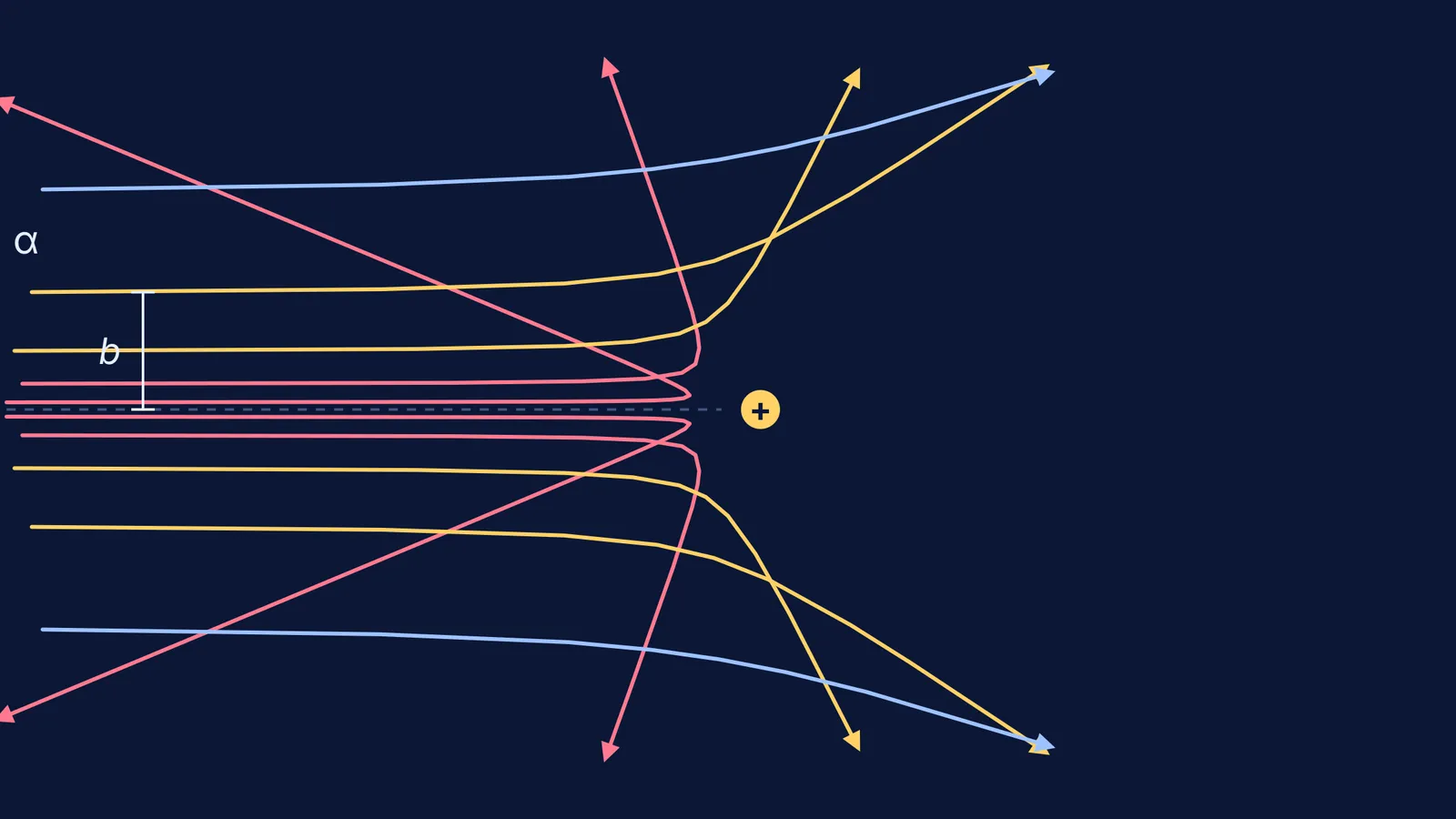
Two lengths decide everything. The impact parameter b is how far your aim line misses the centre of the nucleus. The distance of closest approach d is how near a head-on particle gets before it stops and turns back.
Rutherford showed that the deflection angle θ obeys cot(θ/2) = 2b/d, and that d grows with the nuclear charge and shrinks as the alpha particle's kinetic energy rises (Rutherford 1911).
Predictions to write down before you run a simulation, with aim in units of d:
b = 0.1d: θ ≈ 157°, almost straight back.
b = 0.5d: θ = 90°, a right-angle turn.
b = d: θ ≈ 53°.
b = 3d: θ ≈ 19°.
b = 10d: θ ≈ 5.7°.
b = 1,000d, still inside the atom: θ ≈ 0.06°, which looks straight on screen.
Now double the energy. d halves, so the same aim line is twice as far away in units of d. The particle that turned through 53° now turns through about 28°. Rutherford's theory says the number scattered at a given angle varies inversely as the square of the kinetic energy. Geiger and Marsden tested this (Geiger and Marsden, 1913), and Rutherford wrote that their results were "in very close accord with the theory" (Rutherford, 1914). So doubling the energy cuts the count at any fixed large angle to about a quarter.
Why do most alpha particles pass straight through?
Because almost every aim line misses. To turn through more than 90°, a particle has to pass within d/2 of the centre. Using Rutherford's 1911 figures, the atom's radius is about 3,000 times d, so that target disc covers roughly one part in tens of millions of the atom's cross-section (Rutherford 1911).
In a simulation, fire a wide, evenly spread beam and count. Backscattered particles are rare, as in 1909.
How would the plum pudding model look different?
In J. J. Thomson's model the positive charge is spread uniformly through a sphere the size of the atom, with electrons set inside it (Philosophical Magazine, 1904). Rutherford pointed out that Thomson's scattering theory "is based on the assumption that the scattering due to a single atomic encounter is small". He also noted Geiger's measurement that the most probable deflection through a thin layer of gold was 1° 40′ (Rutherford 1911).
Here is why. Outside a ball of charge, the force is as if all the charge sat at the centre; inside, it weakens. So a spread-out atom can never push harder than a point charge would at the atom's surface. A nucleus lets the particle get about 3,000 times closer, and Coulomb's force grows as the inverse square of distance, so the strongest push is millions of times larger.
A plum pudding simulation therefore shows a beam that fans out slightly and almost never bounces back. Rutherford concluded that many small nudges could not explain the pattern of large-angle deflections; a single close encounter with a nucleus could.
A 15-minute predict-then-test plan
Sketch the nucleus and five aim lines, at 0.1d, 0.5d, d, 3d and 10d, with the path you expect for each.
Write your predicted angle beside each line, using cot(θ/2) = 2b/d.
Run the simulation at one energy and compare. Circle any surprise.
Double the energy and predict again before you run it.
If the simulation has a plum pudding mode, switch to it; if not, reason it out. Predict the largest angle you would ever see.
Write one sentence on why the backscattered particles of 1909 need a nucleus.
The Fermi Simulation Lab has interactive simulations for ideas that are easier to see than to read, so you can practise this predict-then-watch habit. For exam-style numbers, see our guide to closest approach and impact parameter in Rutherford scattering. For the history, read how Rutherford's gold foil experiment found the nucleus and our Class 9 guide to the Thomson, Rutherford and Bohr models.


