On this page
Restriction enzymes cut DNA at specific sequences. So why doesn't a bacterium chop up its own chromosome, which surely contains those same sequences? The answer is a two-enzyme team called a restriction-modification (R-M) system. The question tests whether you understand the logic, not just the definition.
Why don't restriction enzymes cut the bacterium's own DNA?
In a classic R-M system such as EcoRI's, the restriction enzyme has a partner. The partner is a methylase (a methyltransferase) that recognises the same sequence and adds a methyl group to it. The cutting enzyme does not cut a site that carries that mark.
The textbook names both enzymes. Section 9.2.1 of the NCERT Class 12 Biology chapter Biotechnology: Principles and Processes says that in 1963 two enzymes responsible for restricting the growth of bacteriophage in Escherichia coli were isolated: "One of these added methyl groups to DNA, while the other cut DNA." The cutting one was named restriction endonuclease. The same section notes that more than 900 restriction enzymes have since been isolated from over 230 strains of bacteria.
For EcoRI, the details are known exactly. The EcoRI methyltransferase "modifies the second adenine within the canonical site GAATTC, thereby preventing the EcoRI endonuclease from cleaving this site", according to Smith, Crowder and Reich (1992) in Nucleic Acids Research. The protection is strong: Jen-Jacobson and colleagues (1996) in The EMBO Journal found, using short synthetic DNA, that methylating that inner adenine on both strands reduces EcoRI's cleavage rate 600,000-fold.
How does the restriction-modification system work, step by step?
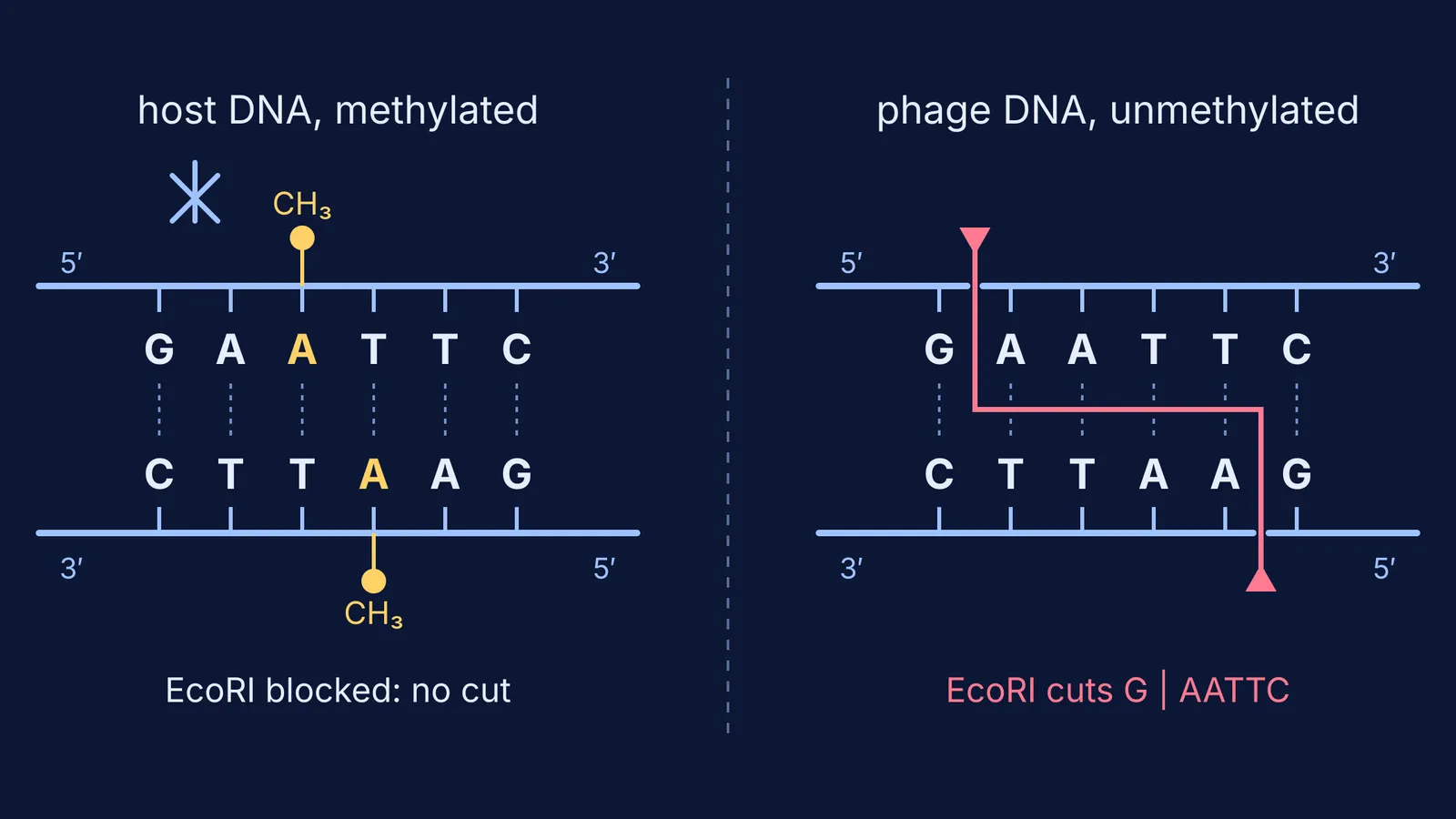
Follow one EcoRI site, GAATTC, through the diagram at the top of this post.
The bacterium makes two enzymes that read the same six-base site: the EcoRI methylase and the EcoRI restriction endonuclease.
The methylase scans the bacterium's own DNA and adds a methyl group (CH3) to the inner adenine of GAATTC on each strand.
The restriction enzyme finds these GAATTC sites but does not cut the methylated ones. The host chromosome stays whole.
A bacteriophage injects its DNA. That DNA was copied in a host without the EcoRI methylase, so its GAATTC sites carry no methyl mark.
The restriction enzyme cuts the phage DNA between G and A on each strand, leaving AATT sticky ends. Chopped phage DNA cannot take over the cell.
GAATTC is a palindrome: read 5' to 3', both strands give the same sequence, which is why each strand carries a methyl mark at mirrored positions. If that idea is shaky, read our explainer on what a palindromic sequence in a restriction site means.
What happens right after the bacterium copies its DNA?
Replication is semi-conservative, so each new double helix has one old, methylated strand and one new, unmethylated strand. Is the cell briefly at risk?
Barely. The 1996 EMBO Journal study found that methylating just one strand still strongly inhibits cutting, and the authors describe how "single-strand and double-strand methylation protect against endonuclease cleavage in vivo" (Jen-Jacobson and colleagues). So the half-marked site stays largely protected until the methylase marks the new strand too.
Can a phage ever escape restriction?
Sometimes. A history by Loenen and colleagues in Nucleic Acids Research (2014) explains that in the early 1950s scientists reported "host-controlled variation in bacterial viruses": one cycle of growth on a certain host changed whether the next generation of virus could grow on other hosts, and the change was reversible. In R-M terms, if the host methylase marks a phage's DNA before the restriction enzyme cuts it, the new phages carry that host's mark and infect the strain freely. Grown once in a different host, they lose the mark and become targets again.
R-M systems may do more than defend. Kommireddy Vasu and Valakunja Nagaraja of IISc Bengaluru reviewed evidence for roles in virulence and even in controlling the rate of evolution. For an exam, though, stick to defence against phage, as NCERT does. The scientists who first worked this out appear in our story on Hamilton Smith, Werner Arber and the restriction enzymes.
How do you write this answer in an exam?
A short answer can be built from four points. Use this frame:
Name the system: a restriction-modification system, two enzymes that recognise the same sequence.
Modification: a methylase adds methyl groups to the host's own recognition sites.
Restriction: the restriction endonuclease does not cut methylated sites, so host DNA is protected.
Defence: foreign (phage) DNA is unmethylated, so it is cut, which restricts the phage's growth.
Avoid two common traps. First, methylation does not change the base sequence: GAATTC is still GAATTC, just with a methyl group attached to one base. Second, the methyl group is added by the host's own methylase, not by the phage and not as a result of cutting.
If names like EcoRI still look like a code, see how restriction enzymes are named.
To check yourself, look up the concepts behind this answer in the Fermi Concept Library, where each biology concept has its own lesson and its place in the map. Then explain the five steps above aloud, without notes.