

On this page
If you are studying genetics or biotechnology, you will quickly meet a cast of molecular scissors with names like EcoRI, HindIII, and BamHI. These are restriction enzymes—proteins that cut DNA at specific sequences, acting as an immune system for bacteria against invading viruses. But their names are not random codes or complex chemical formulas. Each letter and number tells you exactly which bacterium the enzyme comes from and when it was discovered.
Why do we need a naming system for enzymes?
In the early days of molecular biology, researchers named enzymes however they liked (such as "endonuclease II" or "restriction enzyme K"). As more enzymes were found across different bacterial species, the list became confusing and hard to track.
In 1973, biologists Hamilton O. Smith and Daniel Nathans published a landmark paper in the *Journal of Molecular Biology* proposing a standard nomenclature (doi:10.1016/0022-2836(73)90152-690152-6)). They argued that an enzyme's name should immediately identify its biological source. Their system allowed scientists worldwide to understand an enzyme's origin just by reading its name, a standardisation step that helped earn Hamilton Smith, Werner Arber and others the Nobel Prize.
How are restriction enzymes named?
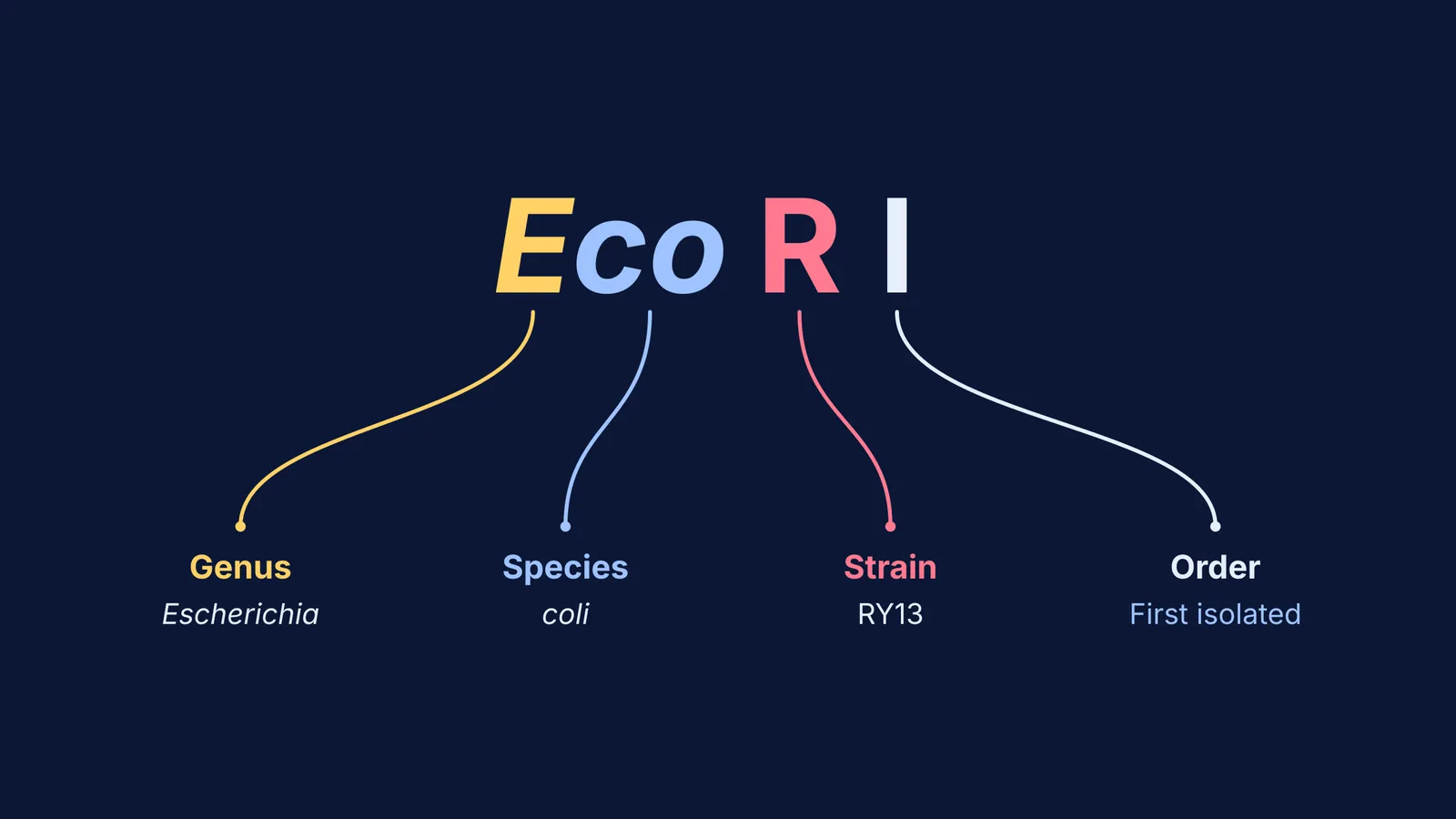
The convention uses a three-letter acronym for the host bacterium, followed by a strain designation and a Roman numeral.
Genus: The first letter comes from the genus of the bacterium and is always capitalised.
Species: The next two letters come from the species name and are written in lowercase.
Strain: This is followed by a letter or number denoting the specific bacterial strain or serotype.
Order: Finally, a Roman numeral shows the order in which enzymes were isolated from that particular strain.
What does each letter in EcoRI stand for?
EcoRI is the classic example of this naming convention. Let's decode it letter by letter:
E (Genus): The "E" stands for *Escherichia*, the genus of the host bacterium.
co (Species): The "co" stands for *coli*, the species name.
R (Strain): The "R" identifies the specific strain of the bacterium, which in this case is the RY13 strain.
I (Order of discovery): The Roman numeral "I" means this was the first restriction enzyme isolated from *E. coli* RY13.
EcoRI is a Type II restriction enzyme that recognises the sequence 5'-GAATTC-3' and makes a staggered cut between the G and the A on both strands. This leaves what biologists call "sticky ends" (a short overhang of unpaired bases: AATT). This precise cutting ability made EcoRI essential for early genetic engineering, as it allowed scientists to cut DNA from different sources and paste them together, paving the way for the first recombinant DNA experiments.
How can you decode any restriction enzyme?
Whenever you meet a new restriction enzyme in your textbook or an exam, use this simple mental checklist to decode its name. Let's test it on another common enzyme, HindIII:
Isolate the first three letters: They tell you the organism. For HindIII, *Hin* comes from the bacterium *Haemophilus influenzae*.
Look for a strain letter: The fourth character points to the specific bacterial strain. The "d" in HindIII stands for serotype d.
Check the Roman numeral: This tells you the chronological order of isolation from that strain. The III means it was the third restriction enzyme isolated from *H. influenzae* strain d.
How do you learn biological conventions?
Biologists love classification. Whether it is naming enzymes, writing out a floral formula, or memorising taxonomic ranks, you will encounter many rules and conventions. Instead of treating them as random facts to memorise by rote, it helps to break them down into their logical parts. Once you see the pattern, you can figure out the meaning of unfamiliar terms on your own.
When you are stuck on a dense biological convention or a mechanism you cannot picture, the Fermi Concept Library is a good place to turn. Fermi's AI tutor can help you unpack the logic behind the names, holding a line of reasoning across a session and checking your understanding as you go. You don't have to guess what a confusing acronym means—you can ask the tutor to break it apart for you, just as you would when studying enzymes for NEET biology or working through a complex genetic pathway.


