On this page
Unseen passages turn up in Class 5 to 8 English papers, and they reward a method more than speed. Three steps work for any passage: preview the questions, find the evidence line, then answer in your own words. Below, we try them on an official Grade 6 sample passage from India's national learning survey.
How do you solve reading comprehension in Class 6?
Use the same three steps every time.
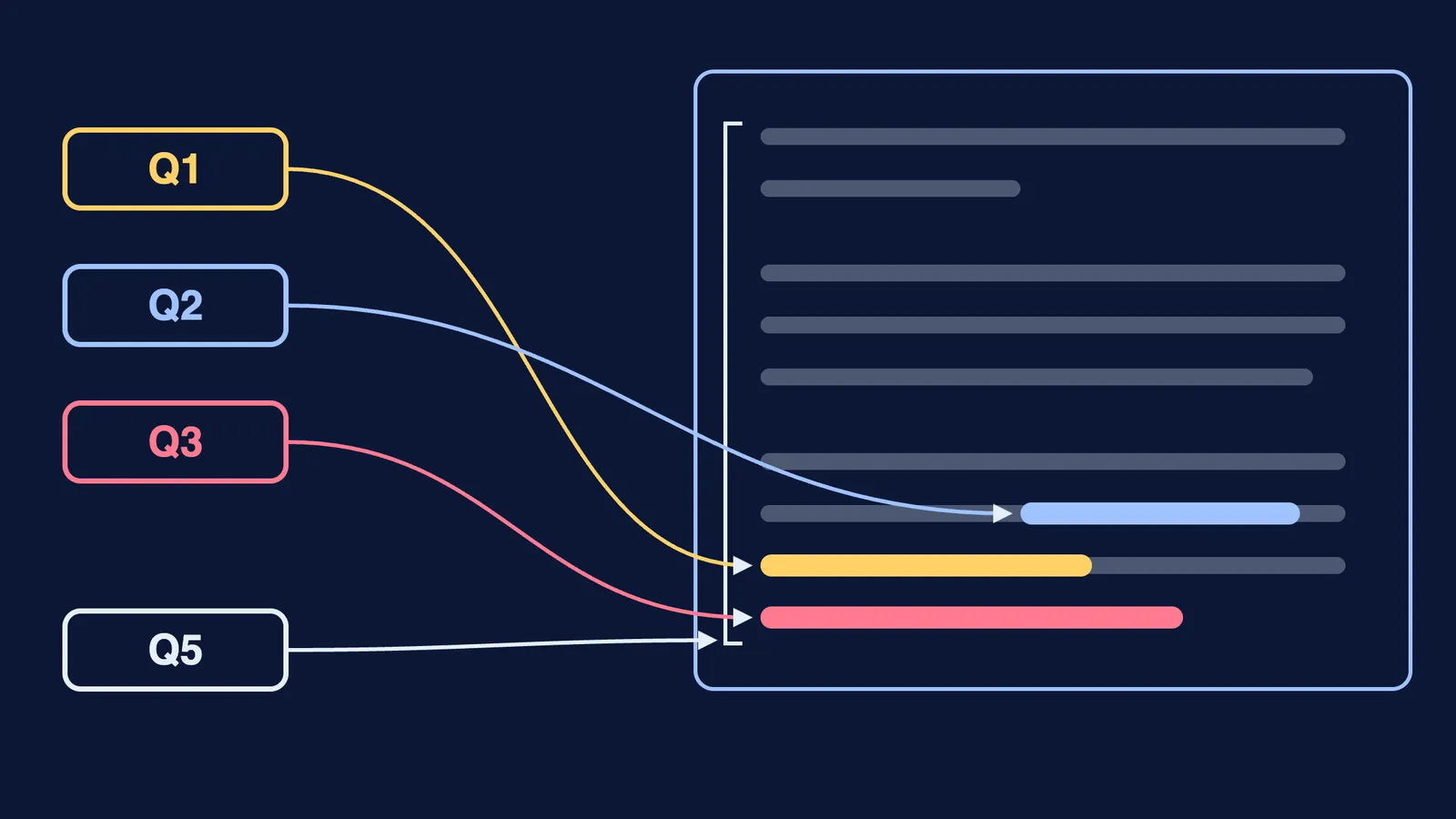
Preview the questions. Read every question before the passage and make a quick guess at each. Circle the key word in each: a name, a number, NOT, main idea.
Read once, then find evidence lines. Read the whole passage at normal speed. Then go back and underline the line that answers each question, with the question number in the margin.
Answer in your own words. For a multiple-choice question, check each option against your underlined line. For a written answer, cover the passage and say the answer aloud before you write it.
Why read the questions before the passage?
In a 2009 study by Lindsey Richland, Nate Kornell and Liche Sean Kao, participants read an essay about vision. In all five experiments, those who first tried questions about the essay did better on a later test than those given extra reading time. Only questions people got wrong at first were scored, so the gain came from trying. In one experiment, just seeing the questions without answering helped less. It was one science essay in a lab, so treat it as a strong hint, not a law.
Finding evidence and putting it in your own words belong to a wider family of comprehension strategies. A 1994 review of 16 studies of reciprocal teaching by Barak Rosenshine and Carla Meister, where students practise summarising, asking questions, clarifying and predicting, found a median effect size of 0.32 on standardised comprehension tests and 0.88 on tests the researchers wrote.
Worked example: an official Grade 6 sample passage
The PARAKH Rashtriya Sarvekshan 2024 Grade 6 sample items from NCERT open with a three-paragraph passage asking whether living things exist only on Earth. Its five questions cover the four kinds you will meet in most papers.
Find it (Questions 1 and 2). "According to the passage, which place might possibly have life?" The evidence line says "Places like Saturn's moon might have life", so the answer is Saturn's moon. Question 2 points to "know very little about other planets".
What it means (Question 3). "What does 'Let's keep looking' indicate?" Read the line before it: "We do not know, but we may find out in the future." The passage is about life, so the answer is looking for life on other planets, not just for other planets.
NOT questions (Question 4). Tick each option against the passage. Three options have an evidence line. "Some planets are composed of gases" has none, so it is the answer.
Main idea (Question 5). The right option, "We still don't know much about the universe we live in", fits every paragraph. The trap, "There are more tiny living things than big living things", makes a claim the passage never does.
How do you write answers in your own words?
Copying a whole line shows you found the words, not that you understood them. Try this routine:
Underline the evidence line.
Cover the passage with your hand.
Start your answer with the words of the question, such as "Humans know..."
Uncover and check one fact, not the wording.
Copied: "We have only started exploring our planet and know very little about other planets." Own words: "Humans have hardly explored other planets yet, so they know little about them."
If a science passage uses an idea you have not met yet, the Fermi Concept Library has a lesson for every concept in physics, chemistry, biology, mathematics and computing, so you can check the idea and return to the passage. To grow your word bank, try this ten-word weekly routine for learning English words in context.
How can parents help with unseen passages at home?
First, check that your child can read the passage aloud smoothly, because strategies help most once the words themselves come easily. The ASER 2024 national findings, from a rural household survey, report that 44.8% of Std V children in government schools could read a Std II level text; the matching figure for Std VIII was 67.5%. If reading aloud is hard, talk to the class teacher about reading support before drilling passages.
Then try ten minutes, three days a week:
Day 1: one passage, questions first, evidence lines underlined.
Day 2: the same passage; your child explains each answer without looking.
Day 3: a new passage, timed.
What to say: "Show me the line", not "That's wrong." The passage stays the judge, not you.
To make more passages and check the key, use this guide to making unseen passage practice with AI, and see why answering questions beats rereading in our one-week rereading vs practice testing experiment.