On this page
Completing the square turns any quadratic into the form (x + h)² = k, which a square root undoes. It is slower than factorisation, but it always works.
Why learn completing the square if the formula exists?
The 2026-27 reprint of the NCERT Class 10 maths textbook states the formula x = (−b ± √(b² − 4ac)) / 2a in section 4.4, straight after factorisation, without deriving it (NCERT Class 10 Mathematics, Chapter 4). The same chapter notes that Sridharacharya (C.E. 1025) derived the formula now known as the quadratic formula by the method of completing the square, as quoted by Bhaskara II.
So the method is where the formula comes from, and you will use it again when finding the maximum or minimum value of a quadratic.
How do you solve 2x² − 7x + 3 = 0 by completing the square?
Divide every term by a = 2 so that x² stands alone: x² − (7/2)x + 3/2 = 0.
Move the constant to the right: x² − (7/2)x = −3/2.
Halve the x-coefficient: half of −7/2 is −7/4.
Square it and add the result to both sides: (−7/4)² = 49/16, so x² − (7/2)x + 49/16 = −3/2 + 49/16.
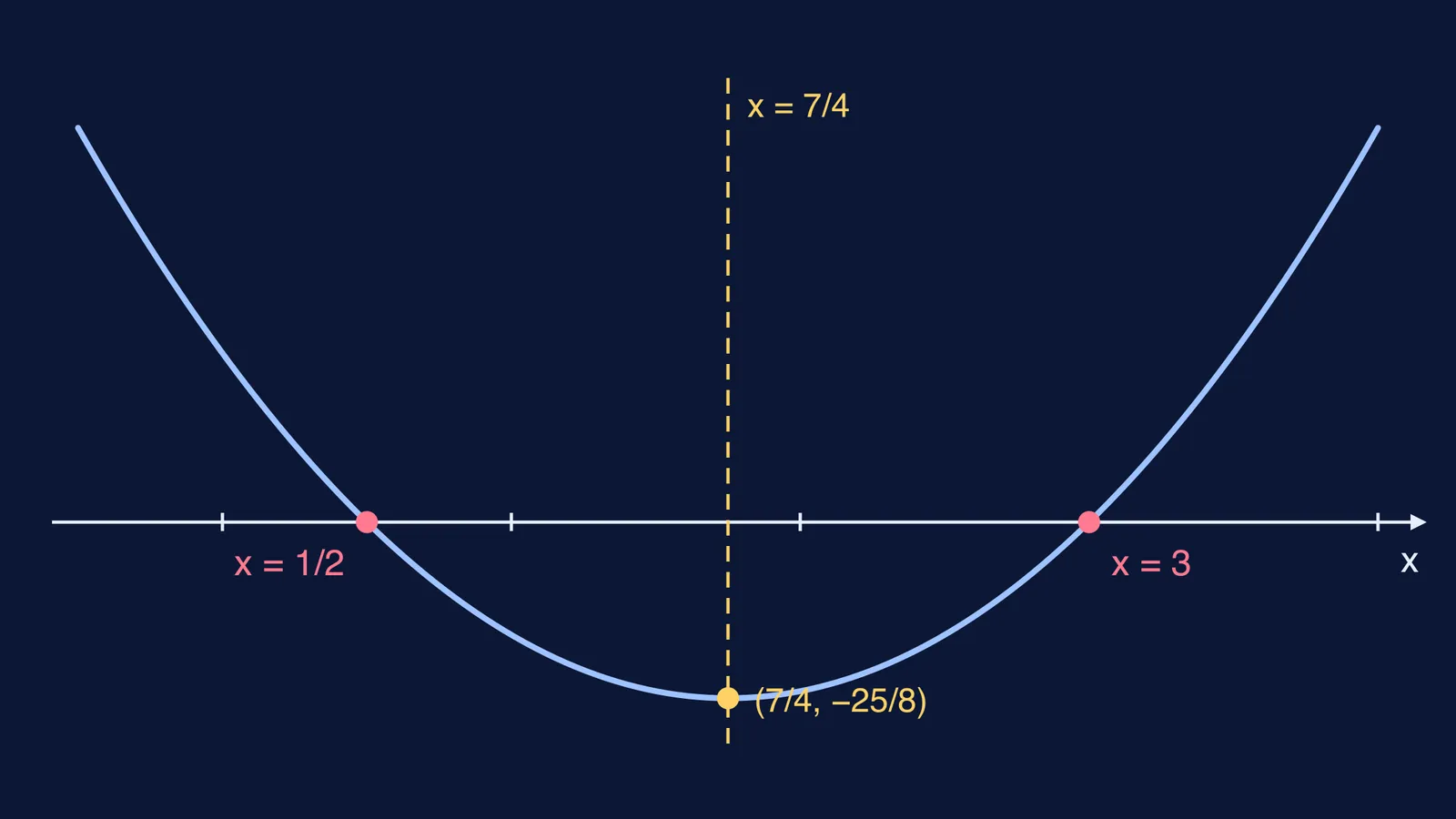
Write the left side as a perfect square, (x − 7/4)². On the right, −3/2 = −24/16, so the right side is 25/16. Now (x − 7/4)² = 25/16.
Take the square root with both signs: x − 7/4 = ±5/4.
Solve: x = 7/4 + 5/4 = 3, or x = 7/4 − 5/4 = 1/2.
Check both answers in the original equation: 2(3)² − 7(3) + 3 = 18 − 21 + 3 = 0, and 2(1/4) − 7/2 + 3 = 1/2 − 7/2 + 3 = 0. Both work.
If step 5 feels shaky, revise how to factorise a perfect square trinomial.
How does completing the square give the quadratic formula?
Run the same seven steps on ax² + bx + c = 0, with a ≠ 0, and keep the letters.
Divide by a: x² + (b/a)x + c/a = 0.
Move the constant: x² + (b/a)x = −c/a.
Halve the x-coefficient: b/2a.
Square it and add to both sides: x² + (b/a)x + b²/4a² = b²/4a² − c/a.
Write the left side as a square and put the right side over 4a²: (x + b/2a)² = (b² − 4ac)/4a².
Take the square root with both signs: x + b/2a = ±√(b² − 4ac)/2a.
Subtract b/2a: x = (−b ± √(b² − 4ac))/2a.
Put a = 2, b = −7 and c = 3 into step 5 and you get (x − 7/4)² = (49 − 24)/16 = 25/16, exactly as in the worked example. The formula is that example with the arithmetic done once, in advance.
Step 5 also explains the discriminant: a square cannot be negative, which is why the NCERT chapter says a quadratic has two distinct real roots, two equal real roots or no real roots as b² − 4ac is positive, zero or negative. When it is negative, the roots are complex: see what complex roots mean when the discriminant is negative.
Which halving mistakes should you avoid?
Most errors happen in steps 1, 3 and 4.
Halving before dividing by a. In 2x² − 7x + 3, halving −7 and squaring gives 49/4. Divide by 2 first, then halve, to get −7/4 and 49/16.
Forgetting to halve. Adding (−7/2)² = 49/4 instead of 49/16 leaves a left side that is not a perfect square.
Adding to one side only. Whatever you add on the left, add on the right.
Flipping the sign in the bracket. x² − (7/2)x + 49/16 is (x − 7/4)², not (x + 7/4)². The sign in the bracket matches the sign of the x-term.
Losing a root. The square root of 25/16 is ±5/4. Writing only +5/4 throws away x = 1/2.
If you keep making the same slip, the Fermi Problem Library has worked problems with a step-by-step solver that explains the reasoning rather than printing an answer, so you can find the line where yours differs.
A five-minute practice plan
Solve 2x² − 7x + 3 = 0 again on a blank page, without looking.
Factorise it as a check: (2x − 1)(x − 3) = 0 gives the same roots.
Try x² + 6x − 7 = 0. Here a = 1, so skip step 1. You should get 1 and −7.
Try 3x² − 5x − 2 = 0. You should reach (x − 5/6)² = 49/36, so x = 2 or x = −1/3.
Derive the formula from ax² + bx + c = 0 once, from memory.
If a step in the derivation still feels like magic, the Fermi Concept Library has a lesson for every concept in mathematics, each with its place in the map, so you can go back to the idea underneath.