

On this page
You don't need calculus to find the smallest value of 2x² − 8x + 3. One line of algebra gives it, and the same line tells you when the answer is a largest value instead.
What is the minimum value of ax² + bx + c?
Start by completing the square. Any quadratic ax² + bx + c with a ≠ 0 can be rewritten as a(x − h)² + k, where h = −b/2a and k = c − b²/4a, as the Wikipedia article on completing the square sets out.
This helps because a square is never negative. (x − h)² is 0 only at x = h, so if a is positive the whole expression is at least k. That makes k your minimum, reached at x = h.
Here it is for 2x² − 8x + 3:
Take the 2 out of the x terms: 2(x² − 4x) + 3.
Half of −4 is −2, so add and subtract its square inside the bracket: 2[(x − 2)² − 4] + 3.
Multiply out: 2(x − 2)² − 8 + 3 = 2(x − 2)² − 5.
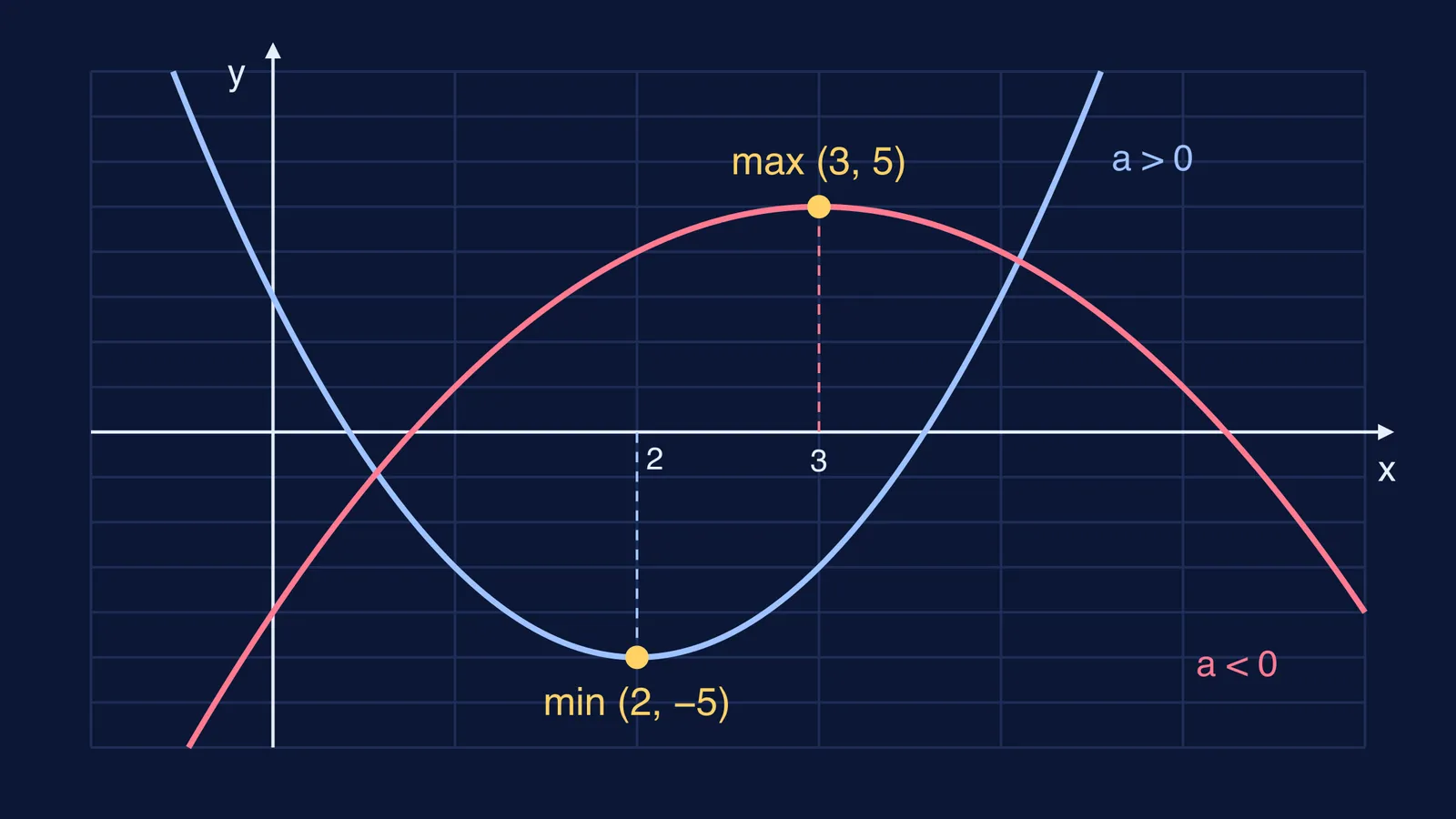
The minimum is −5, at x = 2. Check it: 2(4) − 16 + 3 = −5.
How do you find the minimum using −D/4a?
Write k over a common denominator: c − b²/4a = (4ac − b²)/4a = −(b² − 4ac)/4a. The quantity b² − 4ac is the discriminant D, the same number that tells you whether the roots are real, as the Wikipedia article on the discriminant explains. So the extreme value is −D/4a, reached at x = −b/2a. This matches the vertex (−b/2a, c − b²/4a) given in the Wikipedia article on the quadratic function.
Same example: a = 2, b = −8, c = 3 gives D = 64 − 24 = 40, so −D/4a = −40/8 = −5.
Use −D/4a when you only need the number. Complete the square when the question also wants the position, a range or a proof.
When does a quadratic have a maximum instead?
The sign of a decides. The vertex is the maximum point if a < 0 and the minimum point if a > 0, as stated in the quadratic function article. An upward U has a lowest point but no highest one.
Take −x² + 6x − 4, where a = −1:
Take out the minus sign: −(x² − 6x) − 4.
Complete the square inside: −[(x − 3)² − 9] − 4.
Simplify: −(x − 3)² + 5.
Since −(x − 3)² is never positive, the maximum is 5, at x = 3. The formula agrees: D = 36 − 16 = 20 and −D/4a = −20/(−4) = 5. There is no minimum; the expression keeps falling as x moves away from 3.
Which method fits which exam question?
Most questions come in one of four shapes:
x can be any real number: use −D/4a, then check the sign of a to see whether it's a minimum or a maximum.
x is limited to an interval: first check whether the vertex lies inside it. For 2x² − 8x + 3 with 3 ≤ x ≤ 5, the vertex x = 2 lies outside, so −5 is out of reach. The expression rises to the right of its vertex, so the minimum is f(3) = 18 − 24 + 3 = −3 and the maximum f(5) = 50 − 40 + 3 = 13.
Find k so the expression stays non-negative: for x² + 4x + k ≥ 0 for every x, the minimum is −D/4a = −(16 − 4k)/4 = k − 4. You need k − 4 ≥ 0, so k ≥ 4.
A quadratic in the denominator: to maximise 1/(x² + 2x + 5), write the denominator as (x + 1)² + 4. Its smallest value is 4, at x = −1, so the largest value of the fraction is 1/4. This works because the denominator stays positive.
What mistakes cost marks on these questions?
Check these before you write the final answer:
Did you check the sign of a before calling the value a minimum?
Did you give the value, not just the position? −b/2a tells you where the extreme is, not what it is.
Did you square b with its sign? (−8)² is 64, not −64.
When completing the square, did you take out a first?
If x is restricted, is the vertex actually inside the allowed interval?
Is the question asking for a minimum when a < 0? Then over all real x the answer is that none exists.
If you keep slipping at the same step, the Fermi Problem Library has worked problems with a step-by-step solver that explains the reasoning rather than printing an answer, so you can see where your working went wrong. To revisit vertex form or the discriminant, the Fermi Concept Library gives each mathematics concept its own lesson and its place in the map.


