On this page
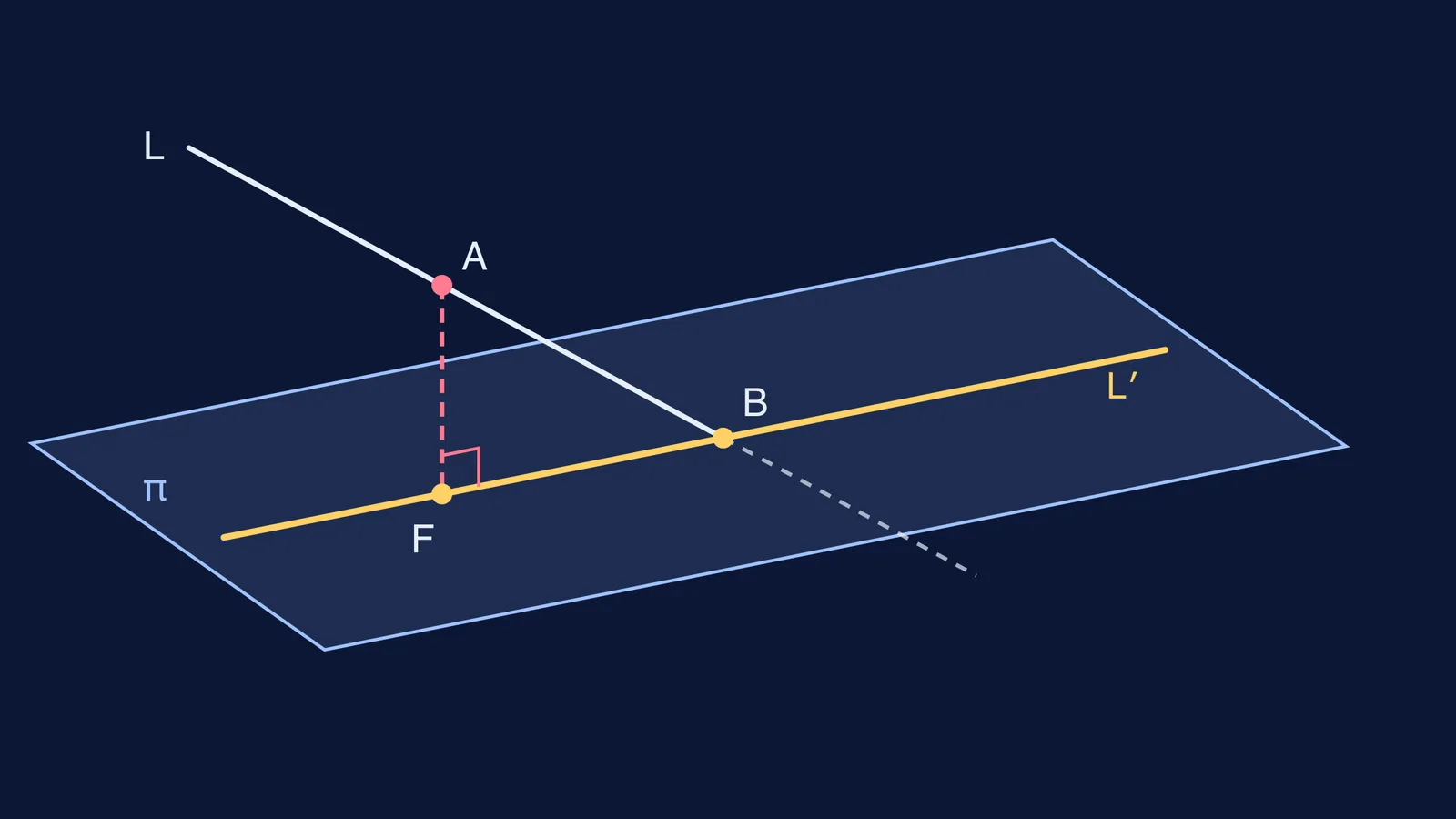
The projection of a line L on a plane π is the shadow L casts when light falls onto the plane at right angles to it. Every point of L drops straight onto π, and those points form a new line L′ in the plane. You never need to project every point: two points fix a line, and the easiest two are the foot of one perpendicular and the point where L meets the plane.
How do you find the equation of the projection of a line on a plane?
Use these four steps whenever L cuts π and is not perpendicular to it.
Pick a point A on L, usually the one you can read off the symmetric form.
Find F, the foot of the perpendicular from A to π. For the plane ax + by + cz + d = 0 and A = (x1, y1, z1), F = A - k(a, b, c), where k = (ax1 + by1 + cz1 + d)/(a² + b² + c²).
Find B, where L meets π, by putting the general point of L into the plane's equation.
Write the line through F and B. Its direction ratios are B - F.
Step 2 is the first half of finding the image of a point in a plane. Step 3 is the method for finding where a line meets a plane. B is already on the plane and F is the shadow of A, so both lie on L′.
What does the method look like with real numbers?
Find the projection of the line (x - 1)/1 = (y - 2)/(-2) = (z - 3)/(-2) on the plane x + y + z = 3.
Step 1. From the symmetric form, A = (1, 2, 3) and the direction is (1, -2, -2). A is not on the plane, because 1 + 2 + 3 = 6.
Step 2. The normal is (1, 1, 1), so k = (1 + 2 + 3 - 3)/3 = 1 and F = (1, 2, 3) - (1, 1, 1) = (0, 1, 2). Check: 0 + 1 + 2 = 3.
Step 3. A general point of L is (1 + r, 2 - 2r, 3 - 2r). The plane gives 6 - 3r = 3, so r = 1 and B = (2, 0, 1).
Step 4. B - F = (2, -1, -1), so the projection is (x - 2)/2 = y/(-1) = (z - 1)/(-1).
Some books find the plane through L perpendicular to π and intersect it with π. Here that plane is y - z + 1 = 0, and F and B both satisfy it, so the routes agree. The four steps are usually quicker in an exam.
What if the line is parallel or perpendicular to the plane?
Before you start, take the dot product of the line's direction with the normal.
Not zero: the line cuts the plane. Use the four steps.
Zero, with A off the plane: L is parallel to π and there is no B. The projection passes through F with the same direction as L.
Zero, with A on the plane: L lies in π and is its own projection.
Direction proportional to the normal: the projection is a single point, B.
The same dot product gives the angle between L and π through sin θ = |d·n|/(|d||n|), which our post on the angle between a line and a plane works through.
Is this topic in the JEE Main and JEE Advanced syllabus?
The two exams differ here. The JEE (Advanced) 2026 syllabus lists the equation of a plane, the distance of a point from a plane and the angle between a line and the plane under "Three dimensions". The NTA's syllabus for JEE (Main) 2027 lists the equation of a line, skew lines and the shortest distance under Three Dimensional Geometry, with no separate entry for planes.
So this method matters most for JEE Advanced. If you are preparing only for JEE Main, check the current syllabus on the NTA website before you give time to planes.
How should you practise projections?
Project the same line L onto the plane z = 0. Answer: (x - 1)/1 = (y - 2)/(-2), with z = 0.
Project (x - 1)/1 = (y - 2)/1 = (z - 3)/(-2) onto x + y + z = 3. The dot product is zero, so the line is parallel to the plane. Answer: x/1 = (y - 1)/1 = (z - 2)/(-2).
Most wrong answers come from a sign error in k, so always check that F satisfies the plane's equation.
If you get stuck on a step, the Fermi Problem Library has worked problems with a step-by-step solver that explains the reasoning rather than printing an answer. If normals or the symmetric form still feel shaky, each idea has its own lesson in the Fermi Concept Library.