On this page
The projection formula sits underneath the cosine rule: each side of a triangle equals the sum of the shadows the other two sides cast on it. Here is the proof from one altitude, a numerical check, and three cyclic expressions it simplifies.
What is the projection formula in a triangle?
In triangle ABC, write a, b and c for the sides opposite angles A, B and C. The projection formulae are:
a = b cos C + c cos B
b = c cos A + a cos C
c = a cos B + b cos A
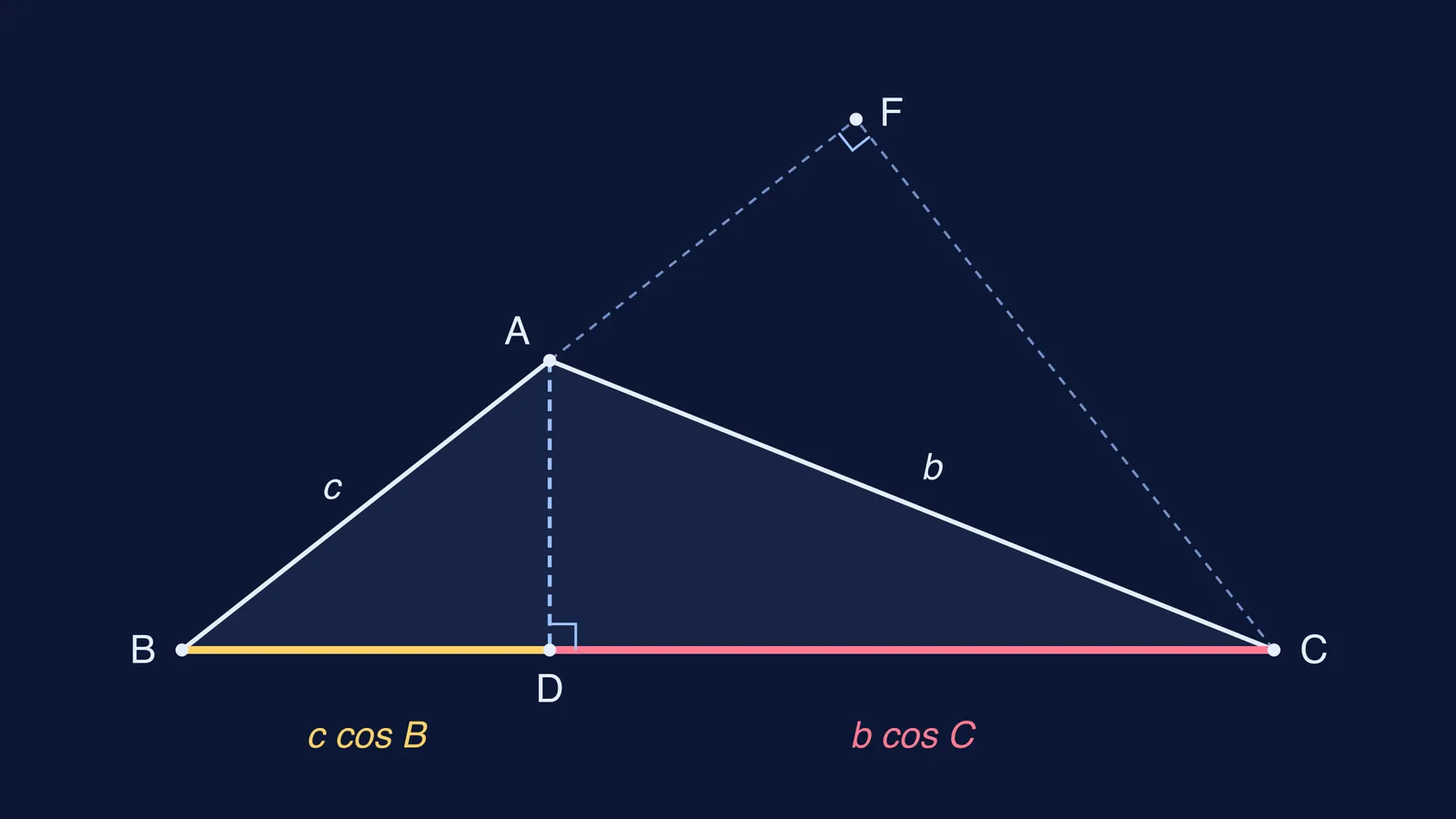
Here c cos B is the projection (shadow) of side AB on BC, and b cos C is the shadow of AC. The law of cosines article on Wikipedia derives the same relation, c = a cos β + b cos α, from the altitude through C.
How do you prove a = b cos C + c cos B?
Drop the altitude from A to the line BC and call its foot D.
B and C acute: D lies between B and C. In right triangle ABD, BD = c cos B; in right triangle ACD, DC = b cos C. So a = BD + DC = c cos B + b cos C.
C obtuse: D falls on BC extended beyond C. BD = c cos B and CD = b cos(180° − C) = −b cos C. So a = BD − CD = c cos B + b cos C again.
C = 90°: D is C, cos C = 0, and a = c cos B is the definition of cosine.
Obtuse B mirrors case 2. Cycle the letters for the other two formulae.
Check it with numbers. Take a = 7, b = 5, c = 3. The cosine rule gives cos A = −1/2 (so A = 120°), cos B = 11/14 and cos C = 13/14. Then b cos C + c cos B = 65/14 + 33/14 = 7, which is a. For side b, c cos A + a cos C = −3/2 + 13/2 = 5: the negative projection does its job.
How does the projection formula give the cosine rule?
Multiply the three formulae by a, b and c:
a² = ab cos C + ca cos B
b² = bc cos A + ab cos C
c² = ca cos B + bc cos A
Add the second and third, subtract the first, and everything cancels except b² + c² − a² = 2bc cos A: the cosine rule, derived the same way on Wikipedia.
How do projection formulae simplify cyclic expressions?
Regroup terms so that each pair is one side's projection formula.
Example 1. Simplify (b + c) cos A + (c + a) cos B + (a + b) cos C. Expand and pair: (b cos C + c cos B) + (c cos A + a cos C) + (a cos B + b cos A) = a + b + c.
Example 2. Show that c cos²(B/2) + b cos²(C/2) = s, where s is the semi-perimeter. Use cos²(x/2) = (1 + cos x)/2. The left side becomes (b + c + c cos B + b cos C)/2 = (b + c + a)/2 = s.
Example 3. Simplify (b − c cos A)/(c − b cos A). From the second formula, b − c cos A = a cos C. From the third, c − b cos A = a cos B. The ratio is cos C / cos B.
A three-step checklist for any cyclic expression
Expand until every term is a side times a cosine (turn cos²(x/2) into (1 + cos x)/2).
Pair terms whose letters differ: b cos C with c cos B, c cos A with a cos C, a cos B with b cos A.
Replace each pair with one side. If pieces are left over, switch to the cosine or sine rule.
For that choice, see when to use the sine rule or the cosine rule. The same toolkit leads to the inradius, circumradius and exradius formulas, and the history of al-Kashi's law of cosines explains the rule's other name.
Is the projection formula in the JEE syllabus?
The trigonometry section of the JEE (Advanced) 2026 Information Brochure lists trigonometric functions, addition and multiple-angle formulae, general solutions of trigonometric equations and inverse trigonometric functions; it does not name the sine rule, cosine rule or projection formulae. JEE Main, boards and other exams publish their own lists, so read yours.
If an expression refuses to pair up, the Fermi Problem Library has worked problems with a step-by-step solver that explains the reasoning rather than printing an answer. If the cosine rule feels shaky, the Fermi Concept Library gives each mathematics concept its own lesson.
Try it now: close this page and prove a = b cos C + c cos B for an obtuse C.