

On this page
Most triangle problems tell you which rule to use before you write a line. Read what you are given as a pattern of sides (S) and angles (A), then match it to a rule. Shaky on right triangles? Start with heights and distances in Class 10.
Are the sine and cosine rules in the JEE syllabus?
The trigonometry section of the JEE (Advanced) 2026 Information Brochure lists trigonometric functions, addition and subtraction formulae, multiple and sub-multiple angle formulae, trigonometric equations and inverse trigonometric functions. It does not name the sine rule or the cosine rule.
It does list the centroid, orthocentre, incentre and circumcentre of a triangle under analytical geometry, where the two rules are useful, and the cosine rule gives the resultant of two forces in physics. For JEE Main, check the current NTA information bulletin.
How do you know whether to use the sine rule or the cosine rule?
The sine rule says a/sin A = b/sin B = c/sin C, where each side sits opposite its angle (OpenStax Precalculus 2e, Law of Sines). That common ratio equals 2R, the diameter of the triangle's circumcircle (Law of sines). The cosine rule says a² = b² + c² − 2bc cos A (OpenStax Precalculus 2e, Law of Cosines).
Ask these four questions in order:
Do you know an angle and the side opposite it? Use the sine rule. This covers AAS and ASA; get the third angle from the angle sum.
Do you know two sides and the angle between them (SAS)? Use the cosine rule to get the third side.
Do you know all three sides (SSS)? Use the cosine rule on the largest angle first: the sign of its cosine shows whether the triangle is obtuse.
Do you know two sides and an angle that is not between them (SSA)? Use the sine rule, then check for a second triangle. OpenStax notes that SSA can give one triangle, two, or none.
The fourth case needs the most care. Take A = 30°, a = 6 and b = 10. Then sin B = 10 × sin 30° / 6 = 5/6, so B ≈ 56.4° or B ≈ 123.6°. Both fit with A = 30°, so two triangles match.
Worked example: one triangle, both rules and the projection formula
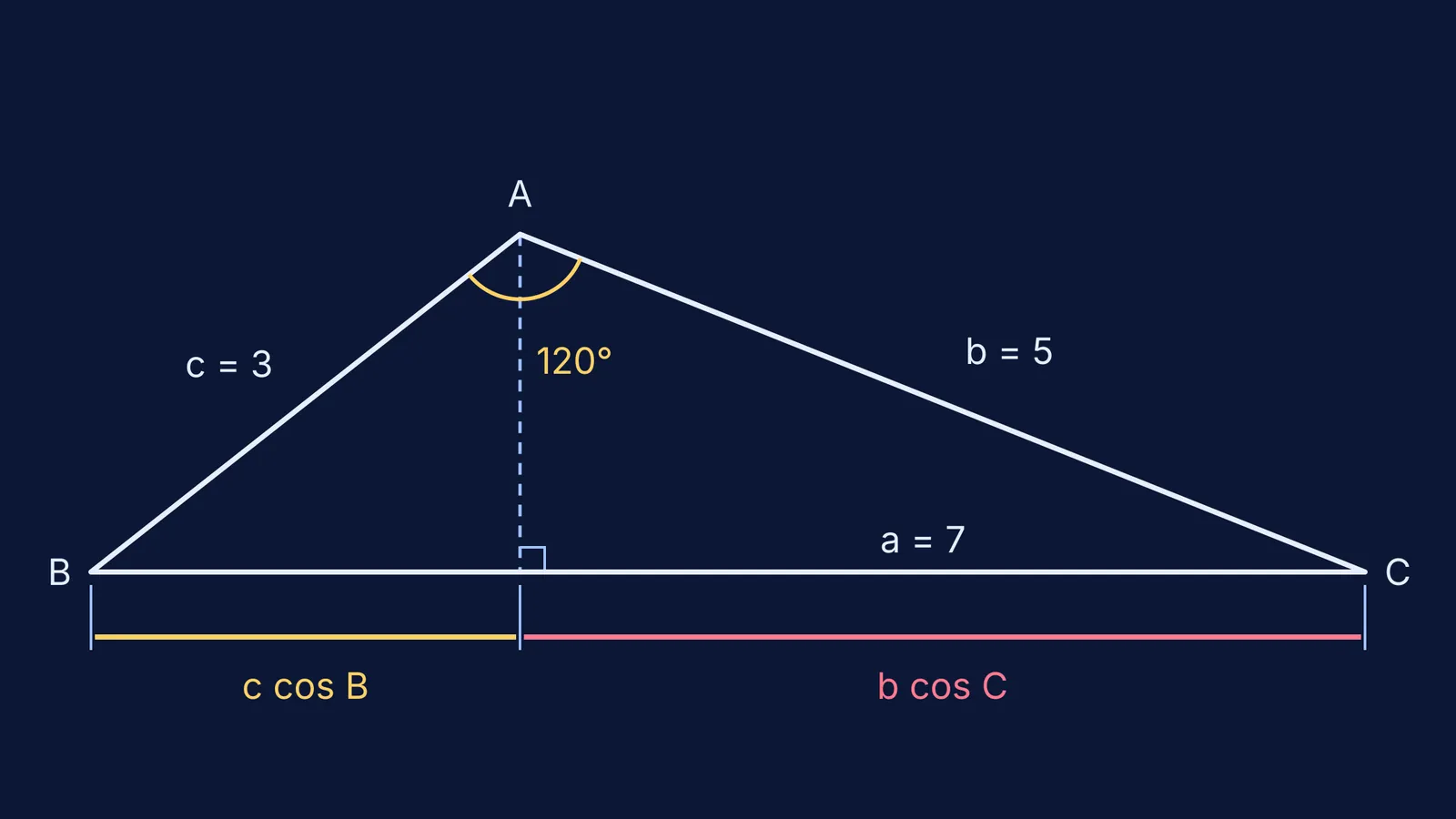
Take a = 7, b = 5 and c = 3. All three sides are known (SSS), so use the cosine rule on the largest angle: cos A = (b² + c² − a²)/2bc = (25 + 9 − 49)/30 = −1/2, so A = 120°.
The sine rule is now safe for B, which must be acute: sin B = 5 × (√3/2) / 7 = 5√3/14.
The projection formula says each side equals the sum of the other two sides' projections onto it: a = b cos C + c cos B (Law of cosines, "From three altitudes"). The cosine rule gives cos B = 11/14 and cos C = 13/14, so b cos C + c cos B = 65/14 + 33/14 = 98/14 = 7, as the diagram at the top shows. Multiply each projection formula by its own side, subtract two from the third, and the cosine rule falls out.
How do you prove triangle identities for JEE?
Most identities give way to one of two moves: turn everything into sides, or turn everything into angles.
Prove that a(b cos C − c cos B) = b² − c².
Route 1: into sides. The cosine rule gives b cos C = (a² + b² − c²)/2a and c cos B = (a² + c² − b²)/2a. Subtract to get (b² − c²)/a, then multiply by a.
Route 2: projection and sine rule. Write a = b cos C + c cos B, so the left side is (b cos C + c cos B)(b cos C − c cos B) = b² cos² C − c² cos² B. The sine rule gives b sin C = c sin B, so b² sin² C − c² sin² B = 0. Add that to the line above and you are left with b² − c².
Use this checklist on any identity:
Sines next to sides: replace a with 2R sin A (and the same for b and c).
Cosines next to sides: use the cosine rule.
A pair like b cos C + c cos B: that is the projection formula, so replace it with a.
Use A + B + C = 180°, so sin(B + C) = sin A and cos(B + C) = −cos A. See our post on conditional identities when A + B + C = π.
Test the identity on the 7-5-3 triangle first; if it fails there, recheck it.
Rusty on the basic formulae? Use our plan for practising trigonometric identities.
If you keep reaching for the wrong rule, work through triangle problems in the Fermi Problem Library. Its step-by-step solver explains the reasoning rather than printing an answer, so you can see why the given data pointed to one rule.


