

On this page
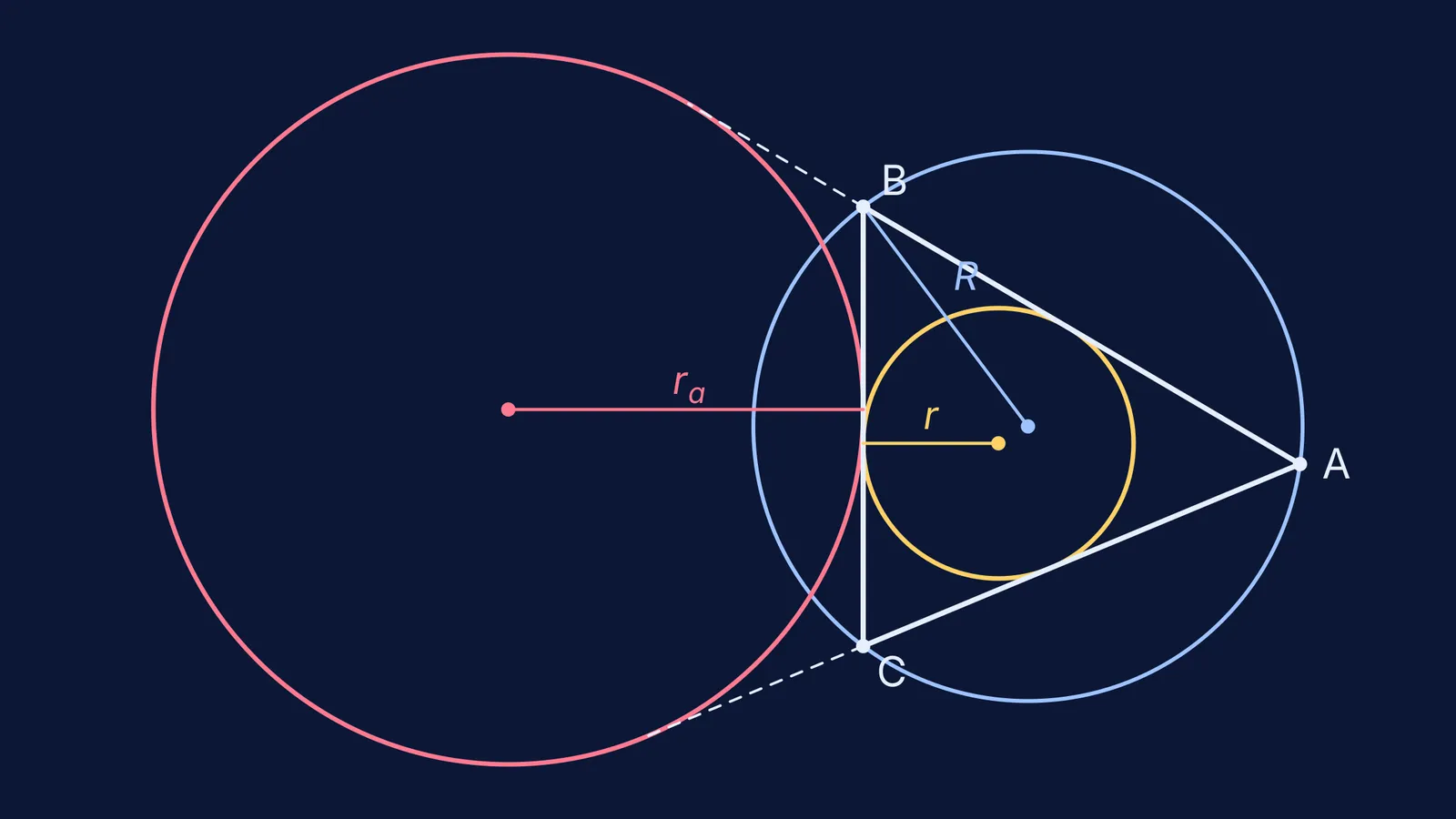
Every triangle has five special radii: the incircle, the circumcircle and three excircles. They are really one idea: find the semiperimeter and the area, and every radius is one division away.
What are the formulas for inradius and circumradius?
The semiperimeter is s = (a + b + c)/2. Heron's formula gives the area as Δ = √[s(s − a)(s − b)(s − c)] (Wolfram MathWorld: Heron's formula).
The inradius r is the radius of the circle that touches all three sides from inside, and r = Δ/s (MathWorld: Inradius).
The circumradius R is the radius of the circle through all three vertices, and R = abc/(4Δ); for a right triangle R is half the hypotenuse (MathWorld: Circumradius).
Why r = Δ/s? Join the incentre to the vertices. You get three triangles with bases a, b, c and height r, so Δ = ½r(a + b + c) = rs. For the base-times-height step, see why the area of a triangle is half base times height.
What is an exradius, and how is it different?
An excircle sits outside the triangle. It touches one side and the extensions of the other two. The exradius opposite side a is r1 = Δ/(s − a), and r2 and r3 follow the same pattern with s − b and s − c (MathWorld: Exradius).
The same page lists three identities linking r, the exradii, R and Δ:
r1 + r2 + r3 − r = 4R
1/r1 + 1/r2 + 1/r3 = 1/r
r × r1 × r2 × r3 = Δ²
Where do the half-angle formulas come in?
The tangent lengths do the work. From vertex A, the two tangents to the incircle each have length s − a (Wikipedia: Incircle and excircles). Equal tangents also prove a quadrilateral circumscribing a circle.
The law of cotangents says cot(A/2) = (s − a)/r, so tan(A/2) = r/(s − a) (Wikipedia: Law of cotangents). The same page gives r = √[(s − a)(s − b)(s − c)/s]. Substitute it and you get the textbook half-angle formula tan(A/2) = √[(s − b)(s − c)/(s(s − a))].
When a problem gives angles and R but no sides, use r = 4R sin(A/2) sin(B/2) sin(C/2) (MathWorld: Inradius).
Worked problem set: one triangle, every formula
Problem 1: the 13-14-15 triangle. Take a = 13, b = 14, c = 15.
s = 21, so Δ = √(21 × 8 × 7 × 6) = √7056 = 84.
r = 84/21 = 4.
R = (13 × 14 × 15)/(4 × 84) = 2730/336 = 65/8.
r1 = 84/8 = 10.5, r2 = 84/7 = 12, r3 = 84/6 = 14.
tan(A/2) = 4/8 = 1/2, tan(B/2) = 4/7, tan(C/2) = 4/6 = 2/3. Since r1 = rs/(s − a), r1 = s tan(A/2) = 21 × 1/2 = 10.5, as before.
Identities:10.5 + 12 + 14 − 4 = 32.5 = 4R; 1/10.5 + 1/12 + 1/14 = 21/84 = 1/4 = 1/r; and 4 × 10.5 × 12 × 14 = 7056 = 84².
Problem 2: run it backwards. The exradii are 10.5, 12 and 14. Find the sides. The reciprocal identity gives r = 4, and the product identity gives Δ = 84. Then s = Δ/r = 21 and s − a = Δ/r1 = 8, so a = 13; likewise b = 14 and c = 15.
Problem 3: the 3-4-5 right triangle. Here s = 6 and Δ = 6, so r = 1 and R = 5/2 (half the hypotenuse). The exradii are 6/3 = 2, 6/2 = 3 and 6/1 = 6. The one opposite the hypotenuse equals s. Check: 2 + 3 + 6 − 1 = 10 = 4R.
Problem 4: can R ever be less than 2r? Euler's triangle formula is R² − d² = 2Rr, where d is the distance between the incentre and the circumcentre (MathWorld: Circumradius). Rearrange it to d² = R(R − 2r). Since d² cannot be negative, R ≥ 2r. Equality needs d = 0, which happens only in an equilateral triangle. For 13-14-15, d² = 65/8 × 1/8 = 65/64.
How should you practise these for exams?
Write s and Δ first. A wrong area spoils every radius.
Pick the formula from what is given: sides mean Δ/s and abc/(4Δ); angles with R mean the half-angle product; exradii mean the reciprocal and product identities.
End each problem by checking one identity.
If the missing piece is an angle or side, see our guide on choosing the sine rule or the cosine rule.
If you get stuck on a step, the Fermi Problem Library has worked problems with a step-by-step solver that explains the reasoning rather than printing an answer. If the gap is the idea itself, the Fermi Concept Library gives each mathematics concept its own lesson.


