

On this page
When a four-sided shape is drawn tightly around a circle so that every side touches the edge, it possesses a beautiful geometric symmetry: the sums of its opposite side lengths are exactly equal.
This rule gives you a rapid way to solve for unknown side lengths in geometry exams, but its real value lies in how you prove it.
What does it mean for a quadrilateral to circumscribe a circle?
If you draw a circle and then draw four tangent lines that enclose it, you have created a tangential quadrilateral. The circle inside is called the incircle, and the quadrilateral is said to circumscribe the circle.
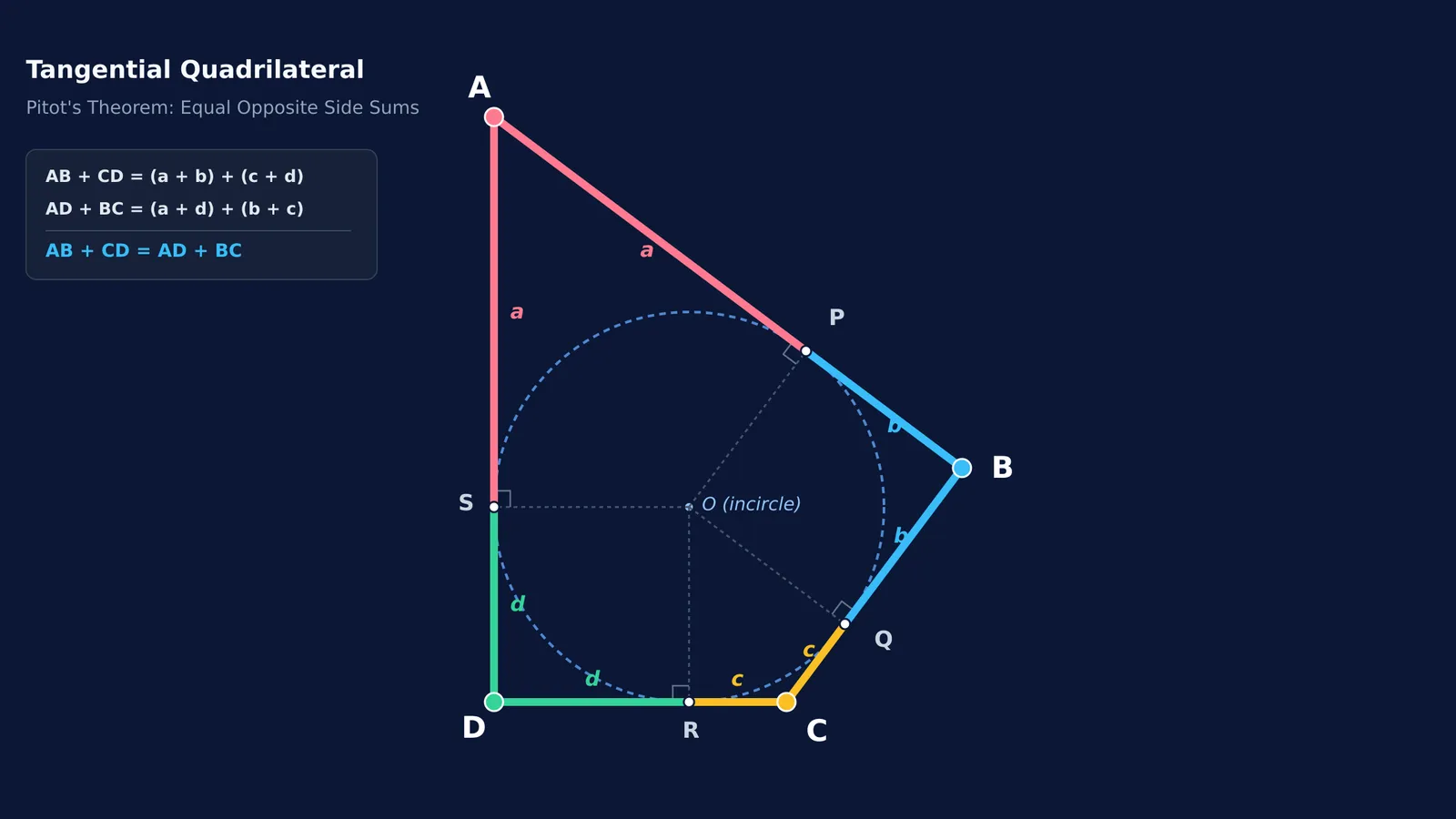
In 1725, the French engineer Henri Pitot proved that for any such shape, the sum of the lengths of two opposite sides equals the sum of the other two opposite sides Pitot theorem - Wikipedia. If your quadrilateral has vertices A, B, C and D, the theorem states that AB + CD = AD + BC.
Over a century later, in 1846, the Swiss mathematician Jakob Steiner proved the converse: if a convex quadrilateral has opposite sides that sum to the same value, it is guaranteed to be a tangential quadrilateral that can perfectly hold an incircle.
How to prove AB + CD = AD + BC?
The proof relies entirely on the two-tangent theorem. This theorem states that if you pick any point outside a circle and draw two tangent lines to the circle, the line segments from your point to the two points of tangency are equal in length.
When a quadrilateral circumscribes a circle, each of its four vertices acts as an external point drawing two tangents. Let the points where the sides touch the circle be P on AB, Q on BC, R on CD, and S on DA.
From vertex A, the two tangent segments are AP and AS. Therefore, AP = AS.
From vertex B, the two tangent segments are BP and BQ. Therefore, BP = BQ.
From vertex C, the two tangent segments are CQ and CR. Therefore, CQ = CR.
From vertex D, the two tangent segments are DR and DS. Therefore, DR = DS.
Now, write out the sum of the two opposite sides AB and CD by breaking them down into these component tangent segments:
AB + CD = (AP + BP) + (CR + DR)
Because of our four rules established above, we can substitute the equal lengths for each segment:
= (AS + BQ) + (CQ + DS)
Rearranging the terms groups them neatly into the other two sides:
= (AS + DS) + (BQ + CQ) = AD + BC
And the proof is complete.
Why do worked examples build geometry skills faster?
When you first encounter problems like this, trying to derive the proof from scratch can feel overwhelming. In a foundational 1985 study on cognitive load, researchers John Sweller and Graham A. Cooper demonstrated that studying step-by-step worked examples improves learning far more than traditional problem-solving The Use of Worked Examples as a Substitute for Problem Solving in Learning Algebra.
When you solve a new geometry problem, your working memory is flooded with the "search" for the right rules and formulas. A worked example removes that search, allowing your brain to focus entirely on building a schema — the mental model of how the different geometric parts relate to one another.
If you find yourself stuck searching for the next step when studying, the Fermi Problem Library provides worked problems with a step-by-step solver that explains the reasoning rather than simply printing an answer. By studying the explicit relationships between the steps, you automate your knowledge for the exam hall.
How do you solve for an unknown side using Pitot's theorem?
Once you know the theorem, applying it is straightforward. Suppose you are told that a quadrilateral ABCD circumscribes a circle, and you are given three side lengths: AB = 15, BC = 18, and CD = 21. What is the length of side AD?
Set up the algebraic equation using Pitot's theorem: AB + CD = AD + BC 15 + 21 = AD + 18 36 = AD + 18 AD = 18
If you want to explore the deeper concepts connecting geometry and tangents, you can review the Fermi Concept Library for lessons that place each geometric rule in a broader map. And if you struggle to picture how changing one angle affects the tangent lengths, Fermi's AI tutor can teach through the problem, drawing the figure and checking your understanding as it goes.
Read more about geometric coordinate systems and proofs:


