On this page
Positronium is an atom with no nucleus: one electron and one positron, its antiparticle, held together by the same Coulomb attraction that binds hydrogen. Martin Deutsch reported the first evidence for it in 1951 in Physical Review. Because the positron is exactly as heavy as the electron, the shortcut you learnt for hydrogen (treat the nucleus as fixed) fails, and reduced mass does the work instead.
Why can't you treat positronium like hydrogen?
In hydrogen the proton is so much heavier than the electron that it barely moves, so the electron alone circles a fixed centre. In positronium neither particle is heavier, so both circle their common centre of mass, like two equal stars in a binary system.
The review by Bass and colleagues in Reviews of Modern Physics describes positronium as the bound state of an electron and a positron. Its para form decays into two photons with a lifetime of 125 picoseconds, and its ortho form decays into three photons with a lifetime of 142 nanoseconds.
How does reduced mass change the Bohr formulas?
For two bodies of mass m1 and m2, you can replace the pair with one particle of reduced mass μ = m1m2/(m1 + m2) moving around a fixed centre at their separation r. For positronium m1 = m2 = m, so μ = m/2. The positronium article on Wikipedia states that this factor of 2 is why its energy levels are roughly half those of hydrogen.
Bohr's results depend on mass like this:
Energy: E_n is proportional to μ, so every level halves.
Separation: r_n is proportional to 1/μ, so every orbit doubles.
Wavelength: λ is proportional to 1/ΔE, so every line doubles.
Our post on deriving the Bohr radius and energy shows where these come from.
What is the ground state energy of positronium?
Start from hydrogen with a fixed nucleus. Its ground state energy is minus the Rydberg energy, which NIST's CODATA tables give as 13.605 693 eV.
Hydrogen, fixed nucleus: E_1 = −13.6057 eV.
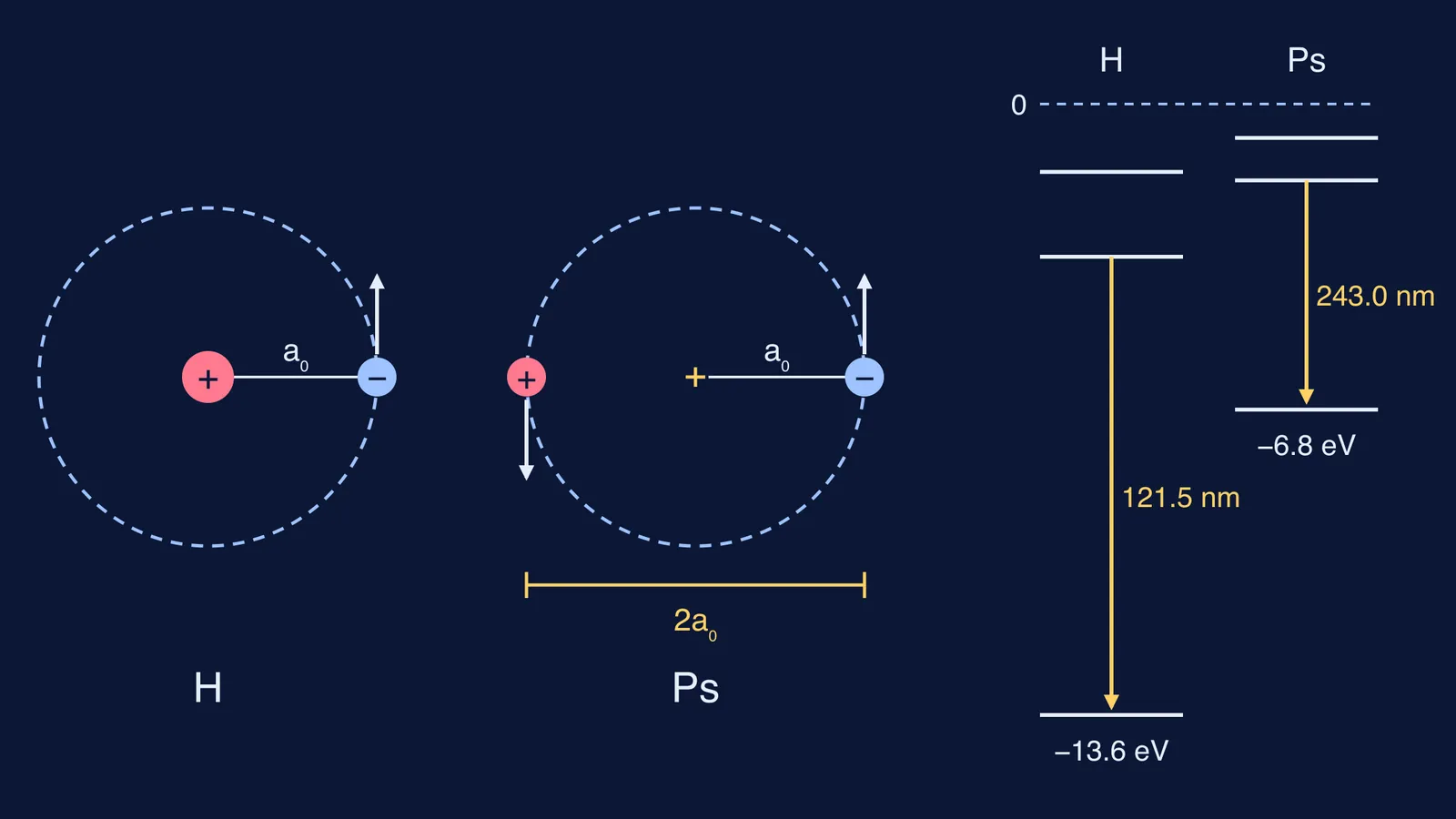
Replace m by μ = m/2: E_1(Ps) = −13.6057/2 = −6.80 eV.
Any level: E_n(Ps) = −6.80/n² eV, so n = 2 sits at −1.70 eV and n = 3 at −0.756 eV.
The ground state energy of positronium is −6.8 eV, the binding energy also quoted in the Bass review. Its ionisation energy is therefore 6.8 eV, half of hydrogen's.
How big is positronium compared with hydrogen?
The Bohr radius is a₀ = 0.529 Å in NIST's CODATA tables. With μ = m/2, the electron–positron separation in the ground state is 2a₀ ≈ 1.06 Å, which matches the Bass review's statement that positronium is twice as large as hydrogen.
Here is the trap. 2a₀ is the distance between the two particles. Each particle circles the centre of mass at half that distance, which is exactly a₀. So "radius of the electron's orbit" and "size of the atom" have different answers in positronium; read the question for which one it wants.
A heavier orbiting particle has the opposite effect, which our post on muonic hydrogen and reduced mass works through.
What wavelength is positronium's first spectral line?
The first line of the Lyman series is the n = 2 → 1 transition. You need hc, built from NIST's Planck constant in eV and the exact speed of light: hc = 1239.84 eV nm.
Energy gap: ΔE = 6.8028 × (1 − 1/4) = 5.102 eV.
Wavelength: λ = hc/ΔE = 1239.84/5.102 ≈ 243.0 nm, in the ultraviolet.
Compare: hydrogen gives 10.204 eV and 121.5 nm, so the positronium line is twice as long.
The same steps put hydrogen's n = 3 → 2 line at about 656 nm (red), so positronium's sits near 1312 nm, out of the visible and into the infrared.
How good is this simple model? In 2025 Heiss and colleagues reported a measured 1S–2S interval for positronium of 1 233 607 210.5 MHz in Physical Review A. Multiplied by Planck's constant, that is 5.1018 eV, equivalent to 243.02 nm. The Bohr estimate of 5.1021 eV is within about 0.01%; the remainder comes from relativistic and quantum electrodynamics corrections, which Bohr's picture leaves out.
A 60-second checklist for any hydrogen-like system
Write μ = m1m2/(m1 + m2) before any formula.
Energies scale by μ/m and by Z²; radii by m/μ and by 1/Z.
Wavelengths scale by m/μ: halve the energy, double the wavelength.
Check whether the question wants the separation or one particle's orbit radius.
If one of these steps keeps slipping, the Fermi Problem Library has worked problems with a step-by-step solver that explains the reasoning rather than printing an answer, so you can see exactly where the factor of 2 enters. For reduced mass as an idea in its own right, the Fermi Concept Library gives each concept its own lesson and its place in the map.
Positronium only exists because the positron does: read how Carl Anderson discovered the positron.