On this page
What happens in Poets and Pancakes?
The chapter in NCERT's Flamingo textbook is an excerpt from My Years with Boss by the Tamil writer Asokamitran (1931-2017). NCERT notes that Gemini Studios, founded by S.S. Vasan, was set up in Chennai (then Madras) in 1940, and that the author's job there was cutting newspaper clippings and filing them.
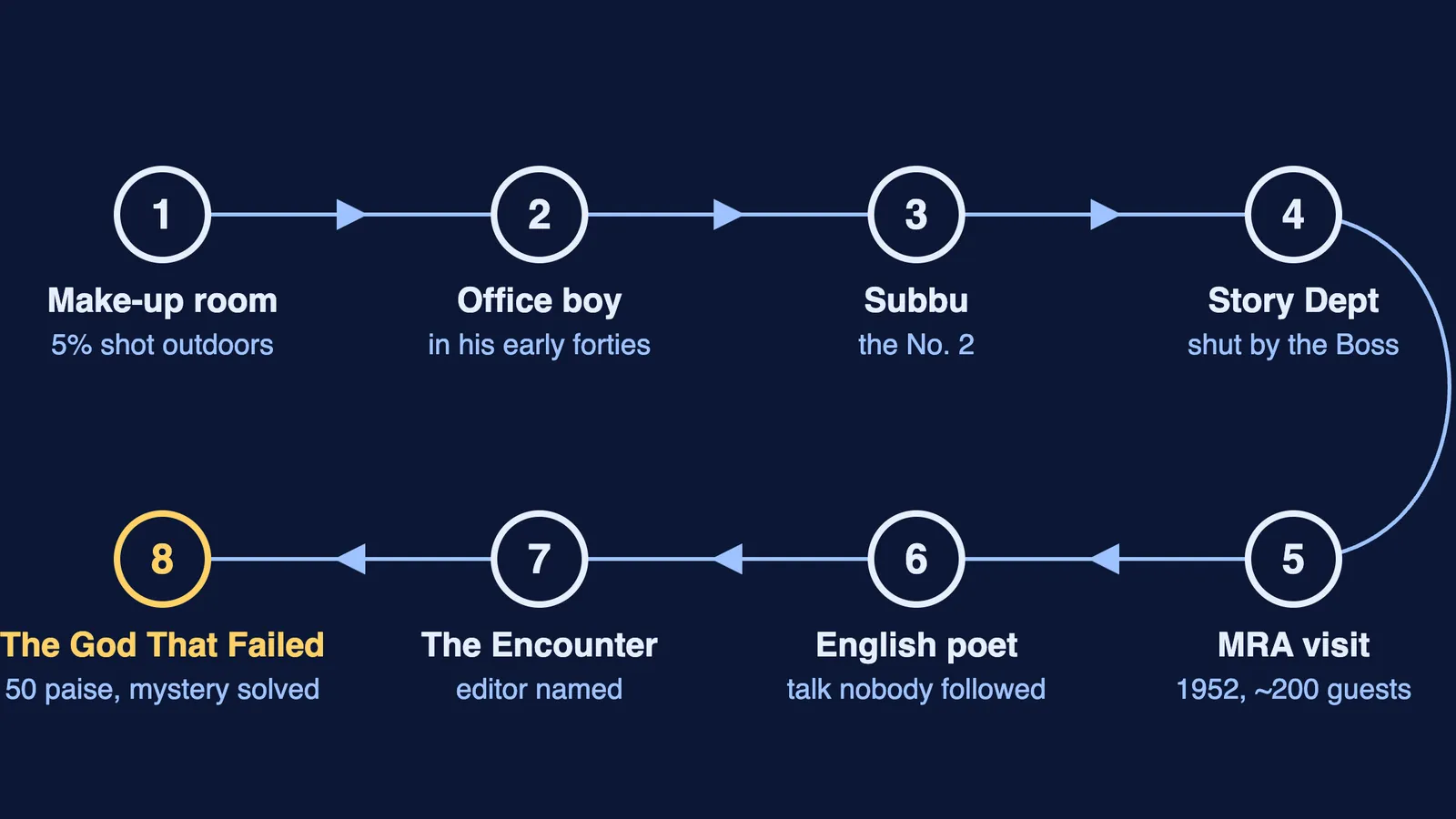
The piece wanders from one person to the next, like a long chat:
The make-up room. Pancake is the brand of make-up the studio buys by the truckload. A team from many Indian regions paints actors heavily under hot lights; the author says only five per cent of a film was shot outside (NCERT).
The office boy. A man in his early forties who joined hoping to become a star or a writer now slaps paint on crowd players. He blames his failure on Subbu.
Subbu. The studio's No. 2 can invent scene after scene on demand, writes poems and a novel, acts well and feeds a houseful of relatives. Still, he has enemies.
The Story Department. Its legal adviser plays back an angry actress's recording to her, and the shock ends her career. Later the Boss shuts the whole department, so the lawyer loses his job along with the poets.
The visitors. In 1952 a Moral Re-Armament group of about two hundred people visits. Months later an English poet gives a talk that no one in the audience can follow.
The answer. Checking The Encounter before entering its short-story contest, the author finds that its editor is the visiting poet, Stephen Spender. Years later, after leaving Gemini, he buys a fifty-paise copy of The God That Failed, which shows Spender was one of six writers describing their break with Communism, and the Boss's interest finally makes sense.
What are the themes of Poets and Pancakes?
NCERT's unit note says the theme is the events and people of a film company in the early days of Indian cinema, with poets and writers in a studio as the sub-theme (NCERT).
Early cinema from the inside. Hierarchy in make-up, indoor shooting, coffee day and night.
Gentle humour and satire. The author mocks pride, office politics and hype without cruelty.
Frustration looks for a target. The office boy pins all his disappointment on one man, Subbu.
Talent and recognition. In his critics' view, Subbu's film success overshadows his literary work, and the author's own quiet job is mistaken for idleness.
Politics at a distance. The khadi-clad poets admire Gandhi but fear Communism only vaguely. The author later learns the MRA opposed Communism, though he doubts it changed the big bosses, and Spender's break with Communism finally explains the Boss's welcome.
Who are the main characters in Poets and Pancakes?
The narrator (Asokamitran): observant, modest and a determined writer.
Subbu: loyal, generous and endlessly inventive, though some see him as a flatterer.
The office boy: a failed dreamer, bitter and long-winded.
The legal adviser: in the author's words, "cold logic in a crowd of dreamers"; he ends a career without meaning to.
The Boss (S.S. Vasan): powerful, practical, more interested in Spender's politics than his poems.
How is humour used in Poets and Pancakes?
Learn three techniques with one example each:
Irony: a mixed team of make-up men proves national integration years before radio and TV started programmes about it.
Exaggeration: the lawyer losing his job because poets were sent home is called a first in human history.
Self-mockery: the author admits everyone, including the Boss, thought he did nothing all day.
Which Poets and Pancakes questions can come in the board exam?
CBSE's English Core syllabus for 2026-27 lists Poets and Pancakes as a Flamingo prose chapter. In Section C you choose one Flamingo prose extract out of two (6 marks), answer five of six Flamingo short questions in 40-50 words (2 marks each), and one of two Flamingo long questions in 120-150 words (5 marks).
Practise these in your own words:
Why does the make-up department amuse the author so much?
What made Subbu so valuable to the Boss?
How did a sound recording end an actress's career?
Why did the Gemini staff fail to connect with the English visitor?
Long answer: How does Asokamitran criticise people without sounding bitter?
Worked answer, question 2 (about 45 words): Subbu was completely loyal and turned all his creativity to the Boss's benefit. Given any odd scene, he could suggest several ways to shoot it within minutes. He also acted, wrote poetry and fiction, and stayed cheerful even after a flop.
Long answer plan: one line on the chapter; then irony, exaggeration and self-mockery, one example each; then say the targets are human weaknesses, not individuals.
For more Flamingo prose, see our guides to Indigo and Gandhi in Champaran and The Rattrap summary and board questions. If physics or chemistry revision is competing for the same week, Fermi's AI tutor can work out what you already know and build a plan for the session.