On this page
The Rattrap is a short story by the Swedish writer Selma Lagerlöf (1858-1940), and it is chapter 4 of the NCERT Class 12 English reader Flamingo (NCERT chapter text). NCERT's note on the author says one theme runs through all her stories: a belief that "the essential goodness in a human being can be awakened through understanding and love." Many questions on this chapter come back to that idea.
What happens in The Rattrap?
Here is the story in six steps, from the NCERT text:
A poor peddler sells wire rattraps, and begs and steals a little to survive. He decides the whole world is a rattrap: food, shelter and riches are the bait, and whoever touches them gets caught.
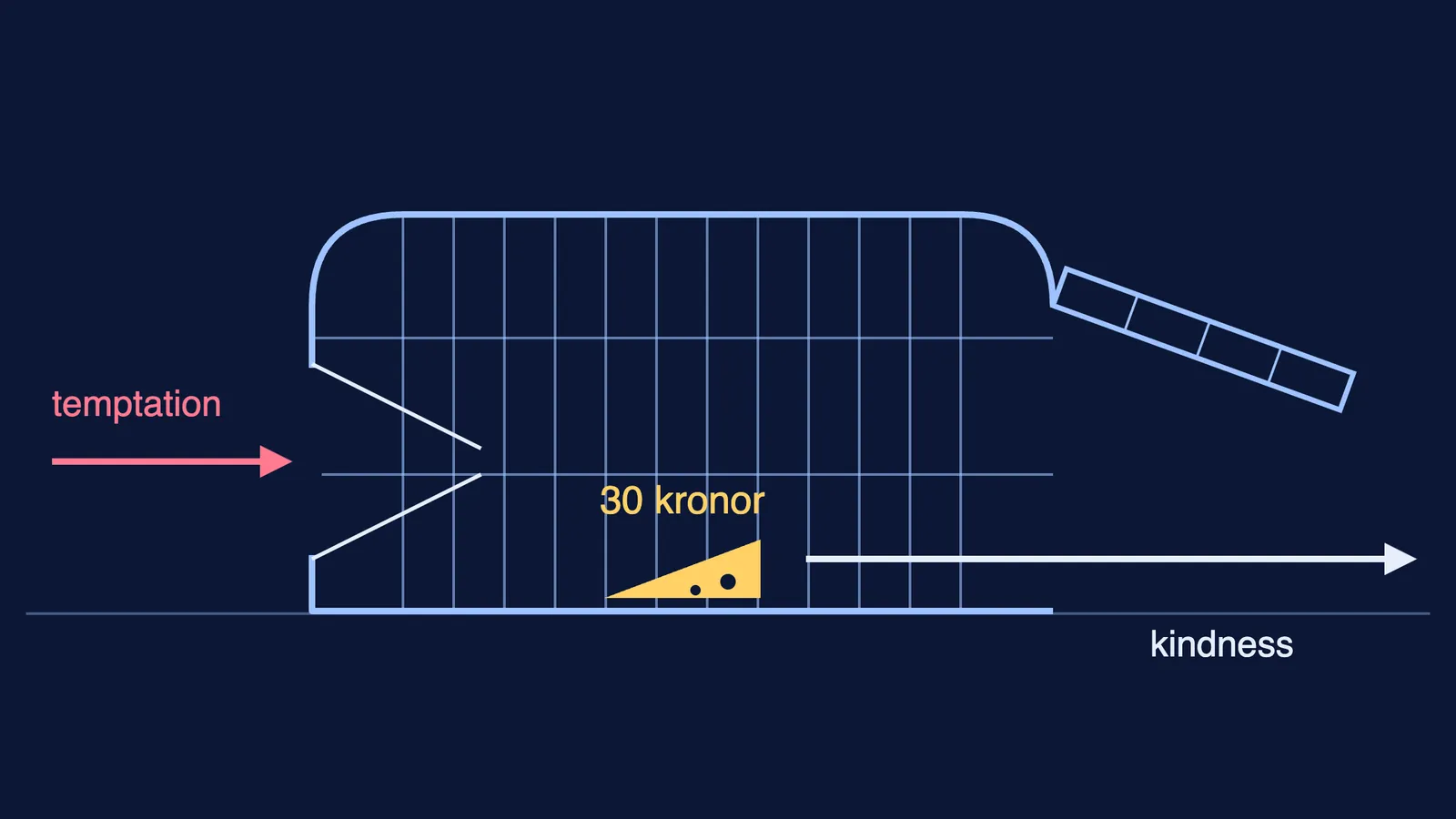
A lonely old crofter gives him supper and shows him the thirty kronor his cow has earned. Next morning the peddler breaks the window and takes the money.
Hiding in the forest, he gets lost and realises he has walked into his own rattrap.
At the Ramsjö iron mill, the ironmaster mistakes him for an old army comrade, Captain von Stahle, and invites him home. The peddler refuses, thinking of the stolen money.
The ironmaster's daughter, Edla Willmansson, gently persuades him to come for Christmas Eve. Washed and shaved, he is clearly a stranger. Her father wants him gone; Edla insists he stays, because they promised him Christmas cheer.
When the family return from church on Christmas morning, he has gone. He leaves Edla a small rattrap holding the thirty kronor, with a letter asking her to return the money to the crofter, signed "Captain von Stahle".
What does the rattrap metaphor mean?
The peddler believes the world "was nothing but a big rattrap" that sets baits for people (NCERT text). The story tests his idea three times:
The crofter's money is bait, and he takes it. Then the forest closes in on him "like an impenetrable prison".
The manor looks like a trap too: "Now I am sitting in the trap and will never get out of it."
Edla's kindness is the one offer with no hook, and it sets him free.
His letter turns the metaphor round: "The rattrap is a Christmas present from a rat who would have been caught in this world's rattrap if he had not been raised to captain, because in that way he got power to clear himself." Being treated with dignity gave him the strength to act with dignity.
What are the main themes of The Rattrap?
Goodness awakened by kindness: the author's belief, shown in the ending.
Loneliness and belonging: the crofter talks because he is lonely; Edla sees the peddler is welcome nowhere.
Greed as a trap: the stolen money is what traps him, in the forest and in fear.
Redemption through trust: he changes because he is trusted, not because he is punished.
Character sketches: the peddler, the ironmaster and Edla
The peddler: poor, bitter and a petty thief, but witty and able to change. Treated with respect, he gives the money back.
The ironmaster: warm to an old comrade, but he judges by appearance, and mentions the sheriff once he sees his mistake.
Edla Willmansson: shy, observant (she notices the man is afraid), compassionate and firm. She keeps her promise after she learns the truth.
Which questions on The Rattrap come in the CBSE board exam?
In CBSE's 2026-27 English Core curriculum, the literature section carries 40 marks; short answers from Flamingo take 40-50 words, and one long answer from Flamingo takes 120-150 words for 5 marks (CBSE English Core curriculum 2026-27). The Rattrap is on its Flamingo prose list, so it can appear as an extract, a short answer or the long answer.
Practise these, based on the NCERT end-of-chapter questions:
How does the peddler read the kindness of the crofter, the ironmaster and Edla?
How is the ironmaster's character different from his daughter's?
What made the peddler finally change his ways?
How does the metaphor of the rattrap highlight the human predicament?
Why did the peddler sign himself as Captain von Stahle?
How do you plan a long answer on The Rattrap?
For "What made the peddler change his ways?", plan four short points, one paragraph each:
Before: he saw the world as a rattrap and robbed the crofter who had trusted him.
The turn: Edla treated him as a captain, and let him stay even after she knew he was not one.
The proof: he returned the money inside a rattrap, writing that being raised to captain gave him "power to clear himself".
The theme: link this to Lagerlöf's belief that goodness is awakened through understanding and love.
If physics or chemistry is your shakiest Class 12 subject, the Fermi Concept Library has a lesson for every concept in physics, chemistry, biology, mathematics and computing.
Tonight, write the six-step summary from memory, then check it against the chapter.