On this page
Indigo is a prose chapter in Flamingo, the NCERT English reader for Class 12, and it is prescribed in the CBSE English Core syllabus for 2026-27. It is an excerpt from Louis Fischer's book The Life of Mahatma Gandhi about Gandhi's fight for indigo farmers in Champaran, Bihar (NCERT Flamingo, chapter 5).
What happens in Indigo, step by step?
Every fact in this section comes from the NCERT text of Indigo.
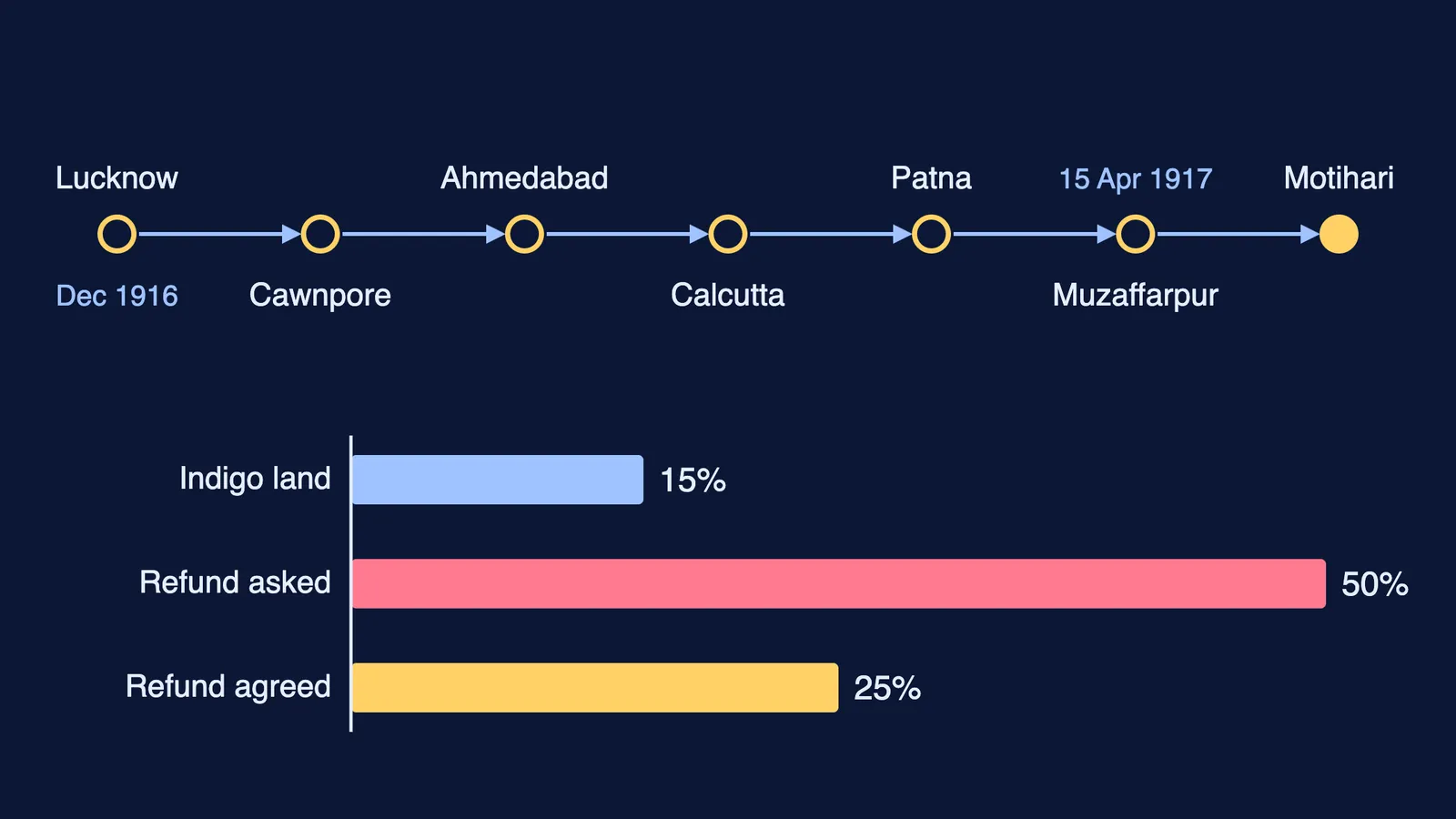
The request. At the Congress session in Lucknow in December 1916, which had 2,301 delegates, a poor, illiterate sharecropper named Rajkumar Shukla asked Gandhi to come to Champaran.
The chase. Shukla followed Gandhi to Cawnpore and Ahmedabad until Gandhi agreed to meet him in Calcutta. They went on to Patna and Muzaffarpur, where Gandhi arrived at midnight on 15 April 1917.
The injustice. English landlords made tenants plant three twentieths, or 15 per cent, of their land with indigo and surrender the whole crop as rent. When Germany developed synthetic indigo, the landlords got the sharecroppers to sign agreements to pay compensation for being released from the deal.
The defiance. In Motihari, Gandhi was served a notice to quit Champaran and wrote on the receipt that he would disobey it. Thousands of peasants gathered around the courthouse and Gandhi pleaded guilty; several days later the Lieutenant-Governor had the case dropped. Fischer writes: civil disobedience had won, for the first time in modern India.
The settlement. Statements from about ten thousand peasants were recorded. Gandhi asked for a 50 per cent refund and accepted the planters' offer of 25 per cent, because making them surrender money, and with it prestige, mattered more than the amount. Primary schools were also opened in six villages.
For the wider freedom struggle, our revision guide to the making of the national movement gives the background.
What are the main themes of Indigo?
NCERT's note on the chapter names the theme as Gandhi's leadership in securing justice for the oppressed “through convincing argumentation and negotiation”, and the sub-theme as the part anonymous Indians played in the freedom movement.
Freedom from fear: Real relief for the peasants meant being free of fear, as Gandhi told the lawyers.
Civil disobedience: he broke an unjust order openly and politely, then asked for the penalty.
Self-reliance: when the lawyers wanted C.F. Andrews to stay and help, Gandhi refused: they should not lean on Andrews just because he was English.
Politics tied to daily life: Fischer calls it “a loyalty to living, human beings”, so schools and sanitation follow the legal win.
How do you write character sketches of Gandhi and Rajkumar Shukla?
Pick two or three qualities and prove each with one incident from the text.
Gandhi
Practical: he gathered facts before acting.
Firm but courteous: he defied the order to leave, yet helped officials control the crowd.
A leader by example: the Bihar lawyers felt that going home while a stranger went to prison would be “shameful desertion”.
Caring beyond the case: he appealed for teachers and got a doctor to volunteer, and Kasturbai taught cleanliness and sanitation.
Rajkumar Shukla
Resolute: the text calls him “illiterate but resolute”.
Patient: he waited months, then sat on his haunches in Calcutta until Gandhi was free.
The spark: one farmer's persistence started the whole campaign.
Which Indigo questions are likely in the Class 12 board exam?
In the CBSE English Core paper for 2026-27, the literature section carries 40 marks. Flamingo short answers are 40-50 words for 2 marks each, five out of six; the Flamingo long answer is 120-150 words for 5 marks.
Nobody can promise a question, but these, adapted from the NCERT exercises on Indigo, make the safest practice set:
Why did Gandhi consider the Champaran episode a turning point in his life?
How was Gandhi able to influence the lawyers?
Why did Gandhi agree to a 25 per cent refund?
How do we know that ordinary people also contributed to the freedom movement?
Long answer: “Freedom from fear is more important than legal justice for the poor.” Do you agree?
A worked 2-mark answer
Question: Why did Gandhi agree to a 25 per cent refund?
Answer (49 words): Gandhi felt the amount mattered less than the principle. By returning part of the money, the planters also surrendered part of their prestige. The peasants, who had seen the landlords as above the law, now learned they had rights and defenders. They learned courage, which was the real gain.
For extract-based items in the same paper, read our guide on how to answer case-based questions in CBSE board exams. For another prose chapter set out the same way, see our notes on Two Stories about Flying for Class 10.
If English shares your evenings with physics or maths, Fermi's AI tutor can work out what you already know in those subjects and build a plan for the session, so more of your time is left for Flamingo.