On this page
Planning is a short, scoring chapter, and almost every part of it can turn up as a case-based question. Here is what the current syllabus asks for, how the textbook frames each idea, and a drill to test yourself.
What does the CBSE syllabus include for planning in Class 12?
In the official CBSE Business Studies curriculum for 2026-27, Planning is Unit 4 of Part A, Principles and Functions of Management. The same document groups Unit 4 (Planning) with Unit 5 (Organising) for 14 marks out of the 80-mark theory paper.
The unit covers:
Planning: concept, importance and limitations
The planning process
Single-use and standing plans, and the types of plans: objectives, strategy, policy, procedure, method, rule, budget and programme
One detail: the syllabus does not name "features", but the NCERT chapter on planning still explains them and they strengthen your answers, so learn them too.
What are the features, importance and limitations of planning?
The NCERT textbook defines planning as deciding in advance what to do and how to do it, and calls it one of the basic functions of management (NCERT, Chapter 4).
Features. Planning focuses on achieving objectives, is the primary function of management, is pervasive (needed at every level), is continuous, looks to the future, involves choosing between alternatives, and is a mental exercise.
Importance. It gives direction, reduces the risk of uncertainty, cuts overlapping and wasteful activity, encourages new ideas, helps decision-making and sets the standards that controlling later checks against.
Limitations. It can make an organisation rigid, it may reduce creativity, it costs money, it takes time, it struggles when the environment changes fast, and it does not guarantee success.
What are the steps in the planning process?
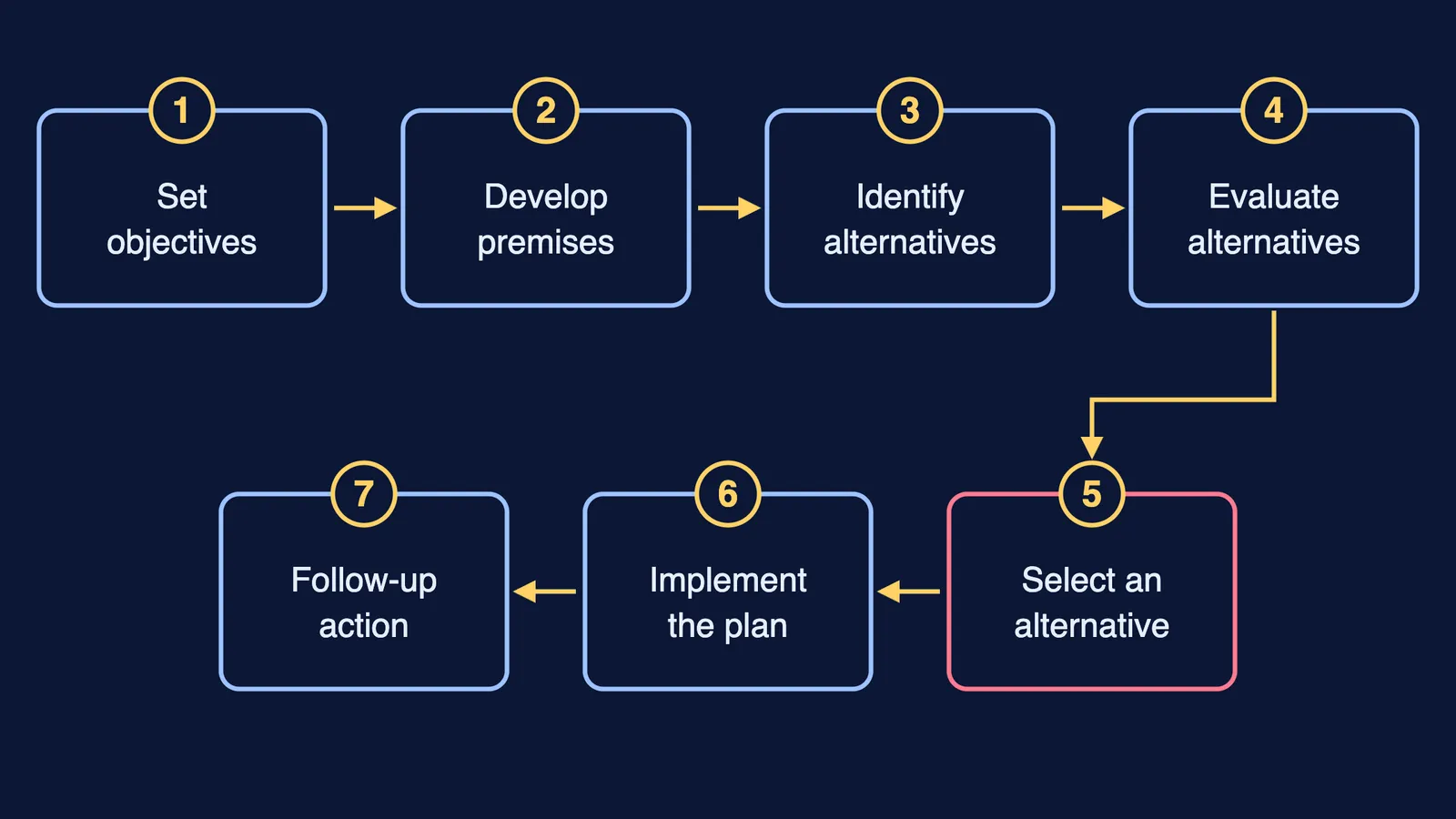
NCERT sets out seven steps, in this order:
Setting objectives
Developing premises (assumptions about the future)
Identifying alternative courses of action
Evaluating alternative courses
Selecting an alternative, which the textbook calls the real point of decision-making
Implementing the plan
Follow-up action, checking that objectives are being met
Worked example: a family sweet shop in Indore wants to raise its Diwali sales.
Objective: sell more boxes this Diwali than last year.
Premises: assume demand for dry-fruit sweets rises and a new rival will cut prices.
Alternatives: start home delivery, add sugar-free boxes, or offer corporate gift packs.
Evaluation: compare the cost, risk and likely sales of each.
Selection: choose corporate gift packs plus delivery.
Implementation: assign staff, order packaging, call offices.
Follow-up: check sales every few days and adjust.
In a case question, look for the verb. "Assumed", "forecast" or "expected" usually points to premises; "compared" or "weighed" points to evaluation; "chose" points to selection.
What is the difference between single-use and standing plans?
According to NCERT, a single-use plan is made for a one-time, non-recurring event or project, such as organising a seminar. Budgets, programmes and projects are single-use plans.
A standing plan is used for recurring activities; it is made once and modified when needed. Policies, procedures, methods and rules are standing plans.
The textbook adds that strategy is usually not classed as either; it belongs to strategic planning by top management.
Definitions to memorise, paraphrased from the chapter:
Objective: the future position management wants to reach.
Strategy: a broad plan for the organisation's direction and scope over the long run.
Policy: a general statement that guides thinking and decisions, such as a school's admission policy.
Procedure: routine steps in a fixed order for carrying out an activity.
Method: the way one step of a procedure should be done.
Rule: a specific statement of what must or must not be done, with no discretion.
Programme: a detailed statement about a project, covering its objectives, policies, procedures, rules, tasks, resources and budget.
Budget: expected results expressed in numbers.
How do you identify the type of plan in a case question?
Try this drill first.
"No employee may use a phone on the factory floor."
"Next year we will spend Rs 12 lakh on advertising."
"We will only sell on credit to customers who have paid on time for two years."
"To claim a refund, fill the form, attach the bill and submit it to accounts."
"We will enter the South Indian market with a cheaper product line."
Answers: 1 rule (standing), 2 budget (single-use), 3 policy (standing), 4 procedure (standing), 5 strategy (usually neither).
If maths or a science subject is also on your list and you are not sure where to start, Fermi's AI tutor can work out what you already know and build a plan for the session.
Next, practise with our guide on how to answer case-based questions in CBSE board exams, revise principles of management: Fayol, Taylor and a mnemonic, and learn how to check which management principle a case shows when you ask AI.