On this page
You have two planes, say x + 2y + 3z − 4 = 0 and 2x + y − z + 5 = 0, and want a third plane that contains their line of intersection and meets one more condition. You do not need the line first. One number, λ, is enough.
Why does P₁ + λP₂ = 0 work?
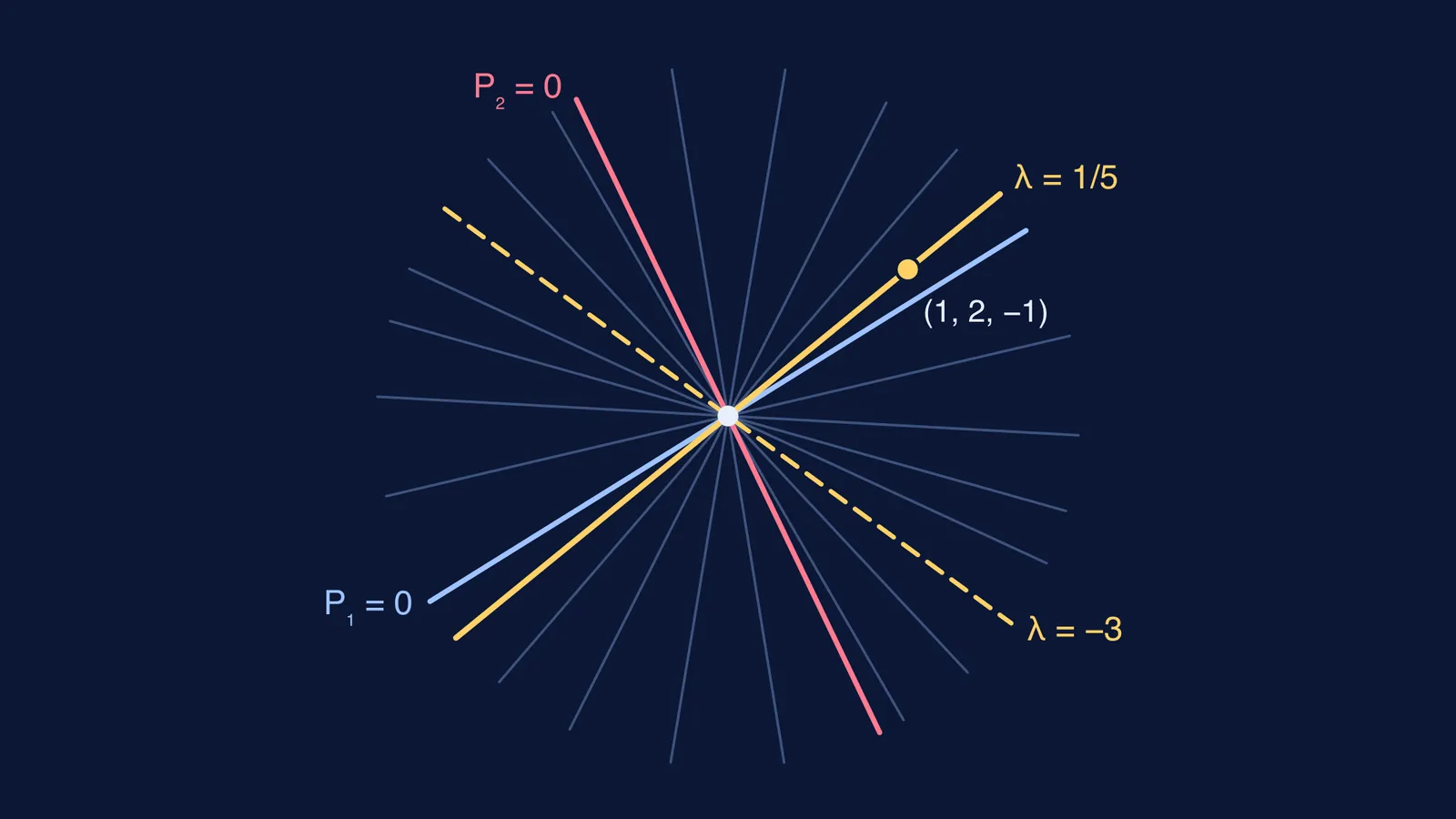
Call the left-hand sides P₁ and P₂. Any point on the line makes P₁ = 0 and P₂ = 0, so it also makes P₁ + λP₂ = 0 for every λ. The equation stays linear in x, y and z, so each λ gives a plane containing the line.
The set of all planes through one line is called a pencil of planes, and the line is called its axis, as Wikipedia's article on pencils explains. MathWorld writes the same family as (n₁·x + p₁) + λ(n₂·x + p₂) = 0 and calls it a sheaf of planes.
The family has one free number, so one extra condition fixes it.
A syllabus note: the chapter summary in the 2026-27 reprint of NCERT's Class 12 chapter Three Dimensional Geometry lists results for lines only. Unit 11 of NTA's JEE (Main) 2027 syllabus covers lines, skew lines and shortest distance, with no plane equations. Check the official syllabus for your own board or exam before deciding how much time this gets.
How do you find λ when the plane passes through a point?
Example 1: find the plane through the line of intersection of P₁ and P₂ that passes through (1, 2, −1).
Write the family: (x + 2y + 3z − 4) + λ(2x + y − z + 5) = 0.
Substitute the point into each bracket: P₁ gives 1 + 4 − 3 − 4 = −2, and P₂ gives 2 + 2 + 1 + 5 = 10.
Solve −2 + 10λ = 0, so λ = 1/5.
Multiply through by 5 to clear the fraction: 5P₁ + P₂ = 0, which is 7x + 11y + 14z − 15 = 0.
Quick check: at (1, 2, −1), 7 + 22 − 14 − 15 = 0.
How do you find λ for a perpendicular or parallel condition?
Read the normal vector straight off the family by collecting the coefficients of x, y and z: n = (1 + 2λ, 2 + λ, 3 − λ). The same normal-vector idea gives the angle between two planes.
Example 2: the plane must be perpendicular to x + y + z = 1. Two planes are perpendicular when their normals are, so the dot product with (1, 1, 1) is zero: (1 + 2λ) + (2 + λ) + (3 − λ) = 6 + 2λ = 0. That gives λ = −3, and P₁ − 3P₂ = 0 simplifies to 5x + y − 6z + 19 = 0. Check the normals: 5 + 1 − 6 = 0.
Example 3: the plane must be parallel to the x-axis, so its normal has no x-component: 1 + 2λ = 0, giving λ = −1/2. Then 2P₁ − P₂ = 0 becomes 3y + 7z − 13 = 0.
How do you check the final plane?
A plane contains a line when it contains one point of it and its normal is perpendicular to the line's direction. Check both.
Point check. Find one point on both planes. Putting x = −3 into P₁ and P₂ gives 2y + 3z = 7 and y − z = 1, so (−3, 2, 1) is on the line. It satisfies all three answers: −21 + 22 + 14 − 15 = 0, then −15 + 2 − 6 + 19 = 0, then 6 + 7 − 13 = 0.
Direction check. The line's direction is n₁ × n₂ = (1, 2, 3) × (2, 1, −1) = (−5, 7, −3), the same cross product used to find the line of intersection of two planes. Each answer's normal dotted with it gives zero: −35 + 77 − 42, then −25 + 7 + 18, then 0 + 21 − 21.
Which mistakes cost marks here?
Substituting the point into P₁ only.
Using the normal of P₁ or P₂ in a perpendicularity condition instead of the family's normal.
Clearing a fraction but not multiplying the constant term.
Stopping at λ without writing the final plane.
Starting with parallel planes: if n₁ and n₂ are proportional, there is no line and no family.
If you lose track between the family and the final equation, the Fermi Problem Library has worked problems with a step-by-step solver that explains the reasoning rather than printing an answer. If the shaky part is normal vectors themselves, the lesson on them in the Fermi Concept Library is a better place to start.
Next, practise the same normal-vector habit on the distance of a point from a plane.