

On this page
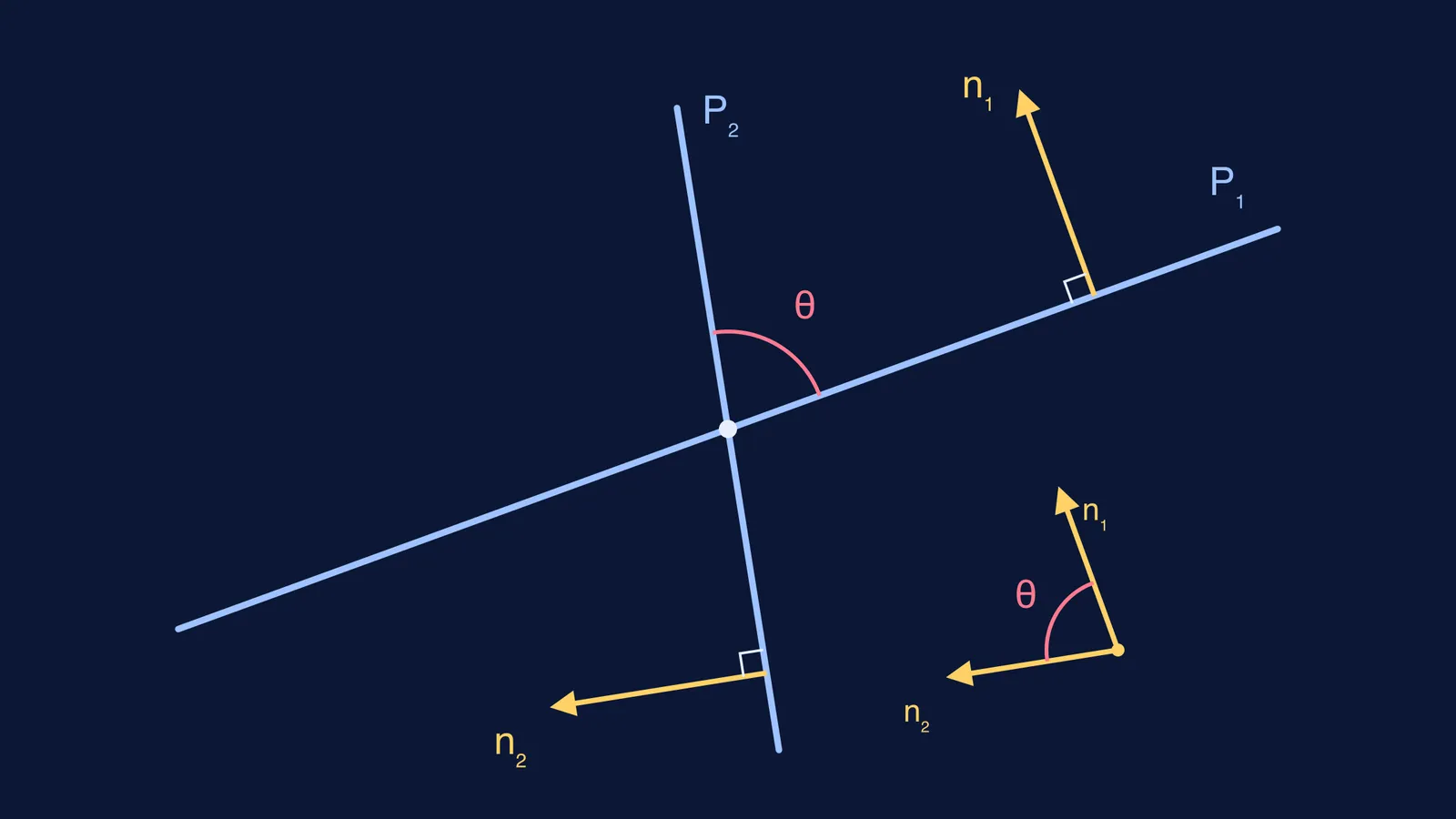
Two planes that cut each other are hard to measure head-on. The standard trick is to compare the arrows that stand perpendicular to them, their normal vectors, instead.
What is the angle between two planes?
In OpenStax Calculus Volume 3, section 2.5, Gilbert Strang and Edwin Herman explain that the angle between two planes has the same measure as the angle between their normal vectors. The same section shows that in a plane written as ax + by + cz + d = 0, the coefficients (a, b, c) give a normal vector. Put those two facts together and you get the formula:
cos θ = |n₁·n₂| / (|n₁||n₂|)
In Cartesian form, for the planes a₁x + b₁y + c₁z + d₁ = 0 and a₂x + b₂y + c₂z + d₂ = 0:
cos θ = |a₁a₂ + b₁b₂ + c₁c₂| / (√(a₁² + b₁² + c₁²) × √(a₂² + b₂² + c₂²))
The constants d₁ and d₂ never appear, because changing d slides a plane without tilting it. The modulus is there on purpose: crossing planes make two angles, θ and 180° − θ, and the absolute value picks the acute one.
When are two planes perpendicular or parallel?
Both tests come from the same normals, and OpenStax works an example of each.
Perpendicular: the normals are perpendicular, so n₁·n₂ = 0, which in Cartesian form is a₁a₂ + b₁b₂ + c₁c₂ = 0.
Parallel: the normals point the same way, so one is a scalar multiple of the other: a₁/a₂ = b₁/b₂ = c₁/c₂. The OpenStax example is x + 2y − z = 8 and 2x + 4y − 2z = 10, whose normals (1, 2, −1) and (2, 4, −2) are multiples of each other.
If a coefficient is zero, do not divide by it. Check whether n₁ = k n₂ for a single number k.
How do you find the angle between two planes, step by step?
Question: Find the angle between the planes 2x + y − 2z = 5 and 3x − 6y − 2z = 7.
Write each step on its own line, so an examiner can follow your working.
Normals: n₁ = 2i + j − 2k and n₂ = 3i − 6j − 2k.
Dot product: n₁·n₂ = (2)(3) + (1)(−6) + (−2)(−2) = 6 − 6 + 4 = 4.
Magnitudes: |n₁| = √(4 + 1 + 4) = 3 and |n₂| = √(9 + 36 + 4) = 7.
Formula: cos θ = |4| / (3 × 7) = 4/21.
Answer: θ = cos⁻¹(4/21), which is about 79.0°.
Leave the answer as cos⁻¹(4/21) unless degrees are asked for. Two quick follow-ups use the same normals.
Find k so that x + 2y + kz = 1 and 2x − 3y + 4z = 5 are perpendicular. Set the dot product to zero: 2 − 6 + 4k = 0, so k = 1.
Are 2x − y + 3z = 4 and 4x − 2y + 6z = 1 parallel? The ratios are 2/4 = (−1)/(−2) = 3/6 = 1/2, so yes. Doubling the first equation gives 4x − 2y + 6z = 8, not 1, so they are two separate parallel planes.
Which mistakes should you check for?
Rewrite each plane as ax + by + cz + d = 0 first. Reading coefficients off 2x + y = 2z + 5 as it stands gets the z sign wrong.
Keep the constant term out of the normal.
Put every negative coefficient in brackets when you multiply.
Keep the modulus, or you may report the obtuse angle, 180° − θ.
Do not confuse this with the angle between a line and a plane, which uses sin and the line's direction vector.
If you keep landing on the obtuse angle or losing a sign, the Fermi Problem Library has worked problems with a step-by-step solver that explains the reasoning rather than just printing an answer.
Is the angle between two planes in the CBSE syllabus?
Check before you spend revision time on it. The CBSE Mathematics (041) syllabus for 2026-27 lists Class XII three-dimensional geometry as direction cosines and direction ratios of a line, Cartesian and vector equations of a line, skew lines, shortest distance between two lines, and the angle between two lines. Planes are not on that list.
The method is still worth learning. The same dot-product step gives the angle between two lines in your board paper, and planes are standard in university calculus texts such as the OpenStax book above. If you are preparing for JEE Main or JEE Advanced, check whether planes are in the current syllabus on the official exam website before you revise them.
If the dot product itself feels shaky, the Fermi Concept Library gives every mathematics concept its own lesson and its place in the map. Try the example again without looking, then change one coefficient and watch θ move.


