

On this page
Two planes that are not parallel meet in a straight line. To write it down you need a direction and one point. Below we work one example from start to finish, then answer the usual follow-up: the plane through that line and a given point.
Why does the cross product of the normals give the direction?
A plane is the set of points whose displacement from a fixed point is perpendicular to a vector n, called its normal vector (OpenStax Calculus Volume 3, section 2.5). For a plane written as ax + by + cz = d, the normal is n = (a, b, c). The same section states that the intersection of two nonparallel planes is always a line.
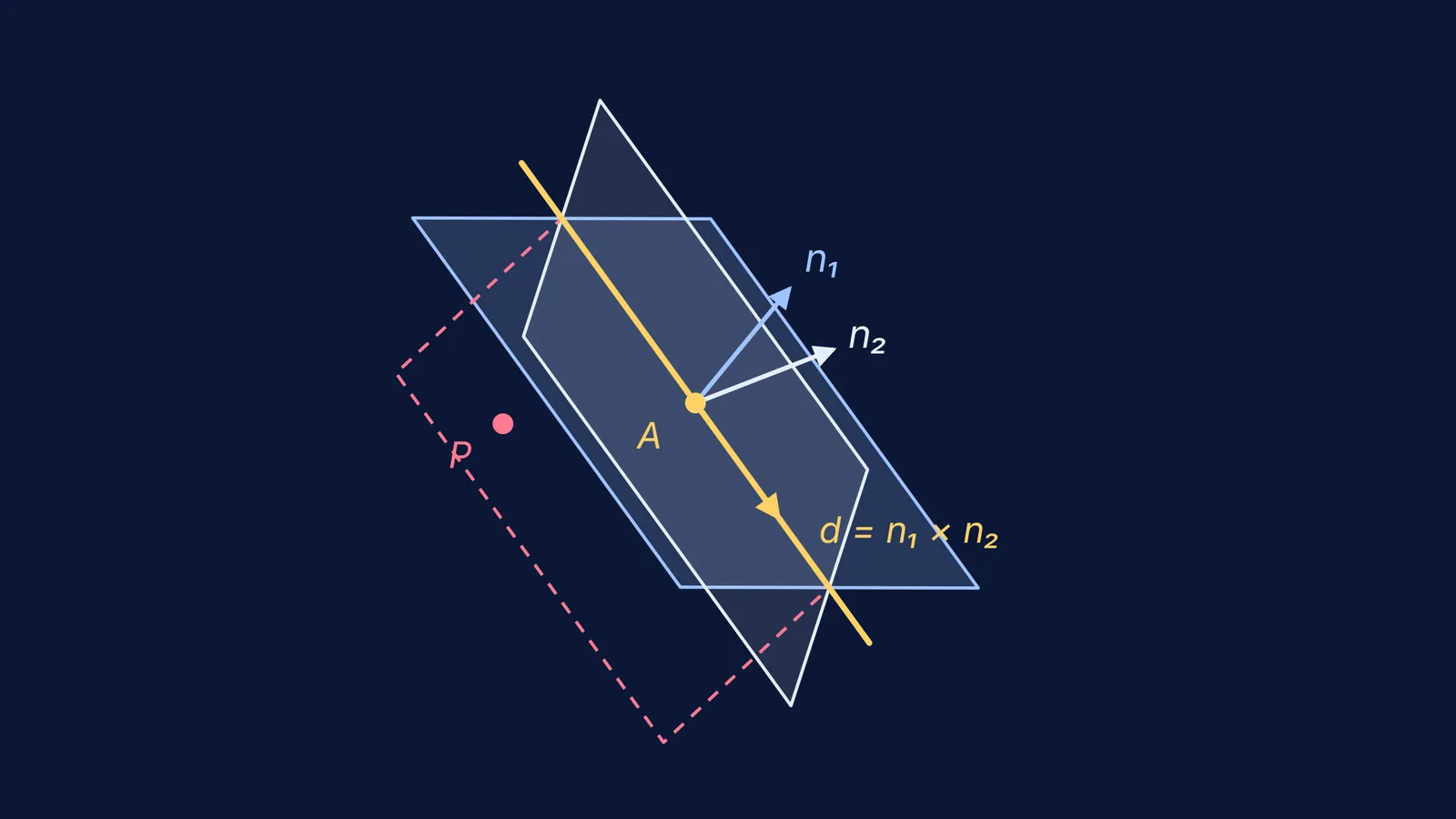
That line lies in both planes, so its direction is perpendicular to both normals, n₁ and n₂. The cross product n₁ × n₂ is perpendicular to both n₁ and n₂ (OpenStax Calculus Volume 3, section 2.4), so it points along the line.
If n₁ × n₂ is the zero vector, the planes are parallel or identical and there is no single line. Our explainer on when the cross product of two vectors is zero covers that check.
How do you find the equation of the line of intersection of two planes?
Take the planes x + y + z = 6 and 2x − y + z = 3.
Read off the normals: n₁ = (1, 1, 1) and n₂ = (2, −1, 1).
Cross them: d = n₁ × n₂ = (1·1 − 1·(−1), 1·2 − 1·1, 1·(−1) − 1·2) = (2, 1, −3).
Check: d · n₁ = 0 and d · n₂ = 0, so d lies in both planes.
Set z = 0: x + y = 6 and 2x − y = 3 give x = 3, y = 3. The point is A(3, 3, 0).
Write the line: (x − 3)/2 = (y − 3)/1 = z/(−3).
In vector form this is r = (3, 3, 0) + t(2, 1, −3); for switching forms, see how to convert a line from Cartesian to vector form in 3D.
Your answer can look different from the book's and still be right: another point on the line, or a multiple of d such as (−4, −2, 6), gives the same line. Check that the directions are multiples and that your point satisfies both planes.
How do you find the plane through that line and a given point?
A common follow-up asks for the plane containing the line and P(1, 2, 0). Use one method and check with the other.
Method 1 uses the family of planes. Every plane through the line, except the second plane itself, can be written as (x + y + z − 6) + λ(2x − y + z − 3) = 0, since any point on the line makes both brackets zero. Put in P: −3 − 3λ = 0, so λ = −1. Then (x + y + z − 6) − (2x − y + z − 3) = 0 simplifies to x − 2y + 3 = 0.
Method 2 uses the cross product again. The new plane's normal is perpendicular to d and to AP = (−2, −1, 0). So d × AP = (2, 1, −3) × (−2, −1, 0) = (−3, 6, 0), a multiple of (1, −2, 0). Through A: (x − 3) − 2(y − 3) = 0, which is x − 2y + 3 = 0 again.
Where do students lose marks on this?
A sign slip in the middle term of the cross product. In the determinant formula the j-component carries a minus sign (OpenStax Calculus Volume 3, section 2.4). The dot-product check in step 3 catches this straight away.
Setting z = 0 when d has no z-component.
Missing the case where the given point lies on the second plane. P(1, 0, 1) satisfies 2x − y + z = 3, so the family gives −4 + 0·λ = 0, with no solution. The answer is 2x − y + z = 3 itself.
If your answer still does not match and you cannot see which step went wrong, the Fermi Problem Library has worked problems with a step-by-step solver that explains the reasoning rather than printing an answer. If normals and cross products themselves feel shaky, the Fermi Concept Library gives each concept its own lesson.
Is the equation of a plane in the JEE syllabus?
The official JEE (Advanced) 2026 syllabus lists equation of a plane, distance of a point from a plane, angle between two planes and coplanar lines under three-dimensional geometry. For JEE Main and board exams, check the current official syllabus from NTA or your board, because syllabi change.
Next, try the angle between a line and a plane, and why it uses sin, not cos.


