On this page
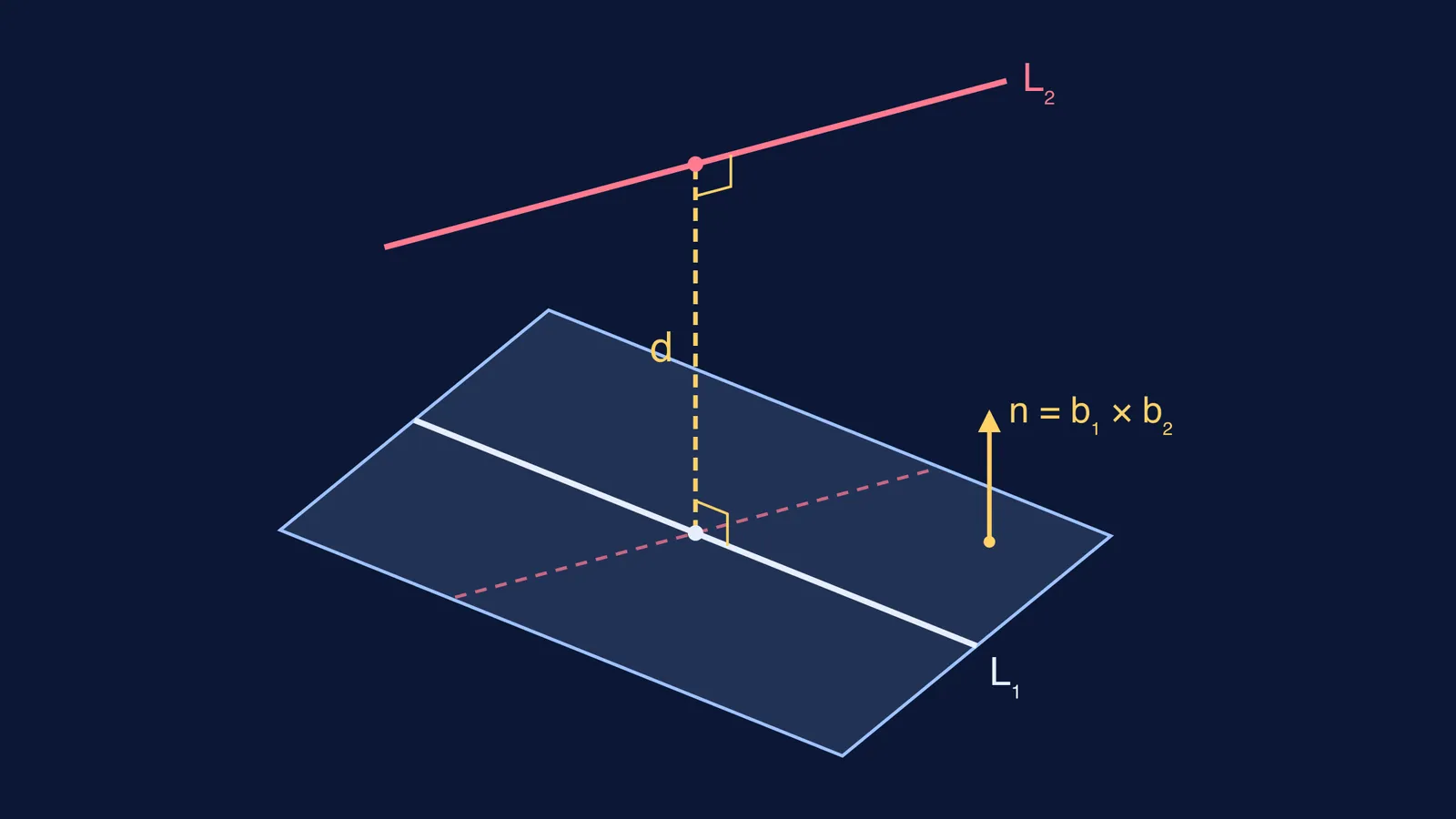
You have two lines in space, L₁ and L₂, and you want the plane that holds L₁ but never meets L₂. The normal is the cross product of the two direction vectors, and the point is any point on L₁. Work through it once and you get the shortest distance between the lines as well.
How do you find the plane containing one line and parallel to another?
Write the lines as L₁: r = a₁ + λb₁ and L₂: r = a₂ + μb₂, the vector form used in NCERT Class 12 Mathematics, Chapter 11, Three Dimensional Geometry.
A plane is fixed by one point on it and one normal vector, as OpenStax Calculus Volume 3 shows. So you need two things.
The normal. The plane contains L₁, so its normal n is perpendicular to b₁. The plane is parallel to L₂, so n is also perpendicular to b₂. The cross product b₁ × b₂ is perpendicular to both, so take n = b₁ × b₂.
A point. The plane contains all of L₁, so a₁ lies on it.
So the plane is (r − a₁) · (b₁ × b₂) = 0.
A worked example, step by step
Find the plane containing L₁: (x − 1)/1 = y/2 = (z − 2)/1 and parallel to L₂: x/2 = (y − 1)/1 = (z + 1)/(−1).
Read off the pieces. L₁ passes through A(1, 0, 2) with b₁ = (1, 2, 1). L₂ passes through B(0, 1, −1) with b₂ = (2, 1, −1).
Take the cross product. b₁ × b₂ = (2·(−1) − 1·1, 1·2 − 1·(−1), 1·1 − 2·2) = (−3, 3, −3). Divide by −3 for a cleaner normal, n = (1, −1, 1).
Use the point from L₁. 1(x − 1) − 1(y − 0) + 1(z − 2) = 0, which simplifies to x − y + z = 3.
Check. b₁ · n = 1 − 2 + 1 = 0 and b₂ · n = 2 − 1 − 1 = 0, so both lines run parallel to the plane. A gives 1 − 0 + 2 = 3, so L₁ lies in it. B gives 0 − 1 − 1 = −2, not 3, so L₂ stays off it.
If the cross product is where your signs slip, see how to expand i, j, k by determinant without sign errors.
Why does this plane give the shortest distance between the lines?
Skew lines are lines in space that are neither parallel nor intersecting, and the shortest segment joining them is perpendicular to both, as Section 11.5 of the NCERT chapter explains.
L₂ is parallel to the plane, so every point of L₂ sits at the same height above it, while L₁ lies in the plane. Any segment from L₁ to L₂ climbs at least that height, and the one along the normal climbs exactly that. So the shortest distance between the lines equals the distance from any point of L₂ to the plane.
Using the distance of a point from a plane, the distance from B to x − y + z − 3 = 0 is |0 − 1 − 1 − 3| / √(1 + 1 + 1) = 5/√3, about 2.89 units.
Now do the same step in vectors. The distance from a₂ to the plane (r − a₁) · (b₁ × b₂) = 0 is |(b₁ × b₂) · (a₂ − a₁)| / |b₁ × b₂|. That is exactly the shortest-distance formula for skew lines in the NCERT chapter, so the plane method is that formula with the geometry showing. Check it: (−3, 3, −3) · (−1, 1, −3) = 3 + 3 + 9 = 15, and |b₁ × b₂| = 3√3, so d = 15/(3√3) = 5/√3 again.
The shortest segment itself runs from (1/3, −4/3, 4/3) on L₁ to (−4/3, 1/3, −1/3) on L₂ (λ = μ = −2/3), along the normal. To see it in 3D, read shortest distance between skew lines: see it, then compute it.
What if the lines are parallel or they meet?
b₁ × b₂ = 0. The lines are parallel, so there is no single answer: every plane through L₁ is parallel to L₂ or contains it. For the distance, use NCERT's formula for parallel lines, d = |b × (a₂ − a₁)| / |b|.
The distance comes out 0. Then a point of L₂ lies in the plane, so all of L₂ does, and the lines are coplanar. Coplanar lines that are not parallel intersect, and your plane contains both.
If your answer goes wrong, the Fermi Problem Library has worked problems with a step-by-step solver that explains the reasoning rather than printing an answer, so you can see which step went off. If the cross product itself feels shaky, the Fermi Concept Library gives each concept its own lesson.
For practice, find the plane through L₂ parallel to L₁, and check you get x − y + z = −2.