On this page
Phyllotaxy, venation and leaf type tell you how leaves sit on the stem, how their veins run and whether the blade is in one piece. The definitions and examples below follow the current NCERT Class 11 Biology chapter, Morphology of Flowering Plants (Reprint 2026-27).
What are the three types of phyllotaxy?
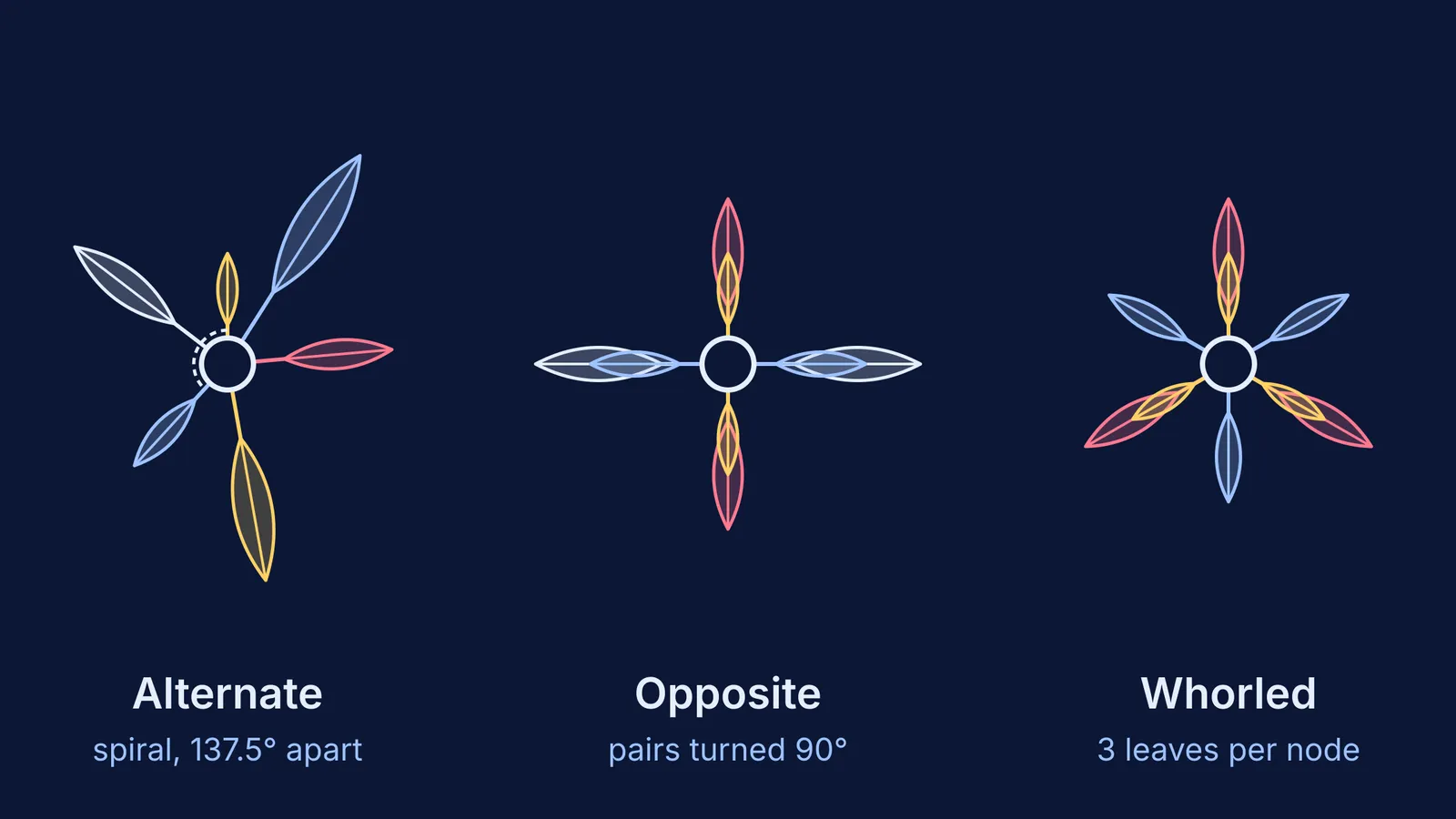
Phyllotaxy is the pattern in which leaves are arranged on a stem or branch, and NCERT names three types: alternate, opposite and whorled (NCERT Class 11 Biology, section 5.3.3).
Alternate: one leaf grows at each node, as in china rose, mustard and sunflower.
Opposite: two leaves grow at each node, facing each other, as in *Calotropis* and guava.
Whorled: more than two leaves grow at a node and form a whorl, as in *Alstonia*.
Alternate leaves are not placed at random, and many follow a spiral. In a spiral arrangement, each new leaf at the shoot tip forms at a fixed angle of 137.5° from the one before, the golden angle, as a 2019 paper by Takuya Okabe, Atsushi Ishida and Jin Yoshimura in the Journal of the Royal Society Interface sums up. The same paper notes that the angle between developed leaves varies within a sequence of Fibonacci fractions of a turn, such as 1/3, 2/5, 3/8 and 5/13. In non-spiral patterns such as distichous, decussate (opposite pairs) and whorled, the angle between successive leaves is a simple fraction of 360°. The diagram above draws a spiral, an opposite and a whorled shoot with those angles.
What is the difference between reticulate and parallel venation?
Venation is the arrangement of veins and veinlets in the lamina, or leaf blade (NCERT Class 11 Biology, section 5.3.1). When the veinlets form a network, the venation is reticulate. When the veins run parallel to each other within the lamina, it is parallel. Dicot leaves generally have reticulate venation, while parallel venation is characteristic of most monocots.
Keep NCERT's hedges, "generally" and "most", in your answers: "all dicots have reticulate venation" claims more than the textbook does.
For the lamina, midrib, petiole and stipules, see our guide to leaf parts, stipules and the pulvinus. For leaf anatomy, read dorsiventral vs isobilateral leaves.
How do you tell a simple leaf from a compound leaf?
A leaf is simple when its lamina is entire, or when its incisions do not reach the midrib. It is compound when the incisions reach the midrib and break the blade into leaflets (NCERT Class 11 Biology, section 5.3.2).
Compound leaves come in two types:
Pinnately compound: many leaflets sit on a common axis called the rachis, which stands in for the midrib, as in neem.
Palmately compound: the leaflets join at one point, the tip of the petiole, as in silk cotton.
What are the main leaf modifications?
The current NCERT chapter goes straight from phyllotaxy to the inflorescence, with no section on leaf modifications, so check that your syllabus still lists them.
Maria Morrow's open botany atlas on LibreTexts/13%3A_Leaves/13.04%3A_Modified_Leaves) describes these modified leaves:
Tendrils: a whole leaf or part of one becomes a green, coiled, thread-like structure, as in *Gloriosa* (glory lily) and many plants of the bean family, Fabaceae.
Spines: leaves turned into defensive structures, as in cacti.
Storage leaves: the thick, fleshy leaves of an onion bulb, and succulent leaves that store water in a tissue called hydrenchyma.
Phyllodes: a petiole that has turned flat and photosynthetic, so it looks like a leaf blade.
Insect traps: leaves that catch insects, as in the pitcher plant (*Nepenthes*), the Venus flytrap (*Dionaea*) and the sundew (*Drosera*).
For more examples, see leaf modifications: phyllode and pitcher.
How can you practise identifying leaf types at home?
Take three twigs from a garden or park and run this check on each one.
Find a node, the point on the stem where a leaf is attached.
Count the leaves at that node. One means alternate, two facing each other means opposite, and more than two means whorled.
Hold a blade up to the light. A net of veins means reticulate, and veins running side by side mean parallel.
Find the axillary bud. It marks the base of one whole leaf.
If the blade is split down to the midrib, decide between pinnate (leaflets along a rachis) and palmate (leaflets from one point).
Look for leaves doing another job: a coil, a spine or a fleshy base.
For example, a guava twig, one of NCERT's own examples, has two leaves facing each other at each node, so its phyllotaxy is opposite. Write each finding as observation, then term: "two leaves per node, so opposite". That line doubles as a short exam answer.
If a definition feels shaky, the Fermi Concept Library covers every concept in biology, each with its own lesson and its place in the map. To test yourself, the Fermi Problem Library has a step-by-step solver that explains the reasoning rather than printing an answer.